

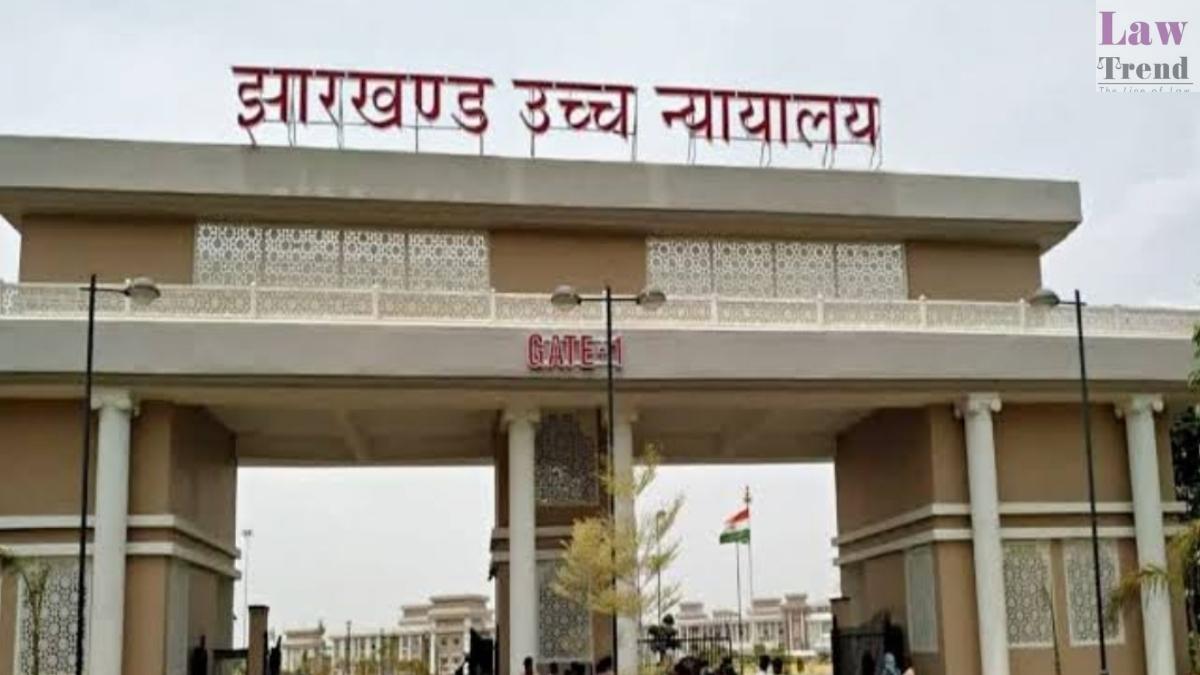
RANCHI: The High Court of Jharkhand has ruled that a subordinate appellate court’s failure to examine documentary evidence available on record amounts to an apparent error that warrants corrective intervention under Article 227 of the Constitution of India. Setting aside an appellate judgment that had affirmed an eviction order passed by the Estate Officer of Bharat Coking Coal Limited (BCCL), Justice Sanjay Kumar Dwivedi held that overlooking relevant documents while summarily finding that an occupant produced no proof constitutes a jurisdictional infirmity. The Court remanded the matter to the Principal District Judge, Dhanbad, for fresh adjudication and permitted a formal land measurement by a competent State authority in the presence of both parties.
Background of the Dispute
The petitioner, Tapeshwar Singh, claimed ownership and possession over 11 decimals of land situated at Mauza-Saraidhela (Khata No. 90, Plot No. 84), which he had purchased through a registered sale deed executed by the Secretary of the BCCL Employees Housing Co-operative Society Ltd. Following the purchase, the property was mutated in the State’s revenue records under Mutation Case No. 2959(ii)/2008-09, and a correction slip and rent receipts were issued. Subsequently, on January 19, 2015, the Mineral Area Development Authority (MADA), Dhanbad, sanctioned a building plan for the construction of a residential house on the site.
The dispute arose after BCCL, via a letter dated February 27, 2015, approached the Circle Officer, Dhanbad, seeking the appointment of an Amin to demarcate Plot Nos. 81, 82, 83, and 84, claiming that these parcels were acquired under Bhu Arjan Case No. 7/65/66. Although a measurement took place on April 6, 2015, where the petitioner asserted his land fell outside the acquired area, no copy of the measurement report was provided to him despite formal representations.
BCCL thereafter issued a show-cause notice to Singh, alleging illegal encroachment. Singh contested the proceedings, maintaining that his purchased land fell outside the acquired area. During the proceedings before the Estate Officer in Case No. 01/2016, the petitioner’s evidence was closed, and his application seeking demarcation through a survey-knowing Pleader Commissioner was rejected. On June 22, 2017, the Estate Officer held Singh to be an encroacher. Singh’s statutory appeal before the Principal District Judge, Dhanbad (Civil Misc. Appeal No. 37/2017), was subsequently dismissed on August 7, 2023, on the premise that he had failed to produce documents supporting his claim. Aggrieved, Singh invoked the supervisory jurisdiction of the High Court under Article 227.
Submissions Before the Court
Counsel for the petitioner argued that the appellate court committed an error apparent on the face of the record. It was submitted that the Estate Officer’s order had expressly cataloged the petitioner’s documents—including the registered sale deed, mutation order sheet, correction slip, rent receipts, MADA map sanction, Nazir receipts, and multiple administrative representations. Despite this, the appellate court summarily affirmed the eviction by erroneously recording that the petitioner had produced no documents to make out his case.
Opposing the petition, counsel for BCCL contended that supervisory jurisdiction under Article 227 cannot be invoked unless an order suffers from perversity or an error apparent on the face of the record. BCCL asserted that the land had been acquired under Bhu Arjan Case No. 7/65/66 and that revenue mutation does not confer or declare title, nor does a building map sanctioned by MADA establish ownership. Consequently, BCCL argued that the concurrent findings did not warrant interference.
The Court’s Analysis and Observations
Examining the record, the High Court observed that the petitioner had prima facie established lawful occupation following his purchase, evidenced by the registered deed, revenue mutation, rent receipts, and the sanctioned building plan.
Crucially, the Court highlighted that Plot No. 84 comprised a total of 44 decimals, whereas BCCL claimed acquisition over only 11 decimals. Because BCCL did not acquire the entire plot, Singh’s claim to a distinct 11 decimals within the same plot necessitated an accurate physical demarcation.
Addressing the scope of supervisory power, the Court noted that while Article 227 does not provide a routine appellate forum for litigants, it imposes an affirmative obligation on the High Court to keep subordinate tribunals within their jurisdictional bounds. Citing the Supreme Court’s ruling in Ouseph Mathai v. M. Abdul Khadir, (2002) 1 SCC 319, the Court observed:
“In fact, power under this Article casts a duty upon the High Court to keep the inferior Courts and tribunals within the limits of their authority and that they do not cross the limits, ensuring the performance of duties by such Courts and tribunals in accordance with law conferring power within the ambit of the enactments creating such courts and tribunals. Only wrong decisions may not be a ground for exercise of jurisdiction under this Article unless the wrong is referable to grave dereliction of duty and flagrant abuse of power by the subordinate Court and tribunals resulting in grave injustice to any party.”
Further referencing Kishore Kumar Khaitan v. Praveen Kumar Singh, AIR 2006 SC 1474, the Court reiterated:
“Further, the jurisdiction under Article 227 of the Constitution may be restrictive in sense that it is to be invoked only to correct errors of jurisdiction. But when a court asks itself a wrong question or approaches the question in an improper manner, even if it comes to a finding of fact, the said finding of fact cannot be said to be one rendered with jurisdiction and it will still be amenable to correction at the hands of the High Court under Article 227 of the Constitution. The failure to render the necessary findings of support its order would also be a jurisdictional error liable to correction under Article 227 of the Constitution of India.”
Applying these precedents, the High Court held that the appellate court committed an apparent error by failing to consider the documents already noted in the Estate Officer’s order. On the necessity of demarcating the property, the Court observed:
“It is not the case of the respondent/BCCL that it has acquired the entire chunk of plot no.84 and if the said situation is there, it was incumbent upon the authority concerned to take the measurement as prayed by the petitioner herein which has not been done.”
Decision
Concluding that the appellate court had overlooked essential evidence, the High Court quashed the order dated August 7, 2023, passed by the Principal District Judge, Dhanbad.
The Court restored Civil Miscellaneous Appeal No. 37 of 2017 to the file of the appellate court with directions to decide the dispute afresh after examining the petitioner’s documents and providing both parties an opportunity to be heard. The High Court further left it open to the appellate authority to have the land demarcated by a competent State authority in the presence of both parties, directing them to appear before the court below on October 5, 2026.
Case Title: Tapeshwar Singh v. Bharat Coking Coal Limited & Ors.
Case No.: C.M.P. No. 691 of 2024
Bench: Justice Sanjay Kumar Dwivedi
Date: 24.09.2026




