

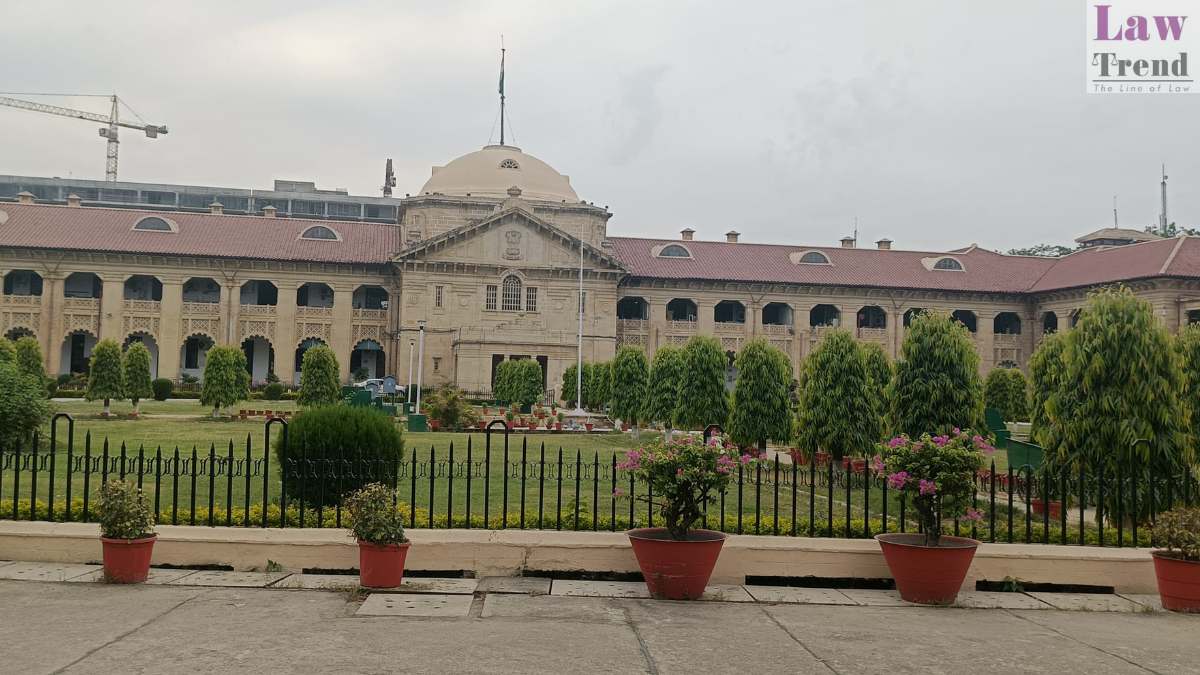
In a significant ruling affirming that the acquittal of certain accused persons does not automatically discredit reliable eyewitness testimony against others, the Allahabad High Court has dismissed the decades-old appeal of convict Man Singh and upheld his conviction and life imprisonment in a 1984 murder and attempted murder case. A Division Bench comprising Justice Siddharth and Justice Vinai Kumar Dwivedi ruled that the doctrine of falsus in uno, falsus in omnibus is not a mandatory rule of evidence in India and reaffirmed that the credible testimony of related and injured eyewitnesses cannot be discarded merely on grounds of relationship or alleged prior enmity.
Delivering the judgment for the Bench, Justice Vinai Kumar Dwivedi held that the surviving appellant, along with co-convict Hari Ram (whose appeal abated upon his demise), acted with common intention, pre-concert, and a prior meeting of minds when they fetched firearms following an altercation over drawing water from a public hand pump and opened fire on the victims.
Background of the Case
The case traces back to an incident on September 1, 1984, at around 5:00 p.m. in Village Gilauri, within the jurisdiction of Police Station Amla (Aonla), District Bareilly. According to the First Information Report lodged by informant Chunni Lal (PW-1), his son Jagpal and nephew Omkar went to fetch water from a public hand pump situated to the west of his house. Accused Hari Ram and Man Singh arrived at the spot, scolded the children, and drove them away.
When Nem Chand (brother of PW-1), Mohan Lal (son of PW-1), and family member Ram Swaroop objected—questioning why the children were prevented from accessing government property—an altercation ensued. Hari Ram and Man Singh then rushed to their houses and returned armed with guns. Upon the alleged exhortation of co-accused Chhadammi and Nanku, Hari Ram fired a shot hitting Nem Chand in the mouth and chest, causing him to collapse and die on the spot. Man Singh fired a second shot, striking Ram Swaroop in the chest and stomach.
Following oral information given by Chunni Lal, an FIR was registered at Police Station Amla at 18:30 hours on the same evening under Sections 302 and 307 of the Indian Penal Code (IPC). The investigation culminated in a charge-sheet against four accused persons.
On July 8, 1988, the IX Additional Sessions Judge, Bareilly, acquitted Chhadammi and Nanku by granting them the benefit of the doubt. However, the trial court convicted Hari Ram under Section 302 IPC (sentencing him to life imprisonment) and Section 307 read with Section 34 IPC (sentencing him to seven years of rigorous imprisonment). Man Singh was convicted under Section 302 read with Section 34 IPC (sentenced to life imprisonment) and Section 307 IPC simpliciter. Aggrieved, both convicts approached the High Court in 1988. During the pendency of the appeal, Hari Ram died, and the appeal against him abated on May 18, 2018, leaving Man Singh as the sole surviving appellant.
Arguments of the Parties
Appearing on behalf of the surviving appellant, learned Amicus Curiae Ms. Manju Verma contended that the trial court committed a grave error by convicting Hari Ram and Man Singh on the very same evidence that resulted in the acquittal of co-accused Chhadammi and Nanku. She argued that there was no legal justification for acquitting some accused while convicting others on identical testimony.
It was further urged that all three eyewitnesses—informant Chunni Lal (PW-1), injured witness Ram Swaroop (PW-2), and Mohan Lal (PW-3)—were close blood relatives of the deceased, rendering their testimony partisan and unreliable in the absence of independent witnesses. Counsel also pointed to alleged major contradictions in the witness depositions, submitting that the conviction was unsustainable.
Opposing the appeal, learned Additional Government Advocate Sri Thakur Azad Singh submitted that the incident occurred in broad daylight and was witnessed directly by the prosecution witnesses. The AGA emphasized that Ram Swaroop was an injured eyewitness who suffered firearm wounds, and established law dictates that the testimony of an injured witness carries great weight and cannot be discarded lightly.
The State further argued that oral testimonies were fully corroborated by the medical evidence of Dr. Balbir Singh (PW-4), who conducted the autopsy of Nem Chand, and Dr. C.P. Singhal (PW-5), who examined the injured Ram Swaroop. The State maintained that relationship is no ground to discard credible evidence and that the acquittal of some accused does not preclude the conviction of co-accused.
Court’s Analysis and Key Observations
Evaluating the evidentiary record, the High Court observed that the FIR was lodged promptly within an hour and a half of the occurrence without any delay, setting forth a natural narrative.
1. Credibility of Injured Eyewitness and Relationship of Witnesses
Addressing the defense plea regarding interested and related witnesses, the Bench underscored that close relation to a deceased victim does not disqualify an eyewitness. Citing the Supreme Court in State of Rajasthan Vs. Smt. Kalki and Another (1981), the Court noted:
“Related is not equivalent to ‘interested’. A witness may be called ‘interested’ only when he or she derives some benefit from the result of a litigation; in the decree in a civil case, or in seeing an accused person punished. A witness who is a natural one and is the only possible eyewitness in the circumstances of a case cannot be said to be ‘interested’.”
The Bench also referred to Sucha Singh and Anr. Vs. State of Punjab (2003) and Thatireddigari Maheshwara Reddy Vs. State of Andhra Pradesh (2024), affirming that relationship does not impair credibility and that relatives are unlikely to shield the real culprit to falsely implicate an innocent person.
On the evidentiary value of injured witness Ram Swaroop (PW-2), the Court relied on Suresh Sitaram Surve Vs. State of Maharashtra (2002), highlighting:
“The evidence of the injured eyewitnesses cannot be discarded in toto on the ground of inimical disposition towards the accused or the improbability of narrating the details of actual attack. True, their evidence has to be scrutinized with caution taking into account the factum of previous enmity and the tendency to exaggerate and to implicate as many as possible.”
The Bench noted that Ram Swaroop sustained two firearm entry wounds to his upper and lower chest, confirming his presence at the scene and demonstrating the clear intention of the appellant to kill.
2. Meeting of Minds and Common Intention
The High Court held that the sequence of events clearly established common intention under Section 34 IPC:
“The above act of the deceased appellant Hari Ram and surviving appellant Man Singh is a clear indication about this fact that both of them had went to their houses and returned with their guns in their hands with pre-planned, pre-concert and with prior meeting of minds to commit the crime and kill by their guns by firing on deceased Nem Chand and Ram Swaroop PW-2.”
The Court noted that Nem Chand sustained six firearm entry wounds targeted between his chest and head, while Ram Swaroop sustained two firearm injuries, confirming coordinated overt acts.
3. Rejection of ‘Falsus in Uno, Falsus in Omnibus’
Directly answering the contention that the conviction could not stand because co-accused Chhadammi and Nanku were acquitted on the same evidence, the High Court examined the legal status of the maxim falsus in uno, falsus in omnibus (false in one thing, false in everything).
Citing the landmark Supreme Court ruling in Nisar Ali Vs. State of Uttar Pradesh (1957), as reiterated in Menoka Malik and Others Vs. State of West Bengal and Others (2019) and Ilangovan Vs. State of Tamil Nadu (2020), the Bench observed:
“This maxim has not received general acceptance in different jurisdictions in India; nor has this maxim come to occupy the status of a rule of law. It is merely a rule of caution. All that it amounts to is that in such cases the testimony may be disregarded not that it must be disregarded… The doctrine merely involves the question of weight of evidence which a court may apply in a given set of circumstances but it is not what may be called ‘a mandatory rule of evidence.'”
The High Court held that while the trial court found the role and presence of Chhadammi and Nanku doubtful, the evidence against Hari Ram and Man Singh was specific, consistent, creditworthy, and corroborated by medical reports. Therefore, the partial acquittal could not enure to the benefit of Man Singh.
The Decision
Finding no perversity or illegality in the trial court’s judgment, the High Court dismissed the criminal appeal of surviving appellant Man Singh and affirmed his conviction and sentence dated July 8, 1988.
The Court cancelled Man Singh’s personal bonds, discharged his sureties, and directed him to surrender before the Chief Judicial Magistrate (CJM), Bareilly, within one month to serve out his remaining sentence. The CJM, Bareilly, was directed to issue non-bailable warrants to secure his arrest and commit him to jail should he fail to surrender within the stipulated period. Additionally, the Bench directed that a fee of Rs. 15,000/- be paid to learned Amicus Curiae Ms. Manju Verma for her assistance.
Case Title: Hari Ram and Other v. State
Case No.: Criminal Appeal No. 1638 of 1988
Bench: Justice Siddharth and Justice Vinai Kumar Dwivedi
Date: September 28, 2026




