

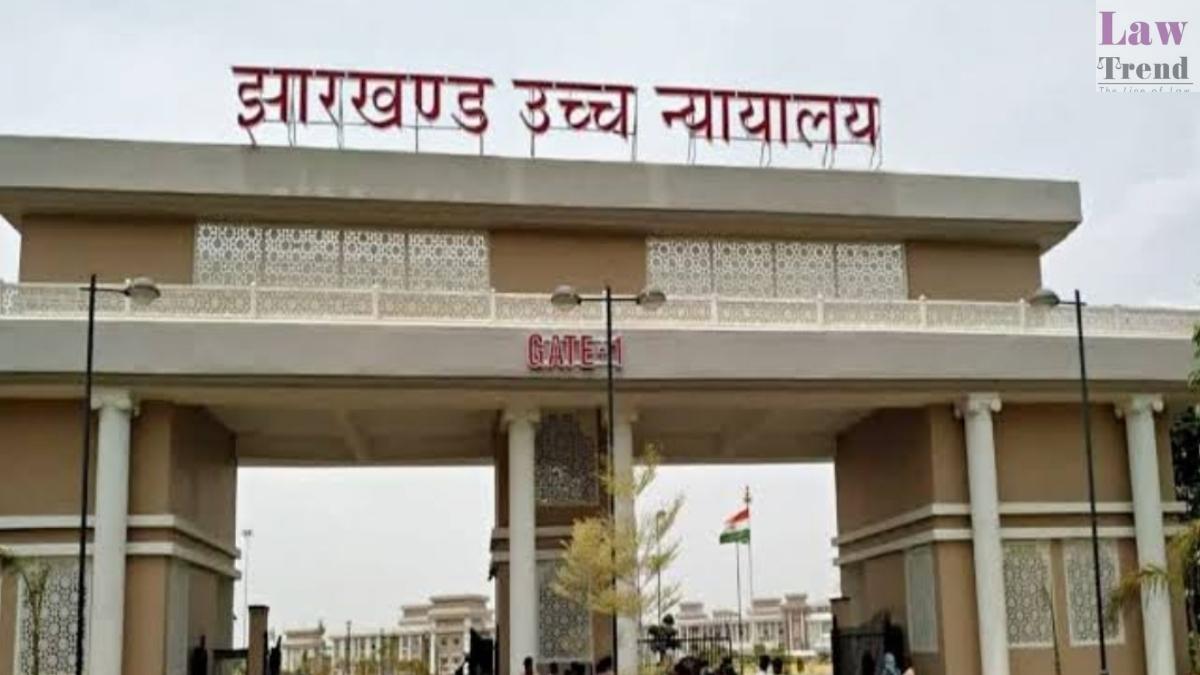
Resolving a jurisdictional challenge under Article 227 of the Constitution of India, the High Court of Jharkhand, presided over by Justice Sanjay Kumar Dwivedi, held that an intervenor claiming rights over a disputed parcel of land is a necessary party to clear confusion regarding plot possession and boundaries. Upholding the trial court’s order allowing an intervention application in a property dispute, the High Court dismissed the writ petition filed by the plaintiff and cleared the way for the pending title suit to proceed on its merits.
Background of the Case
The dispute arose out of Title Suit No. 173 of 2011, instituted by the petitioner, Shabana Khatoon, before the Subordinate Judge-I, Ranchi. The suit sought a declaration of right, title, and interest, alongside a decree of permanent injunction to restrain the Ranchi Municipal Corporation and administrative authorities from interfering with her peaceful possession.
The subject matter involves landed property situated at M.S. Plot No. 375, Holding No. 218, Ward No. VI (Old) corresponding to Ward No. 23/13, Khasmahal Plot No. 2048, located at Tamtamtoli Road, Kantatoli Chowk, Lower Bazar, Ranchi, measuring 3 kathas and 9 chataks.
According to the petitioner, the property was originally owned by Satya Ranjan Bhattachariya, who constructed boundary walls and rooms and resided there with his family. Subsequently, the name of Manindra Nath Chakraverty was mutated in the municipal records in 1968, upon which taxes were routinely paid. Chakraverty transferred the land by a registered sale deed dated September 26, 1980, to Swapan Kumar Saha, who then sold the property to Khatoon via a registered sale deed dated February 16, 1995. Following the purchase, Khatoon obtained mutation in her name from both the Circle Officer, Ranchi, and the Ranchi Municipal Corporation.
During the pendency of the title suit, an intervention application was preferred by Md. Sabir, President of Public Urdu Middle School, Kantatoli Chowk. By an order dated February 24, 2014, the Subordinate Judge-I, Ranchi, allowed the intervention petition and arrayed Sabir as a defendant. Aggrieved by this impleadment, the petitioner invoked the supervisory jurisdiction of the High Court.
Submissions of the Parties
Senior Advocate Amit Kumar Das, assisted by Advocate Shivam Utkarsh Sahay, appeared for the petitioner and contended that the trial court passed the impugned order on erroneous premises. Counsel argued that the intervenor held no right, title, or interest in the suit property to justify being impleaded as a defendant. During the course of hearing, it was additionally submitted that the Urdu School was not operating on the petitioner’s portion of the land, but rather on another portion of the same plot, a question that could be resolved on the basis of evidence in the title suit itself.
Opposing the petition, Advocate Ray Rajat Nath, appearing for the Ranchi Municipal Corporation (Respondent Nos. 1 and 2), submitted that the intervenor was indeed a necessary party. He argued that where a third party places documents on record indicating an interest in the suit property, the court may prima facie recognize such an interest and permit intervention to prevent multiplicity of litigation.
Counsel for the intervenor (Respondent No. 4) failed to appear despite having filed a vakalatnama, and no representation was made on behalf of the State (Respondent No. 3). Considering the matter had been pending since 2014, the High Court proceeded to adjudicate the case on its merits in their absence.
Court’s Analysis and Precedents
Upon examining the trial court record, the High Court noted that the trial judge had evaluated several administrative and municipal records filed by the intervenor. These included Letter No. 1345 dated May 7, 2010, issued by the Ranchi Nagar Nigam, stating that M.S. Plot No. 375 was municipal property and cancelling Holding No. 218.
The records also revealed a communication dated May 5, 2010, wherein the Municipal Corporation requested the Town Anchal Circle Officer to cancel Khatoon’s mutation, identifying Plot No. 375 ‘Parti Kadam’ (measuring 0.484) as Nigam property. Additionally, the intervenor produced a stop-work notice dated March 10, 2010, issued to Md. Badru, alongside an order sheet dated May 17, 2010, in W.P.(C) No. 1758 of 2010 (Sabana Khatoon vs. State and Another), stating that Plot No. 375 was municipality khatiyani land on which an Urdu School operated under municipal possession.
Evaluating these conflicting claims, the court observed that while the petitioner asserted ownership and construction, the municipal documents produced by the intervenor indicated that a school was situated on the plot.
On the governing principles of impleadment, Justice Dwivedi placed reliance on the landmark Supreme Court ruling in Vidur Impex and Traders (P) Ltd. vs. Tosh Apartments (P) Ltd. (2012) 8 SCC 384, reproducing the settled tests:
“41. Though there is apparent conflict in the observations made in some of the aforementioned judgments, the broad principles which should govern disposal of an application for impleadment are: 41.1. The court can, at any stage of the proceedings, either on an application made by the parties or otherwise, direct impleadment of any person as party, who ought to have been joined as plaintiff or defendant or whose presence before the court is necessary for effective and complete adjudication of the issues involved in the suit. 41.2. A necessary party is the person who ought to be joined as party to the suit and in whose absence an effective decree cannot be passed by the court. 41.3. A proper party is a person whose presence would enable the court to completely, effectively and properly adjudicate upon all matters and issues, though he may not be a person in favour of or against whom a decree is to be made. 41.4. If a person is not found to be a proper or necessary party, the court does not have the jurisdiction to order his impleadment against the wishes of the plaintiff. 41.5. In a suit for specific performance, the court can order impleadment of a purchaser whose conduct is above board, and who files b application for being joined as party within reasonable time of his acquiring knowledge about the pending litigation. 41.6. However, if the applicant is guilty of contumacious conduct or is beneficiary of a clandestine transaction or a transaction made by the owner of the suit property in violation of the restraint order passed by the court or the application is unduly delayed then the court will be fully justified in declining the prayer for impleadment.”
Applying these principles to the factual scenario, the High Court observed:
“In the case in hand, in light of aforesaid background it transpires that the documents have been produced by the respondent No.4 of the same plot and confusion is there with regard to portion of the plot, as such to clear the said the intervenor was the necessary party and in view of that the learned Court has rightly allowed the intervention petition and the merit can be decided by the learned Court in the pending title suit on the basis of evidence laid by appearing parties in the title suit.”
Decision of the Court
Finding no jurisdictional error or illegality in the order dated February 24, 2014, passed by the Subordinate Judge-I, Ranchi, the High Court dismissed the writ petition. The court vacated the interim stay granted earlier and granted the parties liberty to appear before the trial court, directing that the pending title suit proceed in accordance with law.
Case Details:
Case Title: Shabana Khatoon v. The Ranchi Municipal Corporation and Others
Case No.: W.P. (C.) No. 2328 of 2014
Bench: Justice Sanjay Kumar Dwivedi
Date: 21.09.2026




