

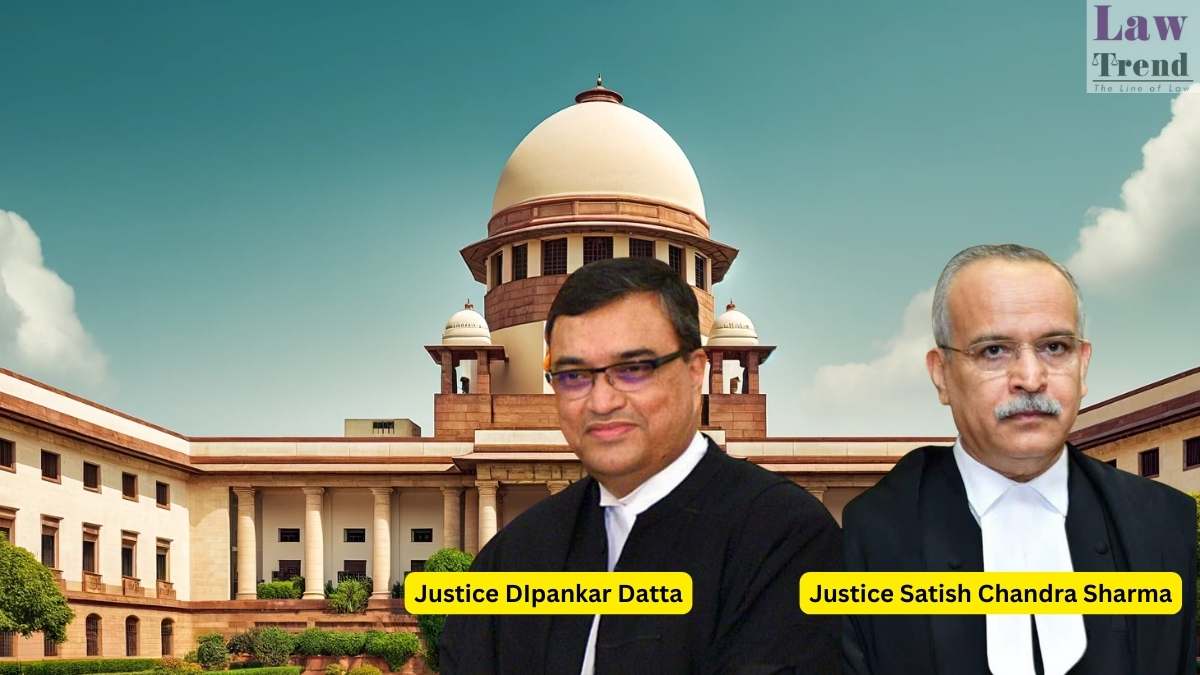
A two-judge bench of the Supreme Court of India, comprising Justice Dipankar Datta and Justice Satish Chandra Sharma, delivered a split opinion on whether a batch of writ petitions challenging the constitutional validity of the Chief Election Commissioner and other Election Commissioners (Appointment, Conditions of Service and Term of Office) Act, 2023 must be referred to a five-judge Constitution Bench under Article 145(3) of the Constitution. While Justice Datta held that the matter only requires the application of settled law and rejected the reference, Justice Sharma held that the challenge raises a substantial question of law as to constitutional interpretation never decided before, warranting adjudication by a Constitution Bench. Following the division of opinion, both judges directed the case records to be placed before the Chief Justice of India to consider constituting a Constitution Bench, while jointly urging the Chief Justice to explore establishing a permanent five-judge Constitution Bench to tackle systemic delays in resolving constitutional references.
The batch of petitions under Article 32 was filed by public-spirited individuals and registered societies, including Dr. Jaya Thakur, Association for Democratic Reforms, and People’s Union for Civil Liberties. They challenged Sections 6, 7, and 8(2) of the 2023 Act as ultra vires Article 14 read with Article 324 of the Constitution. Under Section 7, the Chief Election Commissioner (CEC) and other Election Commissioners (ECs) are appointed by the President on the recommendation of a three-member Selection Committee consisting of the Prime Minister as Chairperson, the Leader of Opposition in the Lok Sabha (or the leader of the single largest opposition party), and a Union Cabinet Minister nominated by the Prime Minister.
Arguments of the Parties
Appearing for the petitioners, senior advocates Vijay Hansaria, Sanjay Parikh, Gopal Sankaranarayanan, Shadan Farasat, and advocates Prashant Bhushan, Kaleeshwaram Raj, and S.N. Shukla argued that the 2023 Act restores executive dominance over the appointment mechanism. They contended that a Constitution Bench in Anoop Baranwal v. Union of India had authoritatively ruled that the Election Commission of India (ECI) must be insulated from exclusive executive control. Consequently, the present dispute merely requires the application of settled principles, not a fresh constitutional interpretation under Article 145(3). Citing State of J&K v. Thakur Ganga Singh, People’s Union for Civil Liberties v. Union of India, Abdul Rahim Ismail C. Rahimtoola v. State of Bombay, and Shrimanth Balasaheb Patil v. Karnataka Legislative Assembly, the petitioners argued that invoking constitutional provisions or statutes of novelty does not automatically justify a reference. Relying on Madras Bar Association v. Union of India, they further contended that the Union’s belated plea for reference—raised only during oral arguments and omitted from its counter-affidavit—was an eleventh-hour attempt to delay adjudication and impermissibly seek dilution of Anoop Baranwal.
Opposing the challenge, Attorney General R. Venkataramani and Solicitor General Tushar Mehta urged that the petitions raise substantial questions of constitutional interpretation under Article 145(3) read with Order XXXVIII, Rule 1 of the Supreme Court Rules, 2013. The Attorney General submitted that Anoop Baranwal only operated as an interim pro tem measure under Article 142 to fill a legislative vacuum until Parliament enacted a law under Article 324(2). Once Parliament occupied the field through the 2023 Act, those interim directions ceased to have independent relevance. He argued that the executive’s numerical presence does not justify an inference of bias, noting high constitutional functionaries are presumed to act fairly and objectively (CPIL v. Union of India). The Solicitor General cited Manoj Narula v. Union of India to highlight the doctrine of constitutional trust reposed in the Prime Minister. He further argued that if the Collegium system excludes outsiders from judicial appointments on grounds of judicial independence, a similar degree of institutional autonomy under the separation of powers must be recognized for the executive and legislature.
Justice Dipankar Datta’s Analysis
Rejecting the Union’s request for a reference, Justice Dipankar Datta held that settled constitutional standards already govern the controversy. Referring to Anoop Baranwal, he observed that while the inclusion of the Chief Justice of India in the selection committee was a transient, pro tem arrangement under Article 142 that worked itself out once Parliament legislated, the core constitutional principle remained established:
“What follows from a reading of Anoop Baranwal (supra) is that the declaration of independence of the ECI being integral to free and fair elections and that the process has to be independent of exclusive executive control, is binding on all courts and, in no unclear terms, animates how Article 324(2) is to be interpreted by the constitutional courts.”
Applying Thakur Ganga Singh, PUCL, and Abdul Rahim Ismail C. Rahimtoola, Justice Datta held that applying settled constitutional principles to a new statute does not transmute the dispute into a substantial question of law as to constitutional interpretation.
On the composition under Section 7 of the 2023 Act, Justice Datta observed prima facie that a Cabinet Minister nominated by the Prime Minister cannot realistically be expected to break rank due to the doctrine of collective responsibility under Article 75(3):
“In such a circumstance, the inclusion of a Cabinet Minister in the Selection Committee fails to provide the independent counterweight that a neutral selector could and he (Cabinet Minister) would merely echo the voice of his leader; and, consequently, the presence of the Leader of Opposition in the Selection Committee becomes largely ornamental, without furthering the purpose of his inclusion.”
Justice Datta also strongly disapproved of the Solicitor General’s oral comparison between the 2023 Act’s Selection Committee and the judicial Collegium system:
“The oft-repeated phrase that “Judges appoint Judges” is a myth, which people have been fed by vested interests through motivated narratives, often drawing sustenance from certain controversial decisions taken in this century in relation to appointment of Judges. A sweeping generalisation that the Collegium acts as a law unto itself overlooks the detailed consultative process envisaged under the Constitution, and the intrinsic role of the executive both at the Centre and in the States as well as intelligence and other agencies in the appointment process including vetting of credentials, and the fact that every appointment bears the imprimatur of the President.”
He noted that the executive wields decisive control by selectively implementing Collegium resolutions, withholding recommendations, and leaving reiterations to gather dust. Consequently, he found the argument drawing parallels between the Collegium and the executive-dominated Selection Committee “rather disingenuous, evasive and disquieting.”
Justice Satish Chandra Sharma’s Dissenting Opinion
Dissenting, Justice Satish Chandra Sharma accepted the submissions of the Attorney General and Solicitor General, holding that the petitions must be heard by a Constitution Bench of not less than five judges.
Justice Sharma noted that the 2023 Act is a fresh enactment following Anoop Baranwal and that its constitutional validity has never been authoritatively examined:
“There is no authoritative decision of this Court till date pronouncing on the constitutional validity of the said Act. A judicial decision in light of what the Constitution provides has to be given by this Court while it is seized of the issue of vires of Section 7 of the said Act and its other provisions. The decision on these writ petitions would be the first of its kind and it is all the more necessary that a reference is made.”
Justice Sharma observed that the Solicitor General’s reliance on the NJAC case (2016) was founded on the doctrine of separation of powers and the proposition that a corresponding constitutional independence must be accorded to the executive. He noted that the submission was not intended as a criticism of the Collegium system. Concluding that whether Parliament was justified in excluding a neutral selector is an important and untouched constitutional question, Justice Sharma held that the mandate of Article 145(3) requires adjudication by a Constitution Bench.
Joint Order and Call for a Permanent Constitution Bench
In their joint order, both judges recognized their split opinion. To avoid further delay through an intermediate reference to a three-judge bench, they directed the papers to be placed before the Chief Justice of India for considering the constitution of a Constitution Bench.
Highlighting that Anoop Baranwal took eight years to be resolved and the reference in State of Uttar Pradesh v. Jai Bir Singh remained pending for over two decades, the bench expressed deep concern over chronic delays in constitutional adjudications:
“Undisputedly, this is an area of grave concern and the inordinate delay in resolution of the references is itself a source of institutional embarrassment which all stakeholders ought to strive to avoid. Self-introspection, indeed, is required.”
The bench jointly requested the Chief Justice of India to explore constituting a permanent five-judge Constitution Bench to hear pure constitutional questions with promptitude.
Case Details:
Case Title: Dr. Jaya Thakur and Ors. v. Union of India and Anr. (with connected matters)
Case No.: Writ Petition (Civil) No. 14 of 2024
Bench: Justice Dipankar Datta and Justice Satish Chandra Sharma
Date: September 23, 2026




