

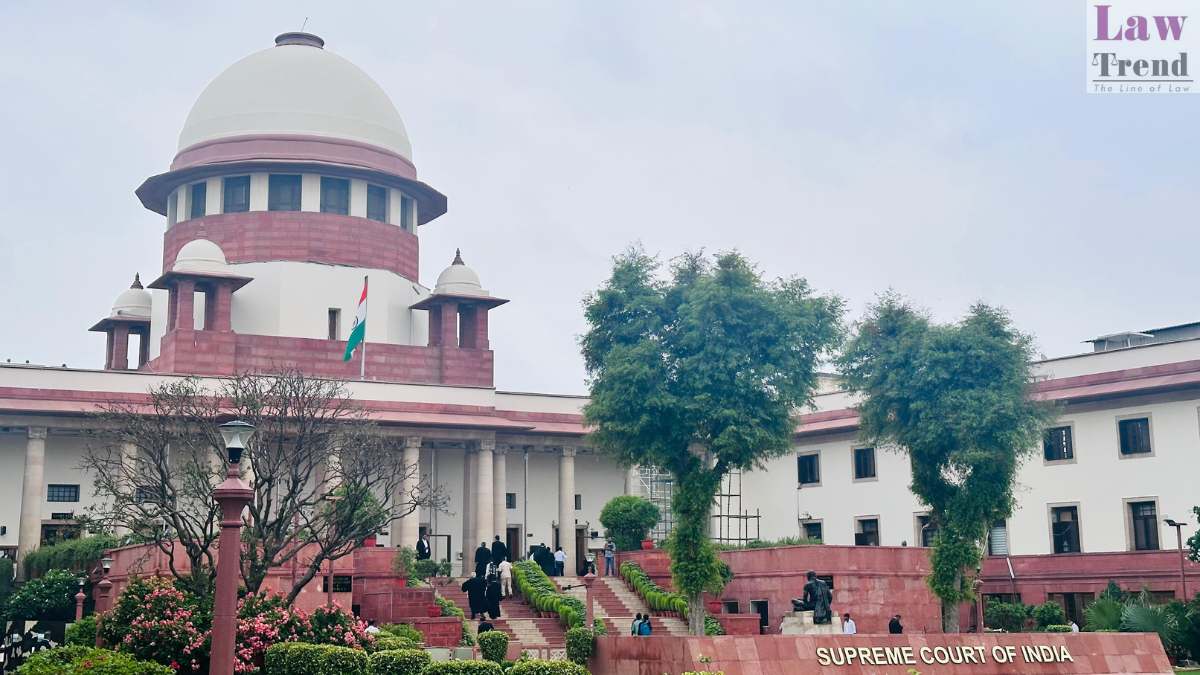
The Supreme Court has ruled that a call letter requiring a candidate to report for initial training does not constitute an operative appointment order under the Railway Protection Force framework, holding that the constitutional protection under Article 311(1) is not violated when a removal order is passed by an authority of equal rank to the officer who actually made the appointment upon completion of training. A Bench comprising Justice Aravind Kumar and Justice Vipul M. Pancholi set aside the concurrent judgments of the Allahabad High Court and the First Appellate Court, thereby restoring the 1983 dismissal of a Railway Protection Special Force (RPSF) constable for unauthorized absence.
Background of the Dispute
The respondent, Ramdhani Prasad, was enlisted as a recruit under training for the post of Rakshak (constable) in the RPSF. On May 3, 1979, the Commandant issued a call letter directing him to report for training at the Battalion headquarters of 2nd Battalion, RPSF, Gorakhpur. The letter expressly stated that appointment was subject to successful completion of the prescribed training and provided for probation.
Following the training, the Assistant Commandant issued Battalion Order dated December 4, 1979, appointing the successful recruits as Rakshaks with effect from that date and posting them to their battalions. The respondent was allotted personal number 2612 and posted to the 7th Battalion. This was subsequently reiterated by Battalion Order No. 58/1980 dated February 25, 1980, issued by the Adjutant for Commandant.
In May 1982, the respondent was sanctioned leave from May 9 to May 26, 1982, but failed to resume duty on May 27, 1982. He remained absent without intimation for 72 days until August 6, 1982. A charge-sheet was issued on October 1, 1982, under Rule 44 of the Railway Protection Force Rules, 1959, alleging gross negligence and breach of discipline. The departmental enquiry was fixed for January 1, 1983. As the respondent failed to appear, the Enquiry Officer proceeded ex-parte and submitted a report on February 24, 1983, finding the charges proved. Following a show-cause notice dated February 26, 1983, to which no reply was submitted, the Adjutant passed an order removing him from service on March 18, 1983. His departmental appeal was rejected by the Commandant on November 7, 1984.
The respondent then filed a civil suit before the Additional Munsif Magistrate, Gorakhpur (Trial Court), which dismissed the suit, holding that the respondent had been validly appointed by the Assistant Commandant and that the Adjutant was an officer not below that rank. However, the Additional Civil Judge, Gorakhpur (First Appellate Court), reversed the Trial Court’s decision, holding that the respondent had been appointed by the Commandant pursuant to the call letter dated May 3, 1979, making his removal by the subordinate Adjutant a violation of Article 311(1) of the Constitution. The First Appellate Court also found the ex-parte enquiry to be in violation of natural justice. On January 12, 2023, the High Court of Judicature at Allahabad dismissed the Union of India’s second appeal, affirming the First Appellate Court’s decree.
Arguments of the Parties
Appearing for the Union of India, Additional Solicitor General Vikramjit Banerjee submitted that the High Court and First Appellate Court proceeded on an erroneous factual premise. He argued that the call letter dated May 3, 1979, was merely a direction to report for mandatory training, whereas the actual appointment was made on December 4, 1979, by the Assistant Commandant. Citing Ramanand Singh v. State of Bihar, he argued that appointment and posting orders can be issued simultaneously.
The appellants further pointed out that under Rule 20 read with Schedule I of the RPF Rules, 1959, an Assistant Security Officer/Assistant Commandant is empowered to appoint Rakshaks, and under Rule 43 read with Schedule II, is competent to impose removal. Relying on Union of India v. Chandra Pal Pandey, counsel submitted that the power of appointment does not vest exclusively in the Chief Security Officer. He also argued that the respondent willfully avoided the enquiry, and relied on P. Karuppaiah v. General Manager, ThiruvalIuvar Transport Corporation Ltd. to invoke the principle of “No work, no pay.”
Opposing the appeal, counsel for the respondent, Mananjay Mishra, contended that the call letter issued by the Commandant was the actual appointment order under which the respondent joined service, whereas the subsequent order was merely a posting order. He submitted that once the Commandant is recognized as the appointing authority, an order of removal by the subordinate Adjutant violates Article 311(1). He placed heavy reliance on Krishna Kumar v. Divisional Assistant Electrical Engineer, Central Railway, which established that delegation of appointment power does not alter the hierarchical status of a subordinate officer. The respondent also asserted that the ex-parte enquiry violated natural justice because he was undergoing medical treatment at the Railway Hospital from December 29, 1982, to March 7, 1983, following an accidental fracture, and that neither the memorandum of charges nor the show-cause notice was effectively served on him.
Court’s Analysis and Key Observations
Examining the contemporaneous documents, the Supreme Court held that the call letter dated May 3, 1979, did not constitute an appointment order. The Bench noted that it expressly conditioned any future appointment on the successful completion of training and employed terms such as “accept the offer” and “candidature for the post.” Conversely, the Battalion Order dated December 4, 1979, specifically stated that the recruits were “appointed as RK” upon completion of training.
Clarifying the legal framework under Article 311(1), the Bench observed:
“It is well settled that while determining the authority by which an employee was appointed for the purposes of Article 311(1) of the Constitution, the court is required to ascertain the authority which in fact made the appointment with reference to the order of appointment and the statutory or regulatory framework governing such appointment. Once that authority is identified, the constitutional protection under Article 311(1) has to be examined with reference to the hierarchical position of the authority which subsequently passes the order of dismissal or removal.”
The Court referred to Krishna Kumar v. Divisional Assistant Electrical Engineer, where it was held:
“Article 311(1) of the Constitution provides that no person who is a member of a civil service of the Union or an all-India service or a civil service of a State or holds a civil post under the Union or a State shall be dismissed or removed by an authority subordinate to that by which he was appointed… delegation of the power to make a particular appointment does not enhance or improve the hierarchical status of the delegate. An Officer subordinate to another will not become his equal in rank by reason of his coming to possess some of the powers of that another.”
Analyzing the Railway Protection Force Act, 1957, and the 1959 Rules, the Court explained that while Section 6 provides that appointment of members of the Force shall rest with the Chief Security Officer, the proviso to Section 6, read with Section 9 and Rules 20 and 43 (Schedules I and II), allows other superior officers to exercise appointment and disciplinary powers. The Bench cited Union of India v. Chandra Pal Pandey, which held that:
“The Section and the proviso in our opinion do not rest the power of appointment merely with the Chief Security Officer. What is contemplated is that the Chief Security Officer will have overall control in the matter of appointment and that control be exercised in accordance with the Rules. If the Rules provide for appointment by other superior officers, it cannot be said to be in derogation of the Act or the purposes of the Act.”
The Bench determined that the respondent’s appointing authority was the Assistant Commandant who issued the order dated December 4, 1979. The Adjutant, Shri I.J. Singh, who passed the removal order on March 18, 1983, was of the same rank as the Assistant Commandant and was competent under Schedule II to impose removal.
The Bench highlighted:
“At this stage, it is relevant to note that the constitutional prohibition contained in Article 311(1) is attracted only where the order of dismissal or removal is passed by an authority subordinate in rank to the authority by which the employee was appointed, whereas, this essential ingredient of Article 311 is absent in the facts of the present case.”
Addressing the claim regarding natural justice, the Court observed that the respondent had received the charge-sheet and submitted a response, had been communicated the date of the enquiry, and had received a show-cause notice proposing removal. The Bench held that the respondent had been afforded reasonable opportunity and the enquiry could not be treated as vitiated simply because it proceeded ex-parte upon his failure to appear.
Decision
Allowing the appeal, the Supreme Court set aside the judgment of the Allahabad High Court dated January 12, 2023, as well as the First Appellate Court’s decree. The Court affirmed the Trial Court’s decision and restored the order dated March 18, 1983, removing the respondent from service.
Case Title: Union of India & Ors. v. Ramdhani Prasad
Case No.: SLP (C) No. 13645 of 2023)
Bench: Justice Aravind Kumar and Justice Vipul M. Pancholi
Date: September 24, 2026




