

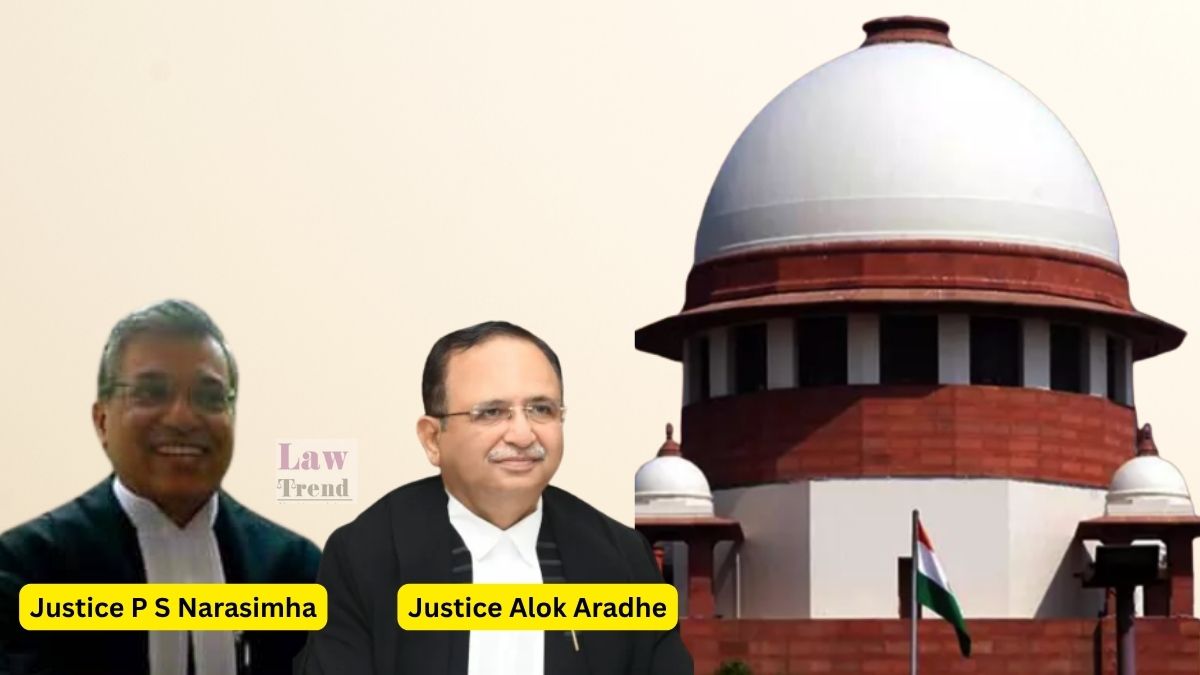
In a significant ruling addressing the interplay between conditional court deposits and interest liability, the Supreme Court held that depositing an awarded amount in court does not equate to payment unless it is unconditional and placed at the complete disposal of the award-holder. A Bench comprising Justice P. S. Narasimha and Justice Alok Aradhe dismissed an appeal filed by the National Seeds Corporation Ltd. and affirmed an order of the Delhi High Court directing the public sector undertaking to pay 12% interest per annum on an arbitral award, observing that the deposit made by the award-debtor was conditional, resisted at every stage, and not made in accordance with Order XXI Rule 1 of the Code of Civil Procedure, 1908 (CPC). Flagging widespread systemic disparity across Indian courts, the Bench also requested the Law Commission of India to examine the need for uniform legislation on court deposits in consultation with the Reserve Bank of India, the Ministry of Finance, and the Ministry of Law and Justice.
Opening the judgment, the Bench observed: “A deposit is not synonymous with payment. A sum put beyond the debtor’s own reach neither extinguishes his liability nor places it in the creditor’s hands. Between the deposit of a sum in court and the final discharge of liability lies a spectrum of possibilities, attended by a corresponding degree of uncertainty. Resolving that uncertainty, in the specific context of enforcement of an arbitral award, is at the heart of this appeal.”
Background of the Case
The dispute arose out of an Arbitral Award dated June 13, 2019, passed against the appellant, National Seeds Corporation Ltd., in favor of the respondent, National Agro Seed Corporation (India), for Rs. 1,46,40,005.02 along with 12% annual interest from August 26, 2017, aggregating to Rs. 1,77,97,434.
The appellant challenged the award before the High Court of Delhi under Section 34 of the Arbitration and Conciliation Act, 1996. On October 16, 2019, the High Court granted an ex parte interim stay on the enforcement of the award subject to the appellant depositing 50% of the principal awarded amount within six weeks. In compliance, the appellant deposited Rs. 73,20,003 via demand draft on November 25, 2019.
The Section 34 petition was dismissed on January 5, 2022. The respondent then instituted execution proceedings on January 24, 2022, and filed an interim application on February 14, 2022, seeking release of the deposited funds. In the meantime, the appellant preferred an appeal under Section 37(1)(c) of the 1996 Act, which was dismissed by a Division Bench on May 31, 2022, followed by the dismissal of its Special Leave Petition by the Supreme Court on August 26, 2022.
During the execution proceedings, the appellant deposited the remaining balance of Rs. 1,53,17,792 on April 26, 2022. However, the appellant continuously resisted the release of the deposited funds. When the executing court permitted a partial release of Rs. 1 crore on July 7, 2022, it subjected the release to the respondent furnishing title deeds of immovable property as security. Facing acute financial distress and needing the deeds to avert an auction of its properties, the respondent had to surrender the release order.
Following the dismissal of the appellant’s Special Leave Petition, the executing court, on September 8, 2022, noted that the award had attained finality and ordered the unconditional release of the amount—to which the appellant did not object for the first time. On August 5, 2024, the executing court disposed of the execution petition, ruling that the deposited amount was never truly available to the decree-holder until September 8, 2022, and directed the appellant to pay interest at 12% per annum from June 13, 2019, to September 8, 2022. Aggrieved, the appellant approached the Supreme Court.
Arguments of the Parties
Appearing for the appellant, counsel Mr. Yashvardhan argued that the deposit of the awarded amount signified satisfaction of the award and relied on Himachal Pradesh Housing and Urban Development Authority & Anr. v. Ranjit Singh Rana, Union of India & Anr. v. M.P. Trading and Investment RAC. Corporation Limited, and Union of India v. Concrete Products and Construction Company & Ors. It was contended that in case of a partial deposit, interest ceases to run on the deposited sum, the award-holder is only entitled to interest accrued on the fixed deposit, and reliance on Order XXI Rules 1(1) and (4) of the CPC was misplaced because the 1996 Act is a self-contained code (citing Fuerst Day Lawson Ltd. v. Jindal Exports Ltd., Sundaram Finance Limited & Anr. v. T. Thankam, Sundaram Finance Ltd. v. Abdul Samad & Anr., and Pam Developments Private Ltd. v. State of West Bengal). The appellant further argued that no withdrawal application had been made by the respondent between November 25, 2019, and February 14, 2022, and invoked K.L. Suneja & Anr. v. Dr. Manjeet Kaur Monga.
Opposing the appeal, counsel Mr. Ashutosh Kumar, appearing for the respondent, submitted that the initial deposit of Rs. 73,20,003 was made solely to obtain a stay and was neither deposited to satisfy the award nor placed at the disposal of the respondent. He maintained that cessation of interest liability under Order XXI Rule 1 of the CPC could not enure to the appellant’s benefit since the appellant actively resisted release of the funds at every stage. He highlighted that the release ordered on July 7, 2022, was conditional upon furnishing property title deeds, which does not constitute satisfaction of the award. In support, he relied on P.S.L. Ramanathan Chettiar & Ors. v. O.R.M.P.R.M. Ramanathan Chettiar, K.L. Suneja & Anr., Nepa Ltd. v. Manoj Kumar Agrawal, Delhi Development Authority v. Bhai Sardar Singh & Sons, DLF Limited & Anr. v. Koncar Generators & Motors Limited, and the Dr. T.K. Viswanathan Expert Committee Report.
Court’s Analysis and Principles
Examining the statutory scheme, the Court observed that while the 1996 Act is a self-contained code, Section 36(1) creates a legal fiction whereby an arbitral award is enforced under the CPC in the same manner as if it were a decree of the court. Relying on Paramjeet Singh Patheja v. ICDS Ltd. and Sundaram Finance Ltd. v. Abdul Samad, the Bench noted that an award remains an award and does not become an actual decree, but Section 36(3) mandates that the court, while considering a stay application for a money award, must have due regard to the stay of money decrees under Order XLI of the CPC.
Analyzing Order XXI Rule 1 of the CPC and the Constitution Bench judgment in Gurpreet Singh v. Union of India, alongside P.S.L. Ramanathan Chettiar, the Court crystallized the following key legal principles:
- The 1996 Act is a self-contained code, and Section 36(1) enacts a legal fiction making awards executable as decrees.
- Section 36(3) requires courts dealing with stay applications of money awards to have due regard to CPC provisions on staying money decrees.
- The real effect of depositing money into court is to place the money beyond the reach of the parties.
- A deposit in court must be unconditional and available to the decree-holder for withdrawal to conform with Order XXI Rule 1.
- If the decree-holder is permitted withdrawal only upon furnishing security, it is not a payment in satisfaction of the decree under Order XXI Rule 1.
- If the deposit is not made in terms of Order XXI Rule 1, interest continues to run after the deposit.
- A decree-holder cannot claim interest if it fails to take action to withdraw funds; inaction constitutes deemed refusal.
- Where a deposit is converted to a fixed deposit at the decree-holder’s own request, the decree-holder is entitled only to the interest accrued on that fixed deposit.
- Where only a part of the sum is tendered and made unconditionally withdrawable, interest ceases only to the extent of that deposit.
Applying these principles, the Bench observed that the appellant’s initial deposit of Rs. 73,20,003 was made strictly to obtain an interim stay pending the Section 34 challenge, was not accompanied by notice under Order XXI Rule 1(2), and was repeatedly opposed by the appellant when withdrawal was sought. Furthermore, the partial release permitted on July 7, 2022, was contingent upon furnishing immovable property security. Consequently, the deposit did not satisfy Order XXI Rule 1, and the respondent was not free to withdraw the funds unconditionally until September 8, 2022.
The Court distinguished Himachal Pradesh Housing and Urban Development Authority on the ground that the debtor therein had deposited the entire awarded sum, Concrete Products and Construction Company because it turned on specific contractual clauses barring interest, and M.P. Trading and Investment because the deposit had been converted to a fixed deposit at the decree-holder’s own request.
Call for National Reform on Court Deposits
Addressing systemic concerns, the Court highlighted the widespread lack of standardization across Indian courts regarding how deposits are handled. The Bench noted disparate mechanisms across High Courts: the Delhi High Court and Punjab and Haryana High Court rely on bank fixed deposits, the Supreme Court uses an open tender process among nationalized banks approved by the Chief Justice of India, whereas the Calcutta and Madras High Courts route suitor funds into the Reserve Bank of India or designated government securities.
Emphasizing the economic principle of the “time value of money” and referencing international systems—specifically the United States’ Court Registry Investment System (CRIS) under Title 28 U.S.C. § 2041 and § 2045, and Canada’s Consolidated Revenue Fund under Section 65(1) of the Supreme Court Act, 1985—the Court observed: “This asymmetry, coupled with the varied orders passed by the courts, on a case-by-case basis in accordance with the facts and circumstances of each case, leaves several concerns unaddressed… The lack of common standards and consistent principles are resulting in repeated determinations of routine questions concerning investment, renewal, quantum, accounting and interest on deposits, thereby increasing the burden on Courts/Tribunals.”
The Bench endorsed the recommendations of the Dr. T.K. Viswanathan Committee proposing amendments to Section 36(3) of the 1996 Act to mandate a 50% deposit and ensure that interest ceases only upon unconditional withdrawal.
Decision
Holding that the appellant failed to make the deposit in consonance with Order XXI Rule 1 of the CPC, the Supreme Court found no ground to interfere with the Delhi High Court’s order requiring payment of 12% per annum interest up to September 8, 2022, and affirmed the impugned decision.
Concluding the matter, the Court held that it is “necessary to evolve and formulate a suitable legislation on the subject” and requested the Law Commission of India to examine the issues highlighted in the judgment, study foreign enactments, and consult the Reserve Bank of India, the Ministry of Finance, and the Ministry of Law and Justice. The Registry was directed to forward copies of the judgment to the Chairman of the Law Commission of India, the Governor of the Reserve Bank of India, and the Secretaries to the Ministries of Finance and Law and Justice.
Case Details:
Case Title: National Seeds Corporation Ltd. v. National Agro Seed Corporation (India)
Case No.: Civil Appeal No. of 2026 (@S.L.P. (C) No. 5710 of 2025)
Bench: Justice P. S. Narasimha and Justice Alok Aradhe
Date: September 18, 2026




