

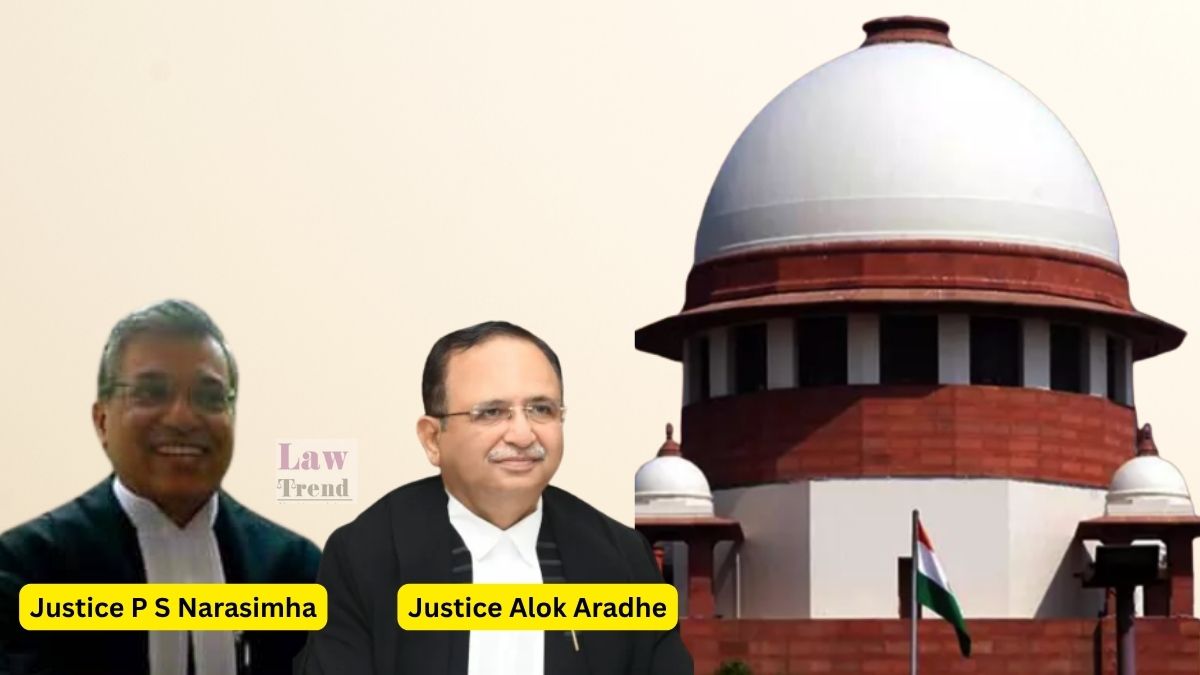
The Supreme Court of India, comprising a Bench of Justice Pamidighantam Sri Narasimha and Justice Alok Aradhe, has dismissed a writ petition filed under Article 32 of the Constitution challenging the revised 2013 selection results and appointments for the post of Technician Grade-2 (Trainee) Electrical in the Uttar Pradesh Power Corporation Limited (UPPCL). The Court held that the petitioners, having scored less than the prescribed cut-off marks for the General Category, were not more meritorious than the selected candidates, were guilty of suppressing material facts, and had established no legal basis to seek an investigation by the Central Bureau of Investigation (CBI).
Background of the Case
The dispute traces back to an advertisement issued on March 4, 2011, by UPPCL inviting applications for 2,974 posts of Technician Grade-2 (Trainee) Electrical across its Electricity Distribution Corporations. Out of these, 1,778 posts were earmarked for the General Category, 353 for Scheduled Castes, 128 for Scheduled Tribes, and 715 for Other Backward Classes (OBC).
The essential qualifications required candidates to possess a two-year National or State-level Trade certificate in the Electrician Trade, a High School certificate (or equivalent) with Science and Mathematics, and a Course on Computer Concepts (DOEACC) certificate to be produced at the time of interview.
Following a written examination on August 7, 2011, attended by 13,576 candidates, 6,288 candidates qualified for interviews held between November 28 and December 28, 2011. Results were declared on May 21, 2012. However, because several candidates could not produce their DOEACC certificates at the interview stage, UPPCL issued press notices extending the submission deadline multiple times, ultimately up to July 31, 2012, stipulating that non-submission would result in automatic cancellation.
Unsuccessful candidates challenged the selection before the Allahabad High Court. While a Single Judge dismissed their petitions on August 30, 2012, a Division Bench held on September 26, 2012, that rules could not be relaxed when the advertisement contained no such provision. The Division Bench ruled that only candidates submitting certificates prior to March 31, 2012, were eligible, and directed UPPCL to exclude those submitting later and declare a fresh select list.
In compliance, UPPCL declared a fresh selection result on January 20, 2013, and issued an appointment-cum-allotment list on January 30, 2013. Unsuccessful candidates filed the present writ petition on February 19, 2013, which was tagged with a batch of Special Leave Petitions challenging the Division Bench’s ruling. On February 22, 2019, in Sanjay K. Dixit & Ors. v. State of Uttar Pradesh & Ors., the Supreme Court upheld the Division Bench’s judgment and dismissed the Special Leave Petitions, leaving the present writ petition for adjudication.
Arguments of the Parties
Appearing for the petitioners, counsel Prashant Bhushan argued that only the initial extension for submitting DOEACC certificates was valid, while subsequent extensions were unauthorised. He contended that although only 715 posts were earmarked for the OBC category, as many as 1,527 candidates were selected under that category in violation of the reservation policy. He further argued that while 2,293 candidates submitted certificates in time, 2,836 candidates were selected, and pointed out mismatches between the lists produced by UPPCL. Contending that lower-scoring candidates were appointed, the petitioners prayed for quashing the revised result dated January 20, 2013, and the appointment list dated January 30, 2013, alongside seeking a fresh revision and a CBI probe into alleged manipulation.
Opposing the petition, counsel Sunil Kumar Jain for UPPCL submitted that the petition was not maintainable due to suppression of material facts, as petitioner nos. 8 to 18 had previously filed Writ Petition No. 2749 of 2012 before the Lucknow Bench of the Allahabad High Court for identical relief, which was disposed of on November 9, 2012. He further argued that the petition suffered from non-joinder of necessary parties and that new issues could not be raised.
On the merits, the respondents pointed out that the cut-off for the General Category was 98.25 marks, and the petitioners, having secured lower marks, could not compare themselves with candidates selected under horizontal sub-categories (dependants of freedom fighters and ex-servicemen), where cut-offs were 65.75 and 80.25 marks, respectively. Regarding the OBC category, the respondents argued that reserved category candidates who score higher marks than the last selected general candidate are entitled to selection in the open category, which cannot be counted against the reservation quota ceiling.
Court’s Analysis
Delivering the judgment, Justice Aradhe noted that on January 30, 2019, the Court had recorded that the petitioners confined their claim solely to being higher in merit than the appointed candidates. Reaffirming the binding nature of judicial proceedings, the Court observed:
“It is trite law that an order is effective inter partes and shall bind them until it is successfully avoided or challenged in a higher forum.”
The Court found that UPPCL’s counter-affidavit had categorically established that the petitioners failed to meet the General Category cut-off of 98.25 marks, a fact that went uncontroverted by the petitioners. Consequently, the Bench observed that no candidate less meritorious than the petitioners had been selected.
Addressing the conduct of the petitioners, the Court found that petitioner nos. 8 to 18 had concealed their prior litigation before the High Court:
“This non-disclosure amounts to suppression of material facts, and such conduct, without anything more, disentitles the petitioners to any relief.”
The Court also highlighted that the selected candidates had already been working for a considerable length of time and could not have their appointments disrupted without even being impleaded:
“At this point of time, particularly in their absence before us, their appointments cannot be disturbed.”
Finally, dealing with the demand for a CBI investigation, the Court referred to Constitution Bench and two-Judge Bench precedents, including State of West Bengal & Ors. v. Committee for Protection of Democratic Rights, West Bengal & Ors., Himanshu Kumar and Ors. v. State of Chhattisgarh and Ors., and Legislative Council U.P. Lucknow and Ors. v. Sushil Kumar and Ors., reiterating that a “direction to CBI to conduct investigation is not to be issued as matter of routine or merely because a party has levelled some allegations on local police.” The Court observed that the petitioners had neither registered a First Information Report nor made allegations against the local police, and provided no factual basis in their pleadings to justify a CBI probe.
Decision
Finding no merit in the grounds urged, the Supreme Court dismissed the writ petition with no order as to costs, disposing of all pending applications.
Case Title: Vinit Kumar & Ors. v. State of U.P. Through Secretary & Ors.
Case No.: Writ Petition (C) No. 123 of 2013
Bench: Justice Pamidighantam Sri Narasimha and Justice Alok Aradhe
Date: September 16, 2026




