

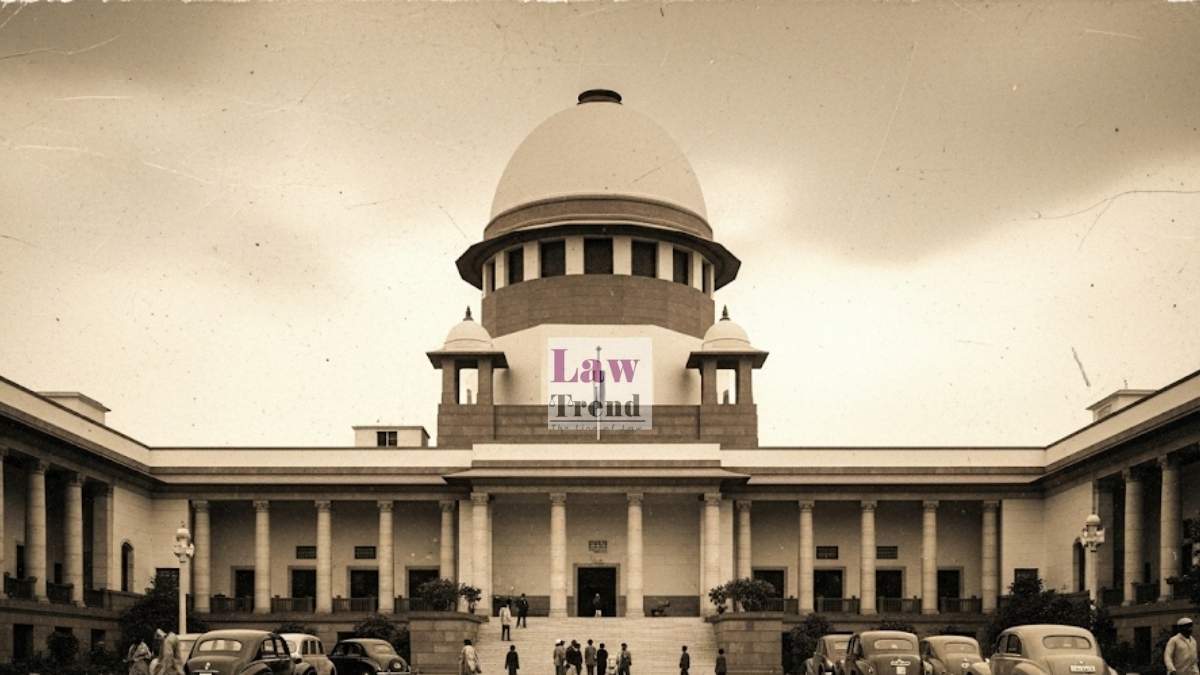
The Supreme Court of India, comprising a Bench of Justice Ujjal Bhuyan and Justice Vipul M. Pancholi, has ruled that upon the dissolution of a partnership at will, an outgoing partner is entitled to their proportionate share in the residue of the firm’s assets realized at market value or public auction, rather than having their entitlement restricted to the valuation prevailing on the date of dissolution. Resolving a decades-old dispute under Sections 46 and 48 read with Sections 7 and 43 of the Indian Partnership Act, 1932, the Court dismissed the appeal filed by the continuing partners and upheld the High Court’s direction to auction the firm’s prime land in Hyderabad to distribute the 25 percent share to the deceased partner’s legal representative.
Background of the Case
In 1964, a partnership firm named M/s Viraj Constructions was constituted to carry out construction works with the Railways. The partnership deed executed on December 31, 1964, established the firm as a partnership at will. On December 13, 1968, a new partner was admitted under a fresh deed, which allocated a 25 percent share in profits and losses to Kasireddy Lakshmi Narayana Reddy (father of the first respondent). Appellant No. 1, Vallappareddy Sumitra Reddy, held a 17 percent share. During the course of business, the firm acquired land admeasuring Ac. 3.27 Guntas in Survey Nos. 28/1, 28/2, and 28/3 situated at Begumpet, Hyderabad.
Following a proposal from other partners, Lakshmi Narayana Reddy issued a letter on March 3, 1970, expressing his intent to retire on a promise of a promissory note of Rs. 22,500. When payment was not made, he filed a recovery suit (O.S. No. 128 of 1975) before the Additional District Judge, Nellore. The partners contested the suit, maintaining that the firm had not been dissolved and that he continued to be a partner. The Nellore court dismissed the suit on May 4, 1979, holding that the firm continued to exist and he had not retired—a finding that attained finality after his appeal was dismissed as not pressed on November 2, 1983.
On October 15, 1983, Lakshmi Narayana Reddy issued a legal notice calling for the dissolution of the firm at will, rendition of accounts, and distribution of his share in the firm’s profits and properties. Receiving no response, he instituted O.S. No. 1601 of 1983 before the Additional Judge, City Civil Court, Hyderabad. The trial court passed a preliminary decree on November 6, 1995, declaring his 25 percent share. On appeal, the High Court modified this decree on March 28, 2001, confirming that the partnership stood dissolved on October 18, 1983, under Section 43 of the Partnership Act, and directing rendition of accounts up to that date with 12 percent interest per annum.
During final decree proceedings, an advocate Commissioner was appointed to take custody of the Begumpet property. The appellants repeatedly sought to restrict the plaintiff’s share strictly to the valuation of the assets as on October 18, 1983, and opposed the sale of the land. However, in a previous round of litigation, the High Court on January 30, 2009, set aside a review order that had recalled the Commissioner’s custody. The High Court had observed:
“The language of the above section is very clear that the outgoing partner is entitled to get his share of profits out of the assets also in addition to other sources available for them for distribution after discharging the liabilities of third parties. When once there is a preliminary decree in favour of the plaintiff for ascertaining the profits on verification of the accounts rendered by the other partners, value of the movable and immovable properties of the firm has to be ascertained and if the other partners who are running the subsequent partnership business are ready to pay the share of the plaintiff, there would not be any problem. Otherwise, the properties have to be brought to sale and the sale proceeds have to be distributed rateably as per their share in the partnership firm.”
When the appellants failed to pay the value, the plaintiff applied for the sale of the land. Although the trial court dismissed this application on April 28, 2010, the High Court reversed it on April 9, 2012, in CRP No. 1554 of 2011, directing the advocate Commissioner to sell the land through public auction if the parties did not reach a mutual settlement within two months, and to pay 25 percent of the sale proceeds to the legal representative of the deceased plaintiff. The appellants challenged this order before the Supreme Court.
Arguments of the Parties
Learned counsel for the appellants, Mr. Ananga Bhattacharyya, argued that in a partnership at will dissolved at the instance of a partner, the outgoing partner is entitled only to their share in the assets valued as on the date of dissolution, not on the date of subsequent assessment or realization. He contended that the preliminary decree fixed October 18, 1983, as the cut-off date for settling accounts, and the award of interest was intended to compensate for any delay. He argued that the High Court traversed beyond the preliminary decree, maintaining that a partner who dissolved the firm in 1983 and was uninvolved thereafter could not claim the benefit of subsequent asset appreciation. The appellants relied on the Supreme Court judgments in Addanki Narayanappa v. Bhaskara Krishtappa and Pamuru Vishnu Vinodh Reddy v. Chillakuru Chandrasekhara Reddy, as well as the Madras High Court decision in N. Muhammad Ussain Sahib v. S.N. Abdul Gaffoor Sahib.
Learned counsel for the first respondent (legal representative of the original plaintiff) countered that the appellants’ objections had already been adjudicated and attained finality. In earlier proceedings, the trial court had held on July 25, 2006, that the plaintiff’s rights existed until the final decree and were not frozen as on October 18, 1983—a finding that was upheld when the appellants’ revision petition and special leave petition were dismissed by the Supreme Court on January 5, 2007. The respondent submitted that the cut-off date applied only to operational profits and losses of the business, whereas under Sections 46 and 48 of the Partnership Act, the realization and distribution of asset values continue until the final decree.
Court’s Analysis
The Supreme Court examined the statutory scheme under Chapter VI of the Indian Partnership Act, 1932, particularly Sections 39, 40, 43, 44, 46, 47, and 48, alongside Section 7 governing partnerships at will. Referring to Karumuthu Thiagarajan Chettiar v. E.M. Muthappa Chettiar and M.O.H. Uduman v. M.O.H. Aslum, the Bench highlighted that the existence of a partnership at will depends entirely on the intention of the partners and can be dissolved by any partner issuing written notice.
The Court distinguished the precedents cited by the appellants:
- In N. Muhammad Ussain Sahib, the Madras High Court held that upon dissolution or retirement, settlement must not be notional but real, converting assets into money, and that market value on dissolution was applied in the context of a fixed-term partnership.
- In Addanki Narayanappa, a three-judge Bench of the Supreme Court held that a partner’s share in partnership property is to be treated as money, representing their proportion of the assets after realization and discharge of debts.
- In Pamuru Vishnu Vinodh Reddy, the valuation date was fixed as the date of retirement because the partner had retired after selling his share, and the reconstituted firm continued without him.
- In Guru Nanak Industries v. Amar Singh, a three-judge Bench clarified the distinction between retirement under Section 37 and dissolution under Section 48, affirming that dissolution mandates the settlement and distribution of accounts under Section 48.
Justice Bhuyan noted that none of the cited authorities dealt with the peculiar facts of the present case, where continuing partners retained firm property without legally purchasing it. The Court affirmed the High Court’s reasoning that a partner’s right on dissolution is two-fold: the right to settle operational accounts and profits up to the dissolution date (October 18, 1983), and the right to share in the residue of the assets upon liquidation under Section 48.
The Supreme Court held:
“The properties, i.e. the land in question belong to the erstwhile partnership M/s Viraj Constructions. The new partnership could have retained the said land in question only by purchasing it from the erstwhile partnership which had not been done. Therefore, retention of the land in question by the new partnership is illegal. That apart, if the same has to be sold today at the value which prevailed as on 18.10.1983, it will cause serious prejudice to the plaintiff and would be grossly unfair to him, besides being a wholly impractical proposition.”
The Court observed that all partners are entitled to their share of proceeds rateably. The Bench added that the defendants had the option to participate and purchase the land in the auction, after which the sale proceeds could be distributed.
Decision
Finding no error or infirmity in the High Court’s judgment dated April 9, 2012, the Supreme Court dismissed the civil appeal, vacated all interim stay orders, and directed the parties and the advocate Commissioner to comply with the High Court’s directions. The Court made no order as to costs.
Case Details:
Case Title: V. Sumitra Reddy & Anr. v. K. Ranganadha Reddy & Ors.
Case No.: Civil Appeal No. 8167 of 2017
Bench: Justice Ujjal Bhuyan and Justice Vipul M. Pancholi
Date: September 09, 2026




