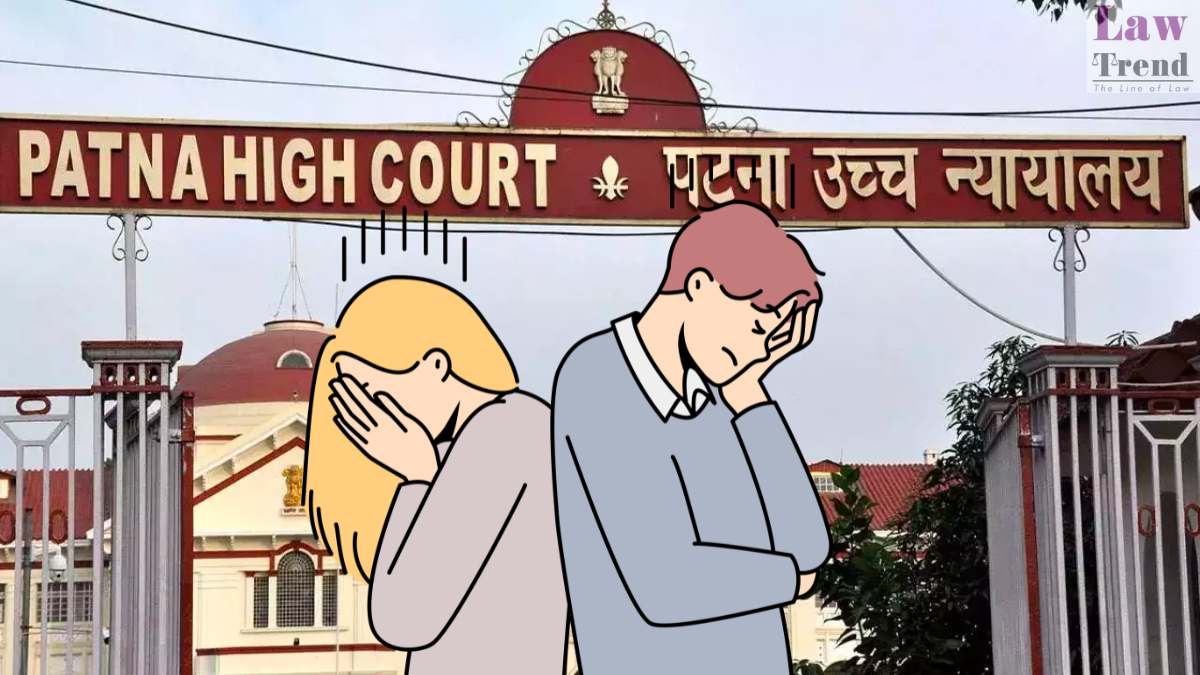
Holding that an allegation of finding a spouse in a “compromising position” cannot be equated with proving sexual intercourse, a Division Bench of Justice Bibek Chaudhuri and Justice Rana Vikram Singh at the Patna High Court dismissed a husband’s plea for divorce, ruling that matrimonial infidelity requires proof beyond reasonable doubt. The High Court affirmed the judgment and decree passed by the Principal Judge, Family Court, Madhubani, which had dismissed the husband’s petition seeking dissolution of marriage on grounds of adultery and cruelty under Section 13(1)(i) and Section 13(1)(ia) of the Hindu Marriage Act.
Background of the Case
The marriage between the appellant-husband and the respondent-wife was solemnized on July 2, 2006. Following the marriage, the couple lived together as husband and wife, and a male child was born of the wedlock in 2010.
The appellant contended that following the birth of their child, the respondent treated him with cruelty. He alleged that the wife maintained an illicit relationship with the husband of her elder sister (respondent no. 2), claiming that he once caught both of them in a “compromising situation” and raised an objection. The appellant further submitted that on March 30, 2013, the wife’s father, accompanied by other individuals, came to his residence and forcibly took her away with all her personal belongings in a Bolero car, after which she deserted him. On these grounds, under Section 13(1)(i) and Section 13(1)(ia), the appellant sought a decree of divorce.
Arguments and Trial Court Findings
The respondent-wife contested the suit by filing a written statement denying all allegations leveled against her. She stated that the allegation of having an illicit relationship with her brother-in-law was concocted and manufactured, contending that leveling such an accusation itself amounted to cruelty.
The respondent also stated that a local Panchayati was held to resolve the disputes between the parties and a settlement was reached, but the appellant failed to honor it. Additionally, she raised counter-allegations that the appellant had attempted to murder her by poisoning, pleading that the divorce case was entirely false.
The Principal Judge, Family Court, Madhubani, framed two points for determination: whether the wife treated the husband with cruelty after the solemnization of marriage, and whether the husband was entitled to a decree of divorce. Upon considering the evidence, the Family Court dismissed the suit on April 4, 2024. The husband then filed an appeal before the High Court. While advocates representing the appellant and the respondent-wife appeared before the High Court, respondent no. 2 remained unrepresented despite service of notice.
High Court’s Analysis and Key Observations
Upon examining the evidence on record and statutory requirements, the High Court noted that Section 13(1) postulation sets out a ground for divorce if, after the solemnization of marriage, either spouse has voluntary sexual intercourse with a person other than their spouse.
Addressing the appellant’s primary accusation, the bench held:
“There is gulf of difference between the term ‘compromising position’ and ‘having sexual intercourse’.”
The bench observed that the appellant’s subsequent actions failed to corroborate the assertion:
“Surprisingly enough, the appellant did not make any complaint against his wife after the alleged occurrence. Even no sanha was made in the local police station. No complaint was made to his matrimonial relations. The parents and other relations of the appellant did not come forward to assert in support of the allegation.”
Highlighting the evidentiary threshold required to establish adultery, the High Court referred to the decision of the Madhya Pradesh High Court in Hargovind Soni vs. Ramdulari (1985 SC Online MP 109), quoting paragraph 6 of the judgment:
“Adultery is generally proved by presumptive proof based upon (a) circumstantial evidence; (b) evidence of non-access and birth of children; (c) contracting veneral disease, and (d) confessions and admission. In fact, adultery is seldom susceptible of proof except by circumstances which would lead to that conclusion. The birth of a child to the wife, when there was no access to her by husband during possible period of conception shows, no doubt, the adultery by the wife. But, it must be satisfactorily established that birth of the child was clearly as a result of adulterous intercourse. There must be a clear proof of adultery. Standard of proof to establish a matrimonial offence like adultery is the satisfaction of Court beyond reasonable doubt. Adultery has also to be inferred from the circumstances which exclude any presumption of innocence in favour of a person against whom it is alleged. Proof of adultery must be of such character as would lead a reasonable man to conclude no other inference than the misconduct. Mere probability is not enough. No implicit reliance can be placed on the bald statement of the husband for recording a finding of adultery against wife.”
Analyzing this precedent, the High Court pointed out the distinct burden of proof governing allegations of adultery:
“Perusal of the above observation clearly suggests a shift regarding evidentiary probity of a civil suit and the allegation of adultery made in the suit for divorce. While a civil suit including other grounds of divorce can be proved on the basis of preponderance of probability, adultery is held to be proved beyond reasonable doubt.”
Applying these principles to the appeal, the bench held that the husband failed to prove the allegation of an illicit sexual relationship between his wife and her brother-in-law. Furthermore, evaluating the claim of cruelty, the court noted that the entire allegation revolved around the unproven illicit relationship and mutual counter-allegations. The bench observed:
“On perusal of the pleadings of the parties, we find that the allegations of cruelty is absolutely vague, omnibus and cannot be considered by this Court for the reasons stated above.”
Decision
Finding no illegality in the judgment and decree passed by the trial court, the High Court dismissed the appeal and affirmed the order of the Principal Judge, Family Court, Madhubani.
Case Details
Case No.: Miscellaneous Appeal No. 445 of 2024
Bench: Justice Bibek Chaudhuri and Justice Rana Vikram Singh
Date: September 3, 2026