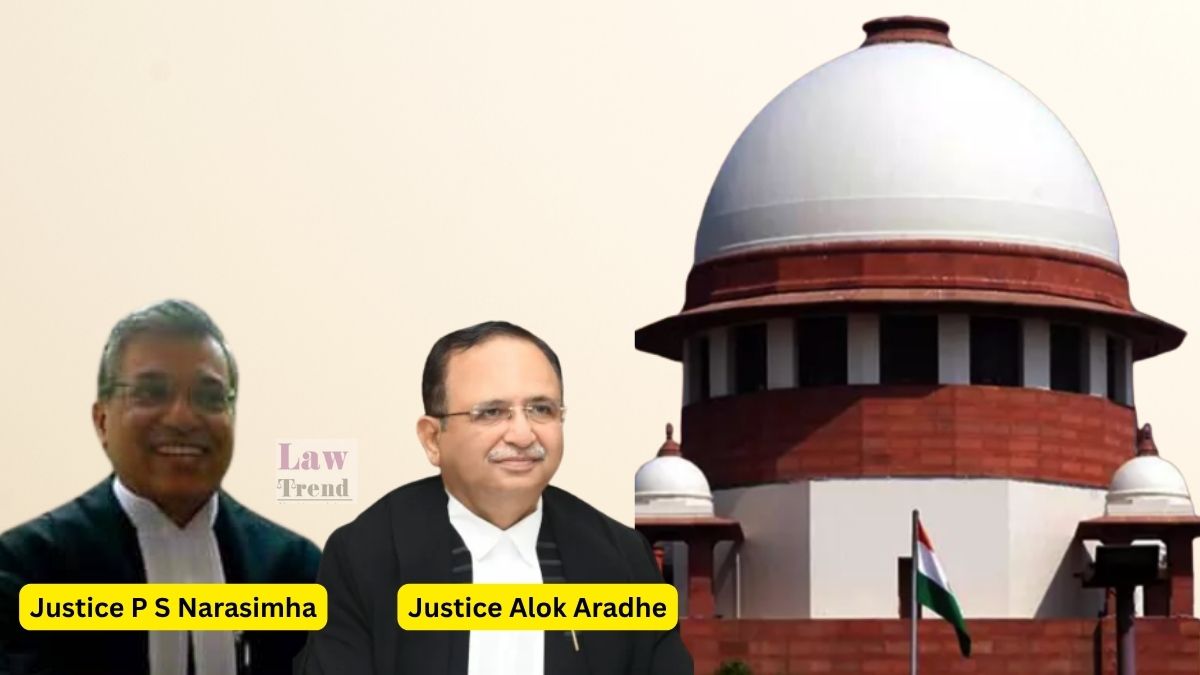
The Supreme Court of India has held that whether a particular claim falls within or outside an “excepted matters” clause of a works contract is a matter squarely within the competence of the Arbitral Tribunal under Section 16 of the Arbitration and Conciliation Act, 1996, and cannot be circumscribed by a High Court exercising writ jurisdiction under Article 226 of the Constitution. A Bench comprising Justice Pamidighantam Sri Narasimha and Justice Alok Aradhe, in a judgment authored by Justice Alok Aradhe, clarified that an observation made by a Division Bench of the High Court directing an arbitrator to decide claims “strictly in accordance with the terms of the contract” shall not be construed to impinge upon the Arbitral Tribunal’s statutory jurisdiction to adjudicate the dispute relating to contract termination.
Factual Background
The dispute arose out of a tender invited on February 21, 2017, by South Central Railway (Respondent No. 2) for the doubling of track between the Guntur-Guntakal Section, covering earthwork, bridge construction, and other miscellaneous works. The bid submitted by the appellant, M/s. GVV Constructions Private Limited, was accepted, and a formal Contract Agreement was executed on November 30, 2017, stipulating an initial completion date of October 23, 2018.
On June 10, 2022, the Railways terminated the contract under Clause 62 of the Indian Railways Standard General Conditions of Contract (GCC). The performance guarantee and security deposit furnished by the company were forfeited, and the appellant was declared disentitled to any compensation for loss.
Aggrieved by the termination, the appellant approached the High Court for the State of Telangana at Hyderabad through a writ petition under Article 226 of the Constitution, alleging non-compliance with the procedure prescribed under the GCC. A Single Judge dismissed the petition on October 18, 2022, holding that complicated questions of fact could not be adjudicated under writ jurisdiction and noting that the contractor could raise all defences before the Arbitral Tribunal. However, the Single Judge also recorded a finding that there was no irregularity in the termination order.
In an appeal filed by the company, the Division Bench of the High Court on December 16, 2025, set aside the Single Judge’s finding regarding the validity of the termination, noting that upholding the termination left no scope for the Arbitral Tribunal to decide the dispute. While granting liberty to the appellant to raise all claims before the tribunal, the Division Bench added a direction that the Arbitral Tribunal was at liberty to decide the claims strictly in accordance with the terms of the contract agreed upon between the parties. Subsequently, a former Supreme Court judge was appointed as the Sole Arbitrator, and arbitration proceedings commenced on January 20, 2026, wherein twelve issues were framed, including the validity of the termination order and whether certain claims fell under “excepted matters.” The appellant then appealed before the Supreme Court against the High Court’s limiting direction.
Submissions of the Parties
Appearing for the appellant, Senior Counsel Gaurav Agarwal submitted that the delays in completion were not attributable to the company and that the contract had been terminated illegally. He pointed out that the Railways had initially opposed the writ petition by asserting that arbitration was an effective alternative remedy, and could not now argue that the termination dispute was beyond the arbitrator’s purview. He argued that the termination issue was intrinsically linked to all other arbitral claims, and contended that the Division Bench’s restrictive direction ran contrary to the Supreme Court’s ruling in ABS Marine Services v. Andaman and Nicobar Administration.
Opposing the appeal, Additional Solicitor General Vikramjit Banerjee contended on behalf of the Union of India that submitting the validity of contract termination to arbitration directly violated Clause 63 of the GCC, which expressly excluded Clause 62 matters as non-arbitrable “excepted matters.” He submitted that such exclusion did not leave the contractor remediless, as the civil court remained the appropriate forum for excepted matters. The ASG argued that the Arbitral Tribunal lacked jurisdiction over excepted matters under the GCC, distinguishing ABS Marine Services and placing reliance on the Supreme Court’s decisions in General Manager, Northern Railway v. Sarvesh Chopra and Harsha Constructions v. Union of India.
The Legal Issue and Statutory Framework
The Supreme Court framed the solitary issue as whether the Division Bench’s observation that the arbitrator was at liberty to decide claims strictly in accordance with the agreed contractual terms travelled beyond the scope of judicial review under Article 226 and impinged upon the Arbitral Tribunal’s jurisdiction under Section 16 of the Arbitration and Conciliation Act, 1996.
Examining Clauses 63 and 64 of the GCC, the Bench observed that while Clause 63 excludes excepted matters from the purview of the arbitration clause, it does not exclude the jurisdiction of a court of law to examine the validity of such departmental decisions.
Addressing the statutory scheme, the Court noted that the 1996 Act is modelled on the UNCITRAL Model Law (Chloro Controls India Pvt. Ltd. v. Severn Trent Water Purification Inc.). The Court highlighted that Section 5 limits judicial intervention to instances expressly provided in the statute, while Section 16(1) codifies the foundational doctrine of kompetenz-kompetenz, empowering the Arbitral Tribunal to rule on its own jurisdiction, including objections regarding the existence or validity of the arbitration agreement.
Judicial Evolution of Referral Scrutiny
The Bench traced the permissible extent of judicial scrutiny prior to or at the referral stage through four distinct phases:
- Purely administrative scrutiny under Konkan Railway Corpn. Ltd. v. Mehul Construction Co. and Konkan Railway Corpn. Ltd. v. Rani Construction (P) Ltd., leaving all contested jurisdictional questions to the tribunal under Section 16.
- The judicial determination standard established by a seven-judge Bench in SBP & Co. v. Patel Engineering Ltd., later classified in National Insurance Co. Ltd. v. Boghara Polyfab (P) Ltd., which designated Category III issues (such as whether a matter is reserved for departmental decision and excepted from arbitration) as issues to be decided solely by the Arbitral Tribunal.
- The legislative introduction of Section 11(6A) via the 2015 Amendment, which confined referral court scrutiny strictly to the existence of an arbitration agreement, as affirmed in Duro Felguera, S.A. v. Gangavaram Port Ltd. and Mayavati Trading (P) Ltd. v. Pradyuat Deb Burman.
- The harmonised standard in Vidya Drolia v. Durga Trading Corporation, laying down the “eye of the needle” test where courts decline reference only when the agreement is ex facie non-existent, invalid, or non-arbitrable (“when in doubt, do refer”). The Bench noted subsequent applications of this rule in Uttarakhand Purv Sainik Kalyan Nigam Ltd. v. Northern Coal Field Ltd. (limitation as an issue for the tribunal under Section 16), the seven-judge Bench decision in In Re: Interplay Between Arbitration Agreements and the Indian Stamp Act, 1899 (overruling N.N. Global Mercantile (P) Ltd. v. Indo Unique Flame Ltd.), SBI General Insurance Company Ltd. v. Krish Spinning, and Office for Alternative Architecture v. Ircon Infrastructure and Services Ltd.
Findings of the Court
Applying these principles, the Supreme Court delivered key observations regarding the boundary between writ review and arbitral jurisdiction:
“What emerges from the foregoing survey is that, under the Act, the question whether a particular claim is covered by, or falls outside, an ‘excepted matters’ clause of a works contract is a matter squarely within the competence of the Arbitral Tribunal under Section 16, and not a question for a court exercising even the wider, appointment-stage jurisdiction under Section 11, much less for a court exercising the discretionary jurisdiction of judicial review under Article 226 of the Constitution, whose very engagement with the merits of the dispute, in the present case, was declined on the ground that it involved complicated questions of fact.”
The Court held that the Division Bench of the High Court, whose role in an intra-court appeal was confined to reviewing the Single Judge’s dismissal, had no jurisdiction to fetter the Arbitral Tribunal:
“The direction that the Arbitrator ‘is at liberty to decide the claim of the appellant strictly in accordance with the terms of the contract agreed upon between the parties’, whatever the intention behind it, has the inevitable effect of circumscribing the width of the Arbitrator’s enquiry, including his authority under Section 16 to rule upon the scope of his own jurisdiction over the dispute relating to termination.”
“Whether the dispute regarding termination is, in whole or in part, an ‘excepted matter’ outside the Arbitrator’s jurisdiction, and, if so, what remedy survives to the appellant in that behalf, are questions that Section 16 of the Act commits to the Arbitrator in the first instance. It was not open to the Division Bench, in the exercise of its writ appellate jurisdiction, to prescribe in advance the manner of, or to place constraints upon, that adjudication.”
The Court also observed that the Division Bench ought not to have made such an observation because the arbitrability of the termination was not an issue placed before it.
Addressing precedents cited by the parties, the Bench distinguished ABS Marine Services, explaining that the clause in that case completely ousted court jurisdiction, unlike Clause 63 of the GCC. Similarly, the respondents’ reliance on General Manager, Northern Railway was held misplaced as that judgment dealt with Section 20 of the repealed Arbitration Act, 1940, from which the 1996 Act departs decisively.
Decision
Disposing of the appeal, the Supreme Court clarified that the observation of the Division Bench shall not be construed as impinging upon the jurisdiction of the Arbitral Tribunal to adjudicate the termination dispute, while expressly declining to express any opinion on the merits of the case. No order was made as to costs.
Case Title: M/s. GVV Constructions Private Limited Versus The Union of India & Ors.
Case No.: Civil Appeal No. ___ of 2026 (@ Special Leave Petition (Civil) No. 7338 of 2026)
Bench: Justice Pamidighantam Sri Narasimha and Justice Alok Aradhe
Date: September 08, 2026