

Zero Period Benefit Cannot Be Denied Merely Because Developer Had Partial Access: Supreme Court Upholds Relief Against NOIDA
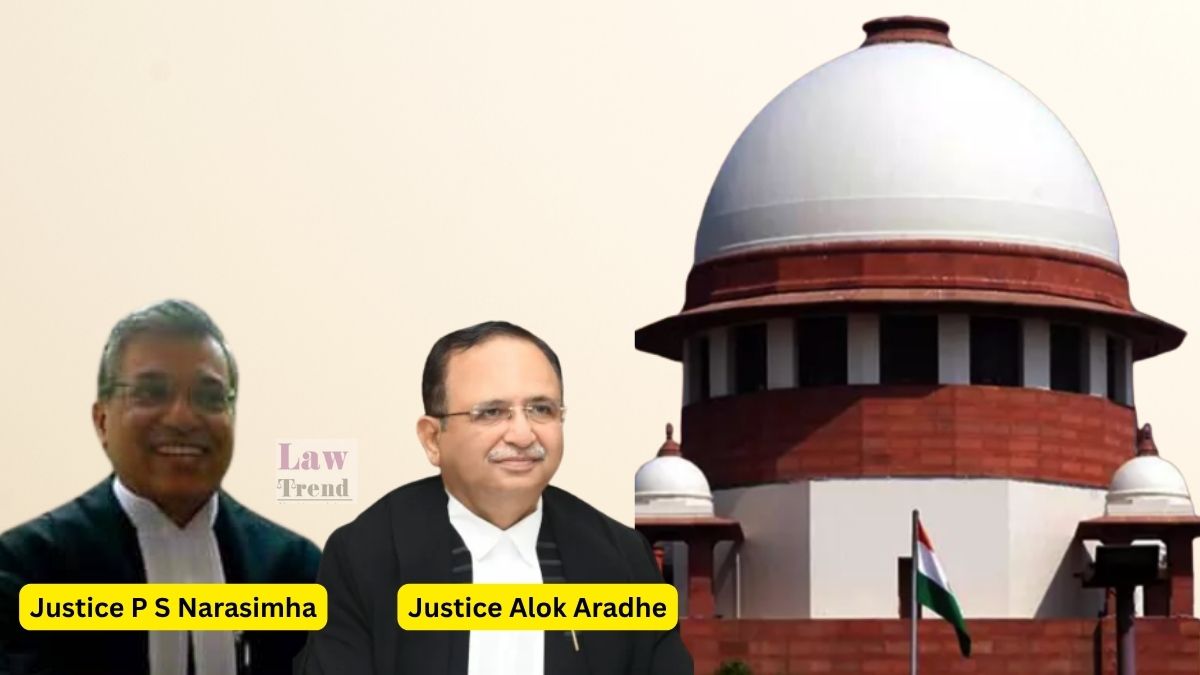
The Supreme Court of India has held that the benefit of the ‘Zero Period Policy’ cannot be denied to a developer merely on the ground that some physical access was available to an allotted plot, especially when the statutory authority failed to provide the designated, adequate access road contemplated in the sanctioned plan. A Division Bench comprising Justice Pamidighantam Sri Narasimha and Justice Alok Aradhe dismissed the appeals filed by the New Okhla Industrial Development Authority (NOIDA) and affirmed the judgment of the Allahabad High Court, which directed NOIDA to extend zero period benefits, recalculate dues without penal interest, and sanction the developer’s revised building plan.

Background of the Case

On September 22, 2011, NOIDA launched a scheme for the allotment of commercial plots for infrastructural development. M/s Sunshine Trade Tower Pvt. Ltd. emerged as the successful bidder, and a lease deed was executed on January 11, 2012, for Plot No. 5-A, Sector 94, Noida, for a total sale consideration of Rs 1,33,86,63,730. Under the approved site plan dated March 6, 2012, the plot was flanked by a 45-metre-wide Front Road on the east and a 24-metre-wide Side Road on the north. The developer was required to construct a commercial complex comprising shopping malls, showrooms, retail outlets, hotels, and offices.

Construction came to an abrupt halt on September 17, 2013, following an interim stay by the National Green Tribunal (NGT) halting work within 10 kilometres of the Okhla Bird Sanctuary (Amit Kumar v. Union of India & Ors.). This restriction was lifted on August 19, 2015, through a Central Government notification revising the eco-sensitive buffer zone.

To resolve systemic disruptions confronting stalled real estate projects, NOIDA formulated a ‘Zero Period Policy’ on March 28, 2016. Clause 5 of the policy provided relief:

“If possession of any land has been given and execution of lease deed has also been done, but there is no access road to the allotted land due to which construction/development on the allotted land is not possible.”

The developer sought zero period benefits citing both the NGT restraint and the complete unavailability of access roads. While NOIDA granted partial relief for the NGT order period, it rejected the developer’s claim regarding lack of road access.

Subsequent official inquiries—including a Tehsildar report dated February 14, 2019, an order of the Uttar Pradesh Real Estate Regulatory Authority (UPRERA) dated October 22, 2020, and a report by the Deputy Collector dated February 20, 2023—unambiguously confirmed that the land earmarked for the 45-metre Front Road fell under Khasra No. 684 of Village Chhalera Bangar. It was recorded as inhabited ‘Abadi’ land, was completely encroached upon by villagers, had never been acquired by NOIDA, and could not be acquired without the consent of the landholders. Furthermore, the 24-metre Side Road was only completed and opened by NOIDA on February 18, 2020.

READ ALSO  Evidence Presented by the Prosecution is Riddled with Inconsistencies and Doubts: Supreme Court Acquits Murder Accused

Despite revisional orders under Section 41(3) of the Uttar Pradesh Urban Planning and Development Act, 1973, read with Section 12 of the Uttar Pradesh Industrial Area Development Act, 1976, granting partial relief and quashing an interim cancellation of the lease, NOIDA issued a fresh demand notice of Rs 100.39 crores and refused to sanction the developer’s revised building plan that reoriented the frontage to the 24-metre road. The Allahabad High Court allowed the developer’s writ petitions, prompting NOIDA to approach the Supreme Court.

Arguments of the Parties

Appearing for NOIDA, Senior Advocate Atmaram N.S. Nadkarni argued that Clause 5 of the Zero Period Policy must be strictly and literally construed. He contended that relief is permissible only when there is absolute physical impossibility of access, rather than the absence of a preferred or secondary road. NOIDA maintained that the developer had continuous access, had excavated the basement, and raised pleas regarding road access as an afterthought to conceal financial difficulties and defaults in lease rental instalments.

Representing the developer, Senior Advocates Mukul Rohatgi and Maninder Singh submitted that the project was planned, marketed, and approved with the 45-metre Front Road as its principal commercial frontage. They argued that the non-acquisition and encroachment of the 45-metre road fundamentally impaired the commercial viability, setbacks, orientation, and layout of the project, rendering lawful construction under the originally sanctioned plan impossible. They asserted that preliminary excavation work could not be equated with the feasibility of completing the sanctioned project.

The Supreme Court’s Analysis

The Supreme Court examined the underlying objective of the Uttar Pradesh Industrial Area Development Act, 1976, and the rationale behind developmental schemes. The Bench observed that private enterprise participation in large-scale infrastructure requires regulatory certainty and a conducive environment.

READ ALSO  भारत मे अमीर और गरीब लोगों के लिए अलग अलग कानूनी प्रणालियां नही हो सकती: सुप्रीम कोर्ट

Addressing the interpretation of Clause 5 of the Zero Period Policy, the Court rejected NOIDA’s strict, literal approach:

“Having considered the matter in detail, we are of the opinion that the provisions of a policy, such as the Zero Period Policy, are not to be interpreted like the provisions of a statute. When interpreting the provisions of a policy, it is necessary for courts to consider both a micro and a macro perspective of the matter. A court must consider the purpose and object of the clause being interpreted and, at the same time, ensure that any interpretation reached sub-serves the broader goals and purposes of the policy as a whole. In this perspective, we are of the opinion that Clause 5 of the Zero Period Policy is intended to ensure that a developer has easy, effective, and legitimate access to the allotted plot and is able to proceed with construction. This Clause is not to be interpreted so as to disapply the benefit of the Zero Period Policy in a situation where a developer struggles to gain access to the allotted plot and barely manages to keep construction ongoing.”

The Bench categorically held that NOIDA cannot take advantage of partial or makeshift access:

“Therefore, the argument that the Developer could have some access cannot be a ground to exempt NOIDA from its obligation to provide easy, efficient, and legitimate access to the Subject Plot. If adequate access was not provided for reasons attributable to NOIDA, then the benefit of the Zero Period Policy cannot be denied, least of all on the ground that some access was available.”

Emphasizing the vital importance of frontage in commercial developments, the Court observed:

“In real estate, elevation and frontage are not merely matters of architectural aesthetics; they are important determinants of commercial value and marketability. A building’s elevation creates its first impression while its frontage determines how prominently it presents itself to the street, customers, and the surrounding urban environment… Clear, predictable, and commercially viable parameters provide the foundations of sound investment, effective development, and sustained real estate value generation.”

The Court found that five concurrent official reports established beyond doubt that the 45-metre road was unacquired, inhabited, and unavailable. Because the frontage had to be shifted to the 24-metre road, the entire orientation, setbacks, and planning parameters required modification. Under these circumstances, the Court ruled that NOIDA’s refusal to sanction the revised building plan was wholly unreasonable and untenable in law.

Decision of the Court

The Supreme Court dismissed NOIDA’s civil appeals and upheld the Allahabad High Court’s directions requiring NOIDA to calculate dues extending the zero period benefit, grant waiver of penal interest, and approve the revised building plan.

READ ALSO  SC sets up fresh 5-judge Constitution bench to hear 4 cases

The Court also recorded the undertaking given on behalf of the developer that the project will be completed within four years from the date of approval of the revised site plan and that the outstanding dues will be cleared in eight instalments.

Case Details

Case Title: New Okhla Industrial Development Authority and Ors. v. M/s Sunshine Trade Tower Private Limited and Anr.

Case No.: Civil Appeal Nos. 10900–10902 of 2025

Bench: Justice Pamidighantam Sri Narasimha and Justice Alok Aradhe

Date: September 8, 2026

Law Trend
Law Trendhttps://lawtrend.in/
Legal News Website Providing Latest Judgments of Supreme Court and High Court

Related Articles

Latest Articles
