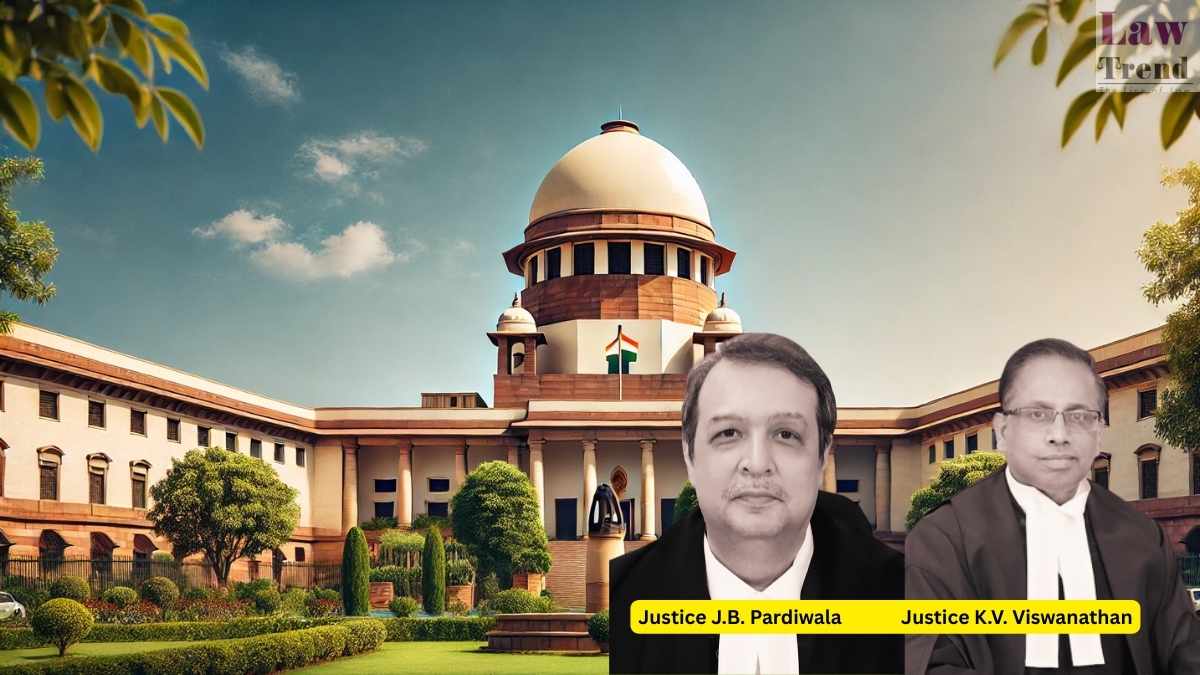
The Supreme Court of India has upheld the constitutional validity of regulatory rules that include royalty, District Mineral Foundation (DMF), and National Mineral Exploration Trust (NMET) payments in the “sale value” of minerals for computing the Average Sale Price (ASP). Dismissing a writ petition filed by mining leaseholders, a bench comprising Justice J.B. Pardiwala and Justice K.V. Viswanathan ruled that these provisions are not violative of Articles 14 and 19(1)(g) of the Constitution, nor are they ultra vires Section 9 of the Mines and Minerals (Development and Regulation) Act, 1957 (MMDR Act).
Background of the Dispute
The petitioners, Kirloskar Ferrous Industries Ltd. and another, approached the Supreme Court challenging the Explanation appended to Rule 38 of the Minerals (Other than Atomic and Hydro Carbons Energy Minerals) Concession Rules, 2016 (the 2016 Rules) and the identical Explanation to Rule 45(8)(a) of the Mineral Conservation and Development Rules, 2017 (the 2017 Rules). These Explanations mandate that for the purpose of computing “sale value,” no deduction shall be made in respect of payments towards royalty, DMF, and NMET.
The dispute had an earlier round of litigation before the Supreme Court in Writ Petition (C) No. 715 of 2024. During those proceedings, it was highlighted that the Ministry of Mines had constituted a committee (the Praveen Kumar Committee), which concluded that since the sale value already includes royalty, DMF, and NMET, the lessee effectively pays “royalty on royalty,” creating an additional cascading charge.
Although public consultations were initiated to amend the MMDR Act to remove this cascading impact—similar to how the actual price of coal was modified in 2020 to exclude these statutory dues—the Union of India ultimately filed an affidavit on May 17, 2025, stating its final policy decision not to amend the rules. The Union pointed out that such an amendment would severely impact state revenues. Consequently, the Supreme Court granted the petitioners liberty to raise a fresh challenge against this decision.
Arguments of the Parties
The petitioners argued that under Section 9(2) of the MMDR Act, read with Entry 24 of the Second Schedule, the rate of royalty for iron ore is fixed at fifteen percent of the ASP on an ad valorem (according to value) basis. They contended that by using subordinate legislation to append Explanations that prohibit the deduction of royalty, DMF, and NMET, the government artificially loaded these levies onto the base price. This, they claimed, deviated from the true concept of ad valorem, created a cascading “compounding” effect, and effectively increased the rate of royalty. They also argued that this month-to-month change breached the three-year restriction on royalty rate revisions under the proviso to Section 9(3) of the MMDR Act. Furthermore, they pointed out that the cascading impact on coal had been remedied by the Central Government, making the different treatment of other minerals discriminatory under Article 14.
Opposing the petition, the Union of India contended that the rates of royalty and the methods of computation differ from mineral to mineral and are well within the scope of “regulation of mines and mineral development.” On the comparison with coal, the Union explained that coal has a public sector monopoly (Coal India Limited and Singareni Collieries Company Limited) and relies on the National Coal Index (NCI) to prevent under-invoicing. Conversely, iron ore is mined by numerous private entities, making the ASP mechanism necessary to combat under-invoicing and price manipulation.
To support its claim, the Union presented charts, graphs, and data from Odisha and Karnataka showing that some miners manipulated declared prices. Specifically, miners reported high ex-mine prices but showed minimal or zero despatches, while reporting low ex-mine prices with high despatches, thereby artificially depressing the monthly ASP to minimize their premium and royalty liabilities. The Union also highlighted that striking down these Explanations would cause an estimated revenue loss of approximately Rs. 6,200 crore per year (exceeding Rs. 3 lakh crore over a 50-year lease period) to State Governments for iron ore alone.
The Court’s Analysis
In its analysis, the Supreme Court emphasized the presumption of constitutionality that applies to both plenary and subordinate legislation, citing the precedent in State of Tamil Nadu and Another v. P. Krishnamurthy and Others (2006). The Court also noted that legislative entries under the Seventh Schedule must be liberally construed to cover all subsidiary and ancillary matters, and that the fixation of royalty rates under Section 9 of the MMDR Act is an integral part of regulating mines, as affirmed in Mineral Area Development Authority & Anr. v. M/s Steel Authority of India and Another (2024).
Addressing the nature of royalty, the Court referred to the Mineral Area Development Authority decision, stating: “Royalty is not a tax. Royalty is a contractual consideration paid by the mining lessee to the lessor for enjoyment of Mineral rights. The liability to pay royalty arises out of the contractual conditions of the mining lease. The payments made to the government cannot be deemed to be a tax merely because the statute provides for their recovery as arrears.”
The Court explained the well-settled distinction between the subject matter of a levy and the standard by which it is measured, reiterating that the measure of a levy is a matter of legislative policy. Drawing support from Ralla Ram v. Province of East Punjab (1948) and Union of India & Ors. v. Bombay Tyre International Ltd. and Others (1984), the Court noted that any standard maintaining a reasonable nexus with the essential character of the levy is valid.
Crucially, the bench held that the legislature and the subordinate rule-making authority have the power to devise measures to prevent tax evasion and price manipulation. Citing decisions such as Sardar Baldev Singh v. CIT (1960), Balaji v. ITO (1961), Navnit Lal C. Javeri v. K.K. Sen (1965), and Union of India and Another v. A. Sanyasi Rao and Others (1996), the Court observed that machinery provisions designed as an antidote to check evasion are constitutional. Quoting from A. Sanyasi Rao, the Court noted: “since it came to light that the income from certain trades could not be properly brought to tax, the legislature enacted the instant machinery provisions. The provisions are reasonable and have sufficient nexus to the objects that are sought to be achieved.”
Applying these principles to the facts, the Court found the Union’s regulatory intervention to be fully justified, stating: “We find nothing manifestly arbitrary in the process adopted. There is nothing capricious or irrational about the measure and it cannot be said that it has been adopted without any determining principle nor do we find the measure excessive or disproportionate for it to be characterized as manifestly arbitrary.”
The Court rejected the petitioners’ arguments on Article 14, stating that comparing coal with iron ore is fundamentally flawed due to their different market structures: “The comparison with coal is completely unjustified as there is no concept of ASP in coal and that too based on data given by the miners. Hence, comparing coal and iron ore, in this context, is akin to comparing apples and oranges which we are not prepared to do.”
Regarding the impact on individual leaseholders who do not engage in price manipulation, the Court emphasized that public interest outweighs individual hardship: “when a measure of levy is prescribed to check evasion, individual hardships cannot be determinative. Afterall, the grundnorm is “Salus populi suprema lex” regard for the public welfare is the highest law. Private rights will have to cede to public interest.”
The Court also dismissed the argument that the rule violated the three-year cap on royalty rate revisions under the proviso to Section 9(3) of the MMDR Act, noting that there is no revision of the “rate of royalty” itself, but only a fluctuation in the monthly market-driven ASP. Additionally, the Court clarified that the committee reports of Shri Praveen Kumar and Dr. Aruna Sharma are merely recommendatory and do not bind the government or the Court.
The Decision
Concluding its judgment, the Supreme Court held that the Explanations to Rule 38 of the 2016 Rules and Rule 45(8)(a) of the 2017 Rules are constitutional, valid, and not ultra vires Section 9 of the MMDR Act. The writ petition was accordingly dismissed with no order as to costs.
Case Details
Case Title: Kirloskar Ferrous Industries Ltd. and Anr. v. Union of India & Anr.
Case No.: Writ Petition (C) No. 733 of 2025
Bench: Justice J.B. Pardiwala, Justice K. V. Viswanathan
Date: July 13, 2026