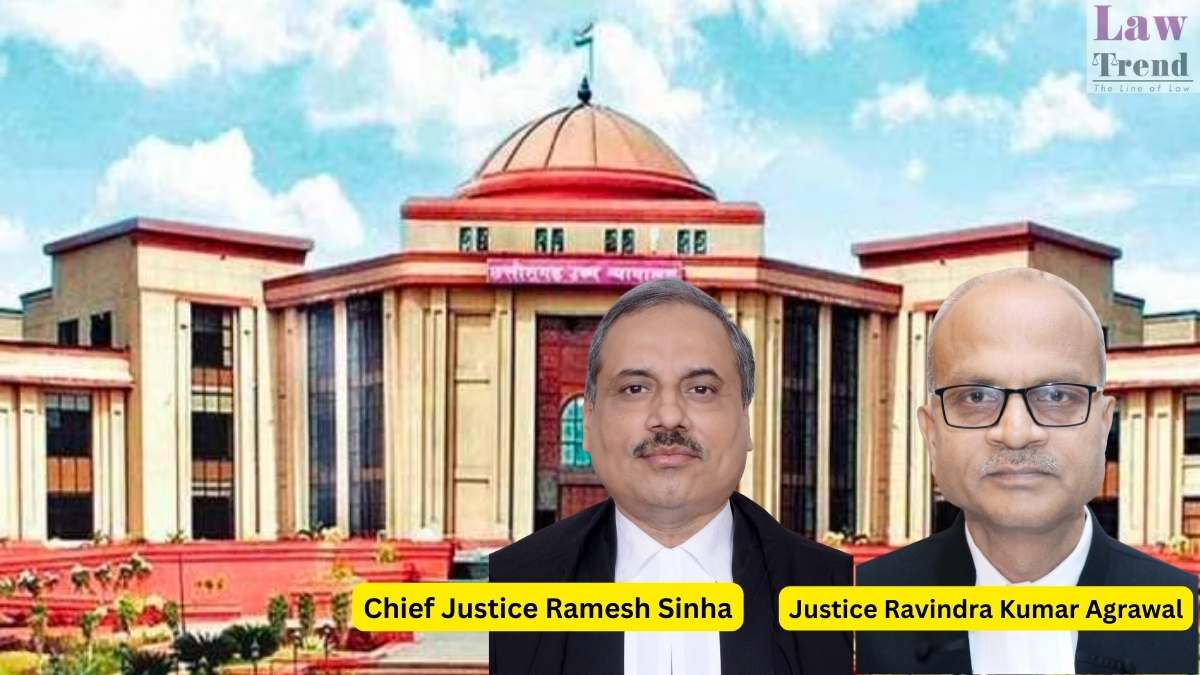
The High Court of Chhattisgarh has ruled that the testimony of police officials is to be tested on the same parameters as any other witness and cannot be discarded merely due to their official status, particularly in Naxalite-affected areas where securing independent public witnesses is often impracticable. In doing so, the division bench of Chief Justice Ramesh Sinha and Justice Ravindra Kumar Agrawal dismissed a criminal appeal and affirmed the conviction of a man sentenced to 10 years of rigorous imprisonment under the Explosive Substances Act, 1908.
Case Background
According to the prosecution, on April 14, 2023, the Bhairamgarh police received secret information that members of a banned Maoist organization were gathering at village Fullod to explode explosive substances and cause harm to the police party. Information was also received that explosives had been delivered to their new camp at Hiroli Pusnar to carry out large-scale harm. On the oral instruction of the Superintendent of Police, Bijapur, a police party led by Taresh Sahu, the then Sub-Divisional Officer of Police (SDOP), Bhairamgarh, along with independent witnesses, proceeded towards village Fullod.
Upon seeing the police party, the suspects began to flee. While four individuals managed to escape, the police apprehended the appellant, Meenu Kalmu alias Kalmumi Manoj alias Denga, who disclosed his association with the Bhairamgarh Area Committee of the banned organization. A search of the appellant led to the recovery of one electric detonator from his pant pocket, for which he had no valid licence or authority.
While in custody, the appellant made a voluntary disclosure statement, admitting that he had thrown a knife and a bag of explosive substances in the field while trying to flee. Based on this statement, the police recovered a bag containing 10 gelatin sticks, six electric detonators, approximately five meters of red codex wire, green safety fuse wire, and a knife.
Following the investigation and obtaining the statutory prosecution sanction from the District Magistrate, the charge sheet was filed. The trial court—the Special Judge for NIA Act/Scheduled Offences, South Bastar, Dantewada—acquitted the appellant of charges under the Indian Penal Code (IPC) and the Unlawful Activities (Prevention) Act (UAPA), but convicted him under Sections 4 and 5 of the Explosive Substances Act, 1908. He was sentenced to 10 years of rigorous imprisonment under Section 4 and 5 years of rigorous imprisonment under Section 5, alongside fines.
Arguments of the Parties
The advocate representing the appellant, Mr. B.P. Rao, argued that the prosecution had failed to prove its case beyond reasonable doubt, pointing out material omissions and contradictions in the testimonies. He highlighted that the sole independent witness, Kamlesh Korsa (PW-1), turned hostile and failed to support the prosecution’s case. He contended that the conviction was based entirely on the testimonies of interested police witnesses. Additionally, he argued that the explosive materials were recovered from an open field and were falsely planted to implicate the appellant.
Opposing the appeal, the Government Advocate representing the State of Chhattisgarh, Mr. Shaleen Singh Baghel, argued that the prosecution’s case was proven beyond reasonable doubt. He emphasized that the appellant was apprehended in a highly sensitive area densely affected by Naxalite activities. The State asserted that the recovery of the electric detonator was fully established, and minor procedural discrepancies or the hostility of an independent witness did not undermine the reliable and consistent testimonies of the official witnesses.
The Court’s Analysis
The High Court meticulously examined the oral and documentary evidence on record. It observed that the testimony of the search officer, SDOP Taresh Sahu (PW-2), was natural, cogent, and remained unshaken despite a lengthy cross-examination. His version was corroborated by other official witnesses, including Head Constable Devendra Chandravanshi (PW-4), Station House Officer Dharmaram Tirkey (PW-7), and Head Constable Gokul Ram Sahu (PW-8).
Furthermore, Sub-Inspector Mahendra Pathak (PW-6) of the Bomb Disposal Squad proved that the seized explosives were disposed of safely via a controlled explosion at the Reserve Centre firing range, and remnants were preserved for forensic examination, ensuring the integrity of the chain of custody. Deputy Superintendent of Police Jitendra Kumar Chandravanshi (PW-11) proved that all statutory sanctions required for prosecution were properly complied with.
Addressing the defence’s primary argument regarding the hostility of the independent witness and the reliance on police witnesses, the High Court held that police testimonies are not inherently unreliable. Referring to the Supreme Court’s ruling in Nathusingh v. State of M.P., the court observed:
“the mere fact that they are police officers was not enough to discard their evidence. No reason was shown for their hostility to the appellant.”
The court further cited Anil v. State of Maharashtra, quoting:
“There is, however, no rule of law that the evidence of police officials has to be discarded or that it suffers from some inherent infirmity. Prudence, however, requires that the evidence of the police officials, who are interested in the outcome of the result of the case, needs to be carefully scrutinised and independently appreciated. The police officials do not suffer from any disability to give evidence and the mere fact that they are police officials does not by itself give rise to any doubt about their creditworthiness.”
The bench also cited the Supreme Court’s ruling in State (Govt. of NCT of Delhi) v. Sunil, noting that there is no legal presumption that police officers are untrustworthy witnesses, and their evidence cannot be approached with initial distrust.
Addressing the lack of independent witnesses in a Naxalite-affected area, the High Court highlighted that such areas present unique operational challenges. It cited the Supreme Court’s decision in Ajmer Singh v. State of Haryana, noting:
“…..it is normally expected that there should be independent evidence to support the case of the prosecution. However, it is not an inviolable rule. Therefore, in the peculiar circumstances of this case, we are satisfied that it would be travesty of justice, if the appellant is acquitted merely because no independent witness has been produced.”
The court further quoted from Ajmer Singh:
“We cannot forget that it may not be possible to find independent witness at all places, at all times. The obligation to take public witnesses is not absolute. If after making efforts which the court considered in the circumstances of the case reasonable, the police officer is not able to get public witnesses to associate with the raid or arrest of the culprit, the arrest and the recovery made would not be necessarily vitiated.”
The bench concluded that the discrepancies pointed out by the defence—such as vehicle registration numbers, the size of the detonator, or the color of the appellant’s clothes—were insignificant procedural details that naturally occur due to the lapse of time and do not affect the core prosecution story. In its Head Note, the court summarized this legal position:
“In cases arising from a Naxalite-affected area, where availability of independent witnesses may not always be practicable, the testimony of police officials cannot be rejected merely because they are official witnesses and may be relied upon if it is found trustworthy, reliable and credible.”
The Decision
The High Court held that the prosecution established a complete chain of incriminating circumstances proving the appellant’s conscious possession of the electric detonator and other explosives. It affirmed that the acquittal of the appellant from the offences under the UAPA and IPC does not weaken the independent evidence proving the offences under Sections 4 and 5 of the Explosive Substances Act, 1908.
Consequently, the High Court affirmed the conviction and sentences passed by the trial court on September 22, 2025, and dismissed the criminal appeal as devoid of merit.
Case Details:
Case Title: Meenu Kalmu Alias Kalmumi Manoj Alias Denga S/o Lacchu v. State Of Chhattisgarh
Case No.: CRA No. 2480 of 2025
Bench: Chief Justice Ramesh Sinha and Justice Ravindra Kumar Agrawal
Date: June 30, 2026