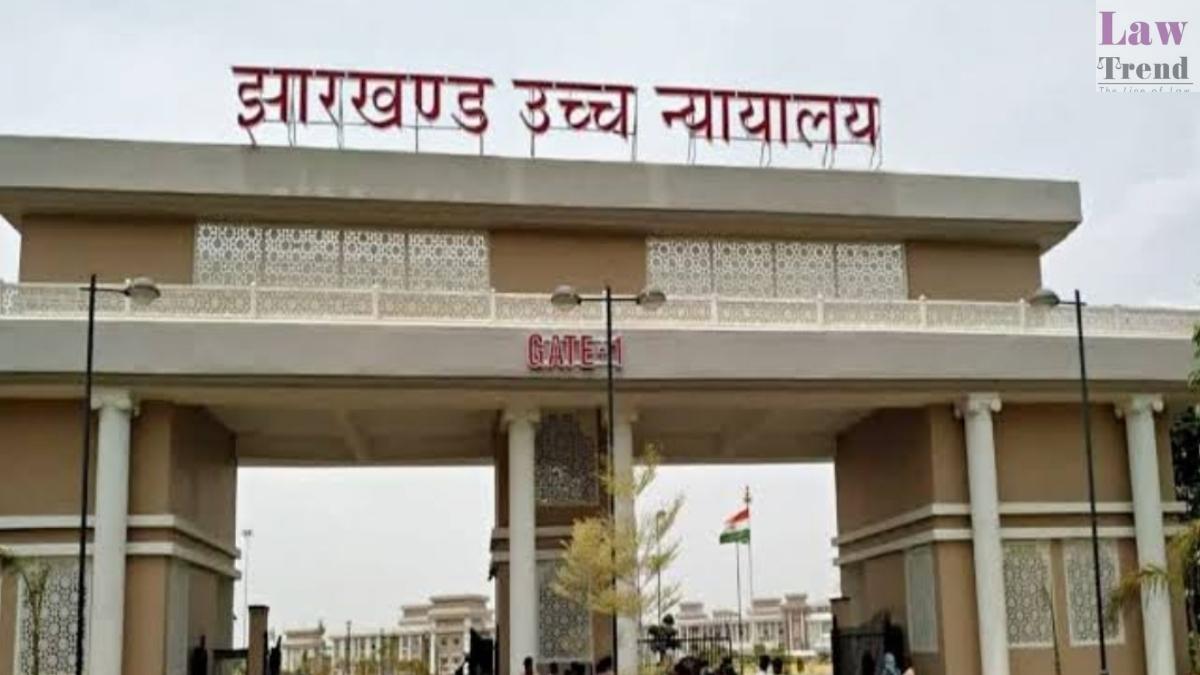
The High Court of Jharkhand has ruled that subsequent land restoration proceedings under the Chhotanagpur Tenancy Act are barred by the principles of constructive res judicata and limitation if an earlier order on the same dispute has attained finality. Presided over by Justice Sanjay Kumar Dwivedi, the court allowed a 2009 writ petition, setting aside the orders of the Divisional Commissioner and the Additional Collector of Ranchi. In doing so, the court restored a 1988 land transfer order that had remained unchallenged for decades.
Background of the Case
The dispute traces back to 1947, when the petitioner’s father, Ramdeo Choudhary, acquired 1.32 acres of land (Khata No. 41, Plot No. 610) in Chatwal village, Ranchi, from Kusal Kujur for a consideration of Rs. 2,500. Although Kusal Kujur assured him that he would obtain the necessary permission from competent authorities to formalize the sale, he failed to do so. Despite this, the petitioner’s father remained in exclusive, undisturbed possession of the land.
In 1962, Kusal Kujur and his sons began disrupting this possession, prompting the petitioner’s father to file a title suit (Title Suit No. 971 of 1962). The suit culminated in a compromise decree on March 12, 1965.
Decades later, in the year 1986–87, the father of respondent no. 6 (Joseph Kujur) initiated a land restoration case (SAR Case No. 10/86-87). On August 26, 1988, the Special Area Regulation (SAR) Court disposed of the case by directing the petitioner to transfer an equivalent area of land (1.32 acres) in the same village to the respondent’s father, in line with the second proviso to Section 71(A) of the Chhotanagpur Tenancy (CNT) Act. Consequently, a registered sale deed was executed on September 21, 1988, and the land was subsequently mutated. This 1988 order went unchallenged and achieved finality.
Nineteen years later, in 2006, Joseph Kujur filed a second restoration case (SAR Case No. 13/06-07). The Land Reforms Deputy Collector (LRDC), acting as the In-charge SAR Officer, rejected the application on July 18, 2007, upholding the 1988 order. However, on appeal, the Additional Collector of Ranchi set aside both the 1988 and 2007 orders, directing the Circle Officer of Chanho to grant possession of the land to Joseph Kujur. This decision was later upheld by the Divisional Commissioner of Ranchi in a revision petition on October 21, 2008, leading the petitioner to approach the High Court.
Arguments of the Parties
The counsel for the petitioner argued that the first restoration proceeding in 1986–87 was initiated more than 40 years after the original 1947 transaction, and the second was filed 19 years after the 1988 order. He contended that both applications were heavily barred by limitation. Furthermore, he argued that because the 1988 order was never challenged, the second proceeding was barred by the principle of constructive res judicata. He also pointed out that the appellate authority’s finding that there was “no structure” on the land was contrary to witness depositions recorded during the 1988 proceedings.
The State’s counsel defended the appellate and revisional orders, arguing that the Additional Collector had correctly found no substantial structure on the disputed land, which justified setting aside the previous orders.
Counsel for respondent no. 6 argued that despite the execution of the registered deed in 1988, his client was never put in possession of the transferred land. He asserted that this failure of possession compelled the respondent to file the second restoration case in 2006.
The Court’s Analysis
In reviewing the record, Justice Sanjay Kumar Dwivedi observed that the State could not produce any material evidence to support the appellate authority’s claim that there were no substantial structures on the land.
The court emphasized that the first transaction took place in 1947, the compromise decree was recorded in 1965, and the first SAR case was initiated after a delay of over 40 years. The second SAR case was filed 19 years after the 1988 order, without ever directly challenging the validity of that 1988 order.
The court declared this sequence of events a clear case of constructive res judicata and limitation. Citing the Supreme Court judgment in Situ Sahu v. State of Jharkhand (2004) 8 SCC 340, the court reiterated that while Section 71(A) of the CNT Act does not prescribe a specific limitation period, restoration applications must be filed within a “reasonable period,” which has been established as 30 years.
On the issues of res judicata and limitation, the court placed reliance on the Supreme Court precedent in Fulchand Munda v. State of Bihar and Others (2018) 14 SCC 774, quoting the following observations:
“Under the CNT Act as it stood in the year 1922, the transfer could have been challenged as it contravenes Section 46 of the CNT Act, being a contract or agreement of transfer. That plea having not been taken by the appellant’s predecessors, the appellant and his predecessors were not entitled to raise the question of transfer being invalid under Section 46 of the CNT Act as it stood in 1922 on the principle of constructive res judicata.”
“Section 71-A of the CNT Act authorises the Deputy Commissioner to evict the transferee from such land and to restore possession to the raiyat if the transfer is being effected in contravention of Section 46 or any other provision of the CNT Act. Thus, if there is contravention of Section 46, the Deputy Commissioner is authorised to evict the transferee from such land and restore it to the transferor under Section 71-A of the CNT Act.”
“The predecessors of the respondents could not be treated to be in possession in contravention of Section 46 as possession of land by them has been upheld by the High Court in its decision. The decision of the High Court cannot be reopened by taking advantage of amendment in Section 46 which came into force with effect from 5-1-1948. Section 71-A of the CNT Act would be attracted only in case the Deputy Commissioner finds that the impugned transfer was made in contravention of Section 46 or any other provision of the CNT Act. The decision of the High Court comes in the way of the Deputy Commissioner in arriving at any such findings. The possession having been denied to the appellant’s predecessors holding that there was no contravention of Section 46 as it stood in 1922, the appellant cannot be permitted to take advantage under Section 46 on same having been amended by an Act of 1947. That apart, although there is no period of limitation prescribed for exercising the power under Section 71-A by the Deputy Commissioner, the party affected is called upon to approach the appropriate authority or the power has to be exercised by the Deputy Commissioner within a reasonable period of time. The gap of more than 50 years for challenging the transaction of 1922 cannot be said to be a reasonable time for exercising the power even if it is not hedged in by a period of limitation.”
Applying these principles, the High Court noted that the appellate and revisional authorities failed to provide any cogent reasoning as to why the principle of res judicata did not apply to this case.
Decision of the Court
The High Court allowed the writ petition and set aside the order dated June 28, 2008, passed by the Additional Collector of Ranchi, as well as the order dated October 21, 2008, passed by the Divisional Commissioner of Ranchi. The court declared that the original SAR order dated August 26, 1988, has attained finality and remains active.
Case Details:
- Case Title: Amar Kumar Choudhary v. The State of Jharkhand & Others
- Case No.: W.P.(C) No. 2621 of 2009
- Bench: Justice Sanjay Kumar Dwivedi
- Date: 06.07.2026