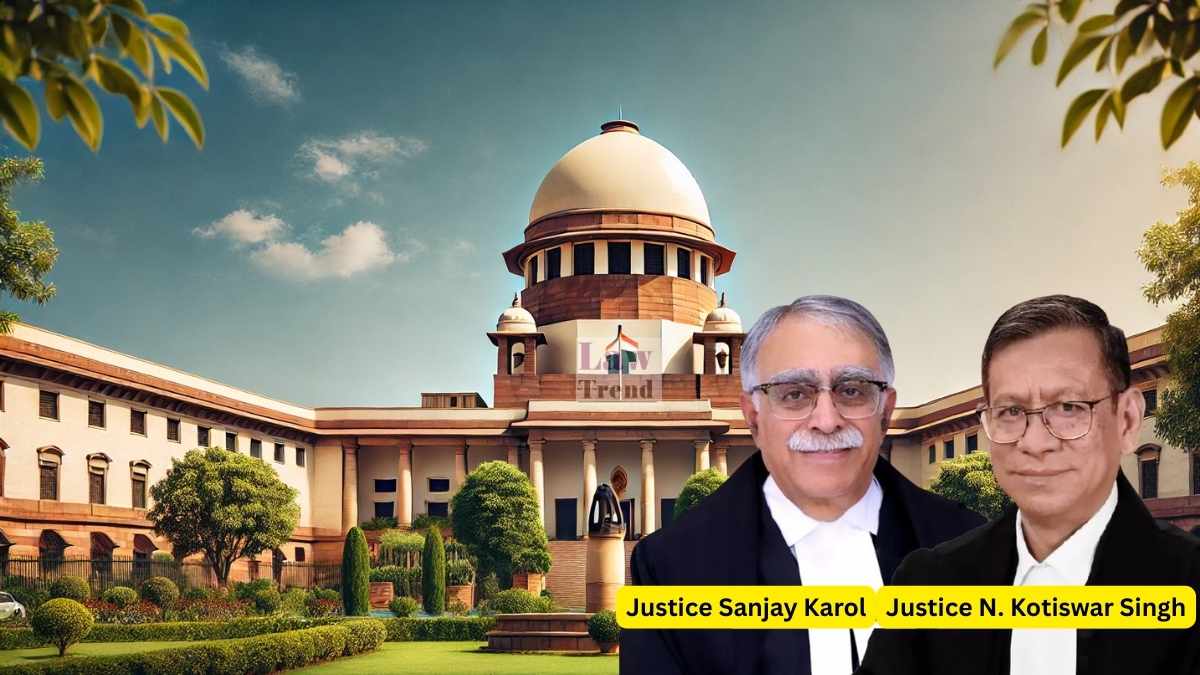
The Supreme Court of India, in a bench comprising Justice Sanjay Karol and Justice N Kotiswar Singh, has ruled that a procedural infraction at the final appointment stage does not automatically invalidate a public recruitment process that is otherwise fair, transparent, and compliant. Setting aside the judgment of the Punjab and Haryana High Court, the Supreme Court directed a cooperative society in Haryana to reconvene its Board of Directors (BOD) to freshly evaluate the decade-long appointments of clerks and peons, clarifying that administrative lapses by hiring authorities should not arbitrarily deprive employees of their livelihood.
The ruling addresses the delicate balance between strict adherence to statutory recruitment norms and the constitutional obligation of courts to ensure fairness where employees, appointed through a duly initiated public selection process and having rendered long years of unblemished service, face the prospect of displacement on account of procedural defects allegedly attributable not to them but to the authorities conducting the recruitment. At its core, the judgment led the court to examine whether every infraction of a recruitment procedure necessarily renders an appointment void in law.
Background of the Case
The case concerns the appellants who were appointed in 2014 to the regular posts of Clerk-cum-Salesman and Peon-cum-Chowkidar in the Thanesar Cooperative Marketing-cum-Processing Society Ltd. (the “Society”) in Kurukshetra, Haryana. The recruitment process was initiated after obtaining permission from the Registrar of Cooperative Societies, Haryana, to fill three clerk-cum-salesman and four peon-cum-chowkidar posts.
An advertisement inviting applications was published in newspapers on July 11, 2014, followed by a corrigendum on July 30, 2014. Interviews were conducted by a sub-committee on August 11, 2014, and on August 13, 2014, the Board of Directors of the Society approved the appellants’ appointments. The appellants subsequently joined and worked continuously for more than ten years without any personal allegations of fraud, manipulation, or lack of eligibility.
However, two members of the Society challenged the appointments in 2015 under Section 27 of the Haryana Cooperative Societies Act, 1984. They contended that the recruitment violated amended Rule 3 of the Primary Cooperative Marketing-cum-Processing Societies Limited Staff Service Rules, 2003. This rule, adopted by the Society in 2011, mandates that decisions on appointments must be taken in a meeting attended by the Assistant Registrar, Cooperative Societies, the Inspector (Cooperative Societies), and the District Manager of the Haryana State Cooperative Supply and Marketing Federation Limited (HAFED), whose “presence and concurrence” are compulsory. On August 13, 2014, these officials were absent from the board meeting.
The complainants also alleged violations of Rule 14(a) because the selected candidates submitted medical certificates from private MBBS doctors instead of the area’s Civil Surgeon, and raised objections regarding reservation, post strength, and the publishing of the advertisement in the Delhi edition of The Indian Express.
The Additional Registrar Cooperative Societies set aside the appointments on June 6, 2017, and the Additional Chief Secretary to the Government of Haryana affirmed this on September 29, 2017. The appellants challenged these orders in the High Court of Punjab and Haryana. A Single Judge dismissed their writ petition on April 22, 2024, holding Rule 3 to be mandatory. On July 29, 2025, a Division Bench dismissed the Letters Patent Appeal (LPA), leading the appellants to approach the Supreme Court.
Arguments of the Parties
The appellants argued that they had been selected through a transparent, merit-based selection process and had no role in the composition of the board’s quorum or the administrative procedures of the Society. Citing the decision in State of U.P. v. Johri Mal (2004), they contended that they should not be penalized for institutional lapses. They also relied on Rajasthan Public Service Commission v. Kaila Devi (2018) regarding the doctrine of curability of procedural irregularities. Additionally, the appellants pointed to Rule 35 of the Service Rules, 2003, which sets a quorum of three members for board meetings, and Section 36 of the 1984 Act, which prevents cooperative society acts from being invalidated merely by procedural defects.
The contesting respondents, who were the original complainants, argued that the appointments were void ab initio. They asserted that Rule 3 and Rule 14(a) were mandatory and that the complete absence of the designated official members at the August 13, 2014 meeting invalidated the board’s decision. They relied on Ramjit Singh Kardam v. Sanjeev Kumar (2020) to argue that no equity can arise from appointments made in violation of statutory rules. The respondents further pointed out that the appellants had already been relieved from service on August 19, 2025.
The Court’s Analysis
The Supreme Court divided the recruitment process into three distinct stages:
- The notification of vacancies via advertisement and invitation of eligible candidates.
- The conduct of interviews and selection.
- The final appointment decision-making by the competent appointing authority.
The Court observed that the first two stages had no fundamental defects. The advertisement had given proper notice to eligible candidates, and the interview was conducted transparently without any allegations of fraud, manipulation, or consideration of ineligible candidates.
Analyzing Rule 3, the Court noted that the requirement to have official non-elected members present during appointments is supervisory, intended to verify that recruitment norms were strictly followed. However, the Court held that their absence does not destroy the validity of the entire selection. The Court observed: even if the presence of these official members has been made compulsory in the meeting of BOD for finalising the appointments to the services in the cooperative society, their absence will not render the appointments illegal as their role is essentially supervisory in nature.
The Court held that the third stage of appointment is severable from the first two phases. Any defect at the final approval level is a curable irregularity, not a fatal illegality that voids the entire selection. The Court declared: Infraction of Rule 3 in our opinion thus, cannot render the entire recruitment process illegal which does not otherwise suffer from any fundamental error or defect.
Furthermore, the Court took note of the fact that the appellants had served for over ten years, albeit under the protection of interim judicial orders.
The Decision
The Supreme Court allowed the appeal and set aside the High Court’s Division Bench judgment dated July 29, 2025.
The Court directed the respondent cooperative society to reconvene a meeting of its Board of Directors within one month to take a fresh decision regarding the final stage of the appellants’ appointments. The Assistant Registrar, Inspector of Cooperative Societies, and District Manager of HAFED must be present at this meeting.
The Court explicitly ruled that the reconvened BOD cannot reopen or re-examine the first two stages of recruitment—namely, the adequacy of the advertisement’s publicity or the conduct of the interviews. Instead, the board must limit its review to verifying whether the appellants met the essential qualifications, did not suffer from disqualifications, were indeed recommended by the selection committee, and that no more meritorious candidates were ignored.
If the appellants are found eligible upon this fresh review, they must be re-appointed to their respective posts. Their past service will be counted for all purposes, though they will not be entitled to arrears of pay or allowances for the period they were out of service following their removal on August 19, 2025.
Case Details:
Case Title: Gaurav Mehla & Ors. v. State of Haryana & Ors.
Case No.: Civil Appeal No(s). of 2026 (Arising out of Special Leave Petition (Civil) No. 23061 of 2025)
Bench: Justice Sanjay Karol, Justice N Kotiswar Singh
Date: June 11, 2026