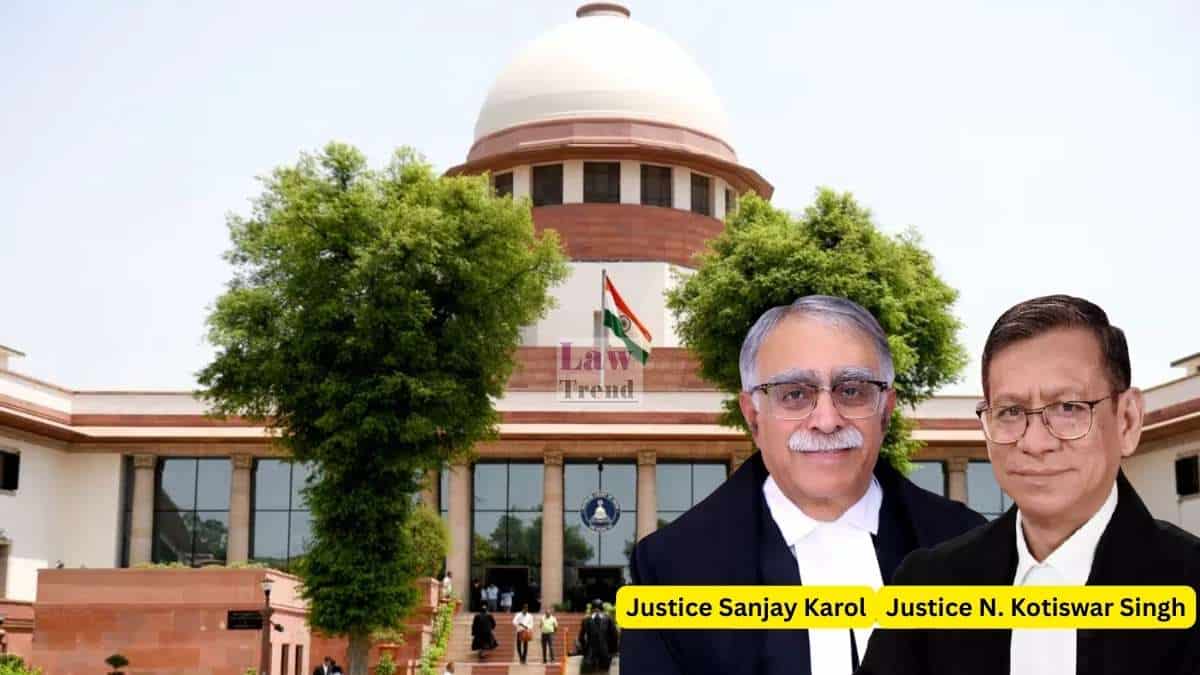
The Supreme Court of India has ruled that Rule 23(1) of the Haryana Civil Services (Compassionate Financial Assistance or Appointment) Rules, 2019, which suspends compassionate benefits during criminal proceedings, applies strictly to compassionate financial assistance and cannot be extended to deny or defer compassionate appointments. A bench of Justice Sanjay Karol and Justice N Kotiswar Singh set aside a judgment of the High Court of Punjab and Haryana, directing the State of Haryana to consider the appellant’s claim for compassionate appointment on its own merits within three months. The Court clarified that unlike financial assistance, the rules governing compassionate appointments do not impose an absolute sequential hierarchy that bars a deceased employee’s children from being considered while a widow is alive, particularly when she has formally relinquished her claim.
Background of the Case
The appellant, Atul Chauhan, is the son of Late Shri Gajender Singh Chauhan, who worked as a Junior Basic Teacher (JBT) in Government Primary School, Gudhrana, Palwal, Haryana since 1997. On September 28, 2021, the government teacher died in a road accident under suspicious circumstances. Consequently, the appellant’s mother, Smt. Pushpa Devi, was booked under Section 302 of the Indian Penal Code, 1860, on allegations of conspiring in her husband’s murder.
During the trial, Smt. Pushpa Devi submitted an affidavit declaring that she had no objection to her sons receiving the service and policy-related benefits, undertaking not to assert any independent claim. The Director of Elementary Education informed local education authorities on May 4, 2022, that the wife was not entitled to benefits, but directed that if the children were major, their claims for compassionate appointment or financial assistance should be submitted.
Smt. Pushpa Devi was eventually acquitted of the murder charge on October 14, 2024, by the Additional Sessions Judge, Palwal, who granted her the “benefit of doubt.” Following this, the appellant represented his case afresh. However, the deceased’s brother, Mahender Singh, challenged the acquittal before the High Court of Punjab and Haryana in a criminal appeal (CRM-A No. 119 of 2025). Citing the pending appeal, the Director of Elementary Education declined the appellant’s claim on February 7, 2025, keeping it in abeyance.
The appellant challenged this decision in CWP No. 13053 of 2025 before the Punjab and Haryana High Court, while also assailing the constitutional validity of Rule 23(1) of the 2019 Rules. The High Court dismissed his petition, holding that the pending criminal appeal was a continuation of the trial, rendering the claim premature, and that the widow holds the primary right to benefits, which must be conclusively determined before the son’s claim can arise.
Arguments of the Parties
The appellant’s counsel argued that Rule 23(1) is textually and explicitly restricted to “compassionate financial assistance” and contains no reference to “compassionate appointment.” They emphasized that the 2019 Rules maintain a deliberate structural distinction between the two forms of relief, and that both the mother and brother had formally renounced their claims in the appellant’s favor.
Conversely, the State of Haryana contended that the 2019 Rules represent a single, integrated welfare scheme. They argued that a purposive construction of Rule 23(1) must extend the suspension of benefits to compassionate appointments as well, stating that any other reading would create an anomaly where a person under criminal suspicion could get public employment but be denied financial aid. They also maintained that the widow’s claim holds priority under Rule 5(1)(f) and (g), meaning no derivative right could accrue to the appellant until her status was conclusively decided.
The Court’s Analysis
Addressing the nature of compassionate appointment, the Supreme Court reiterated that it is not a vested or heritable right but a humanitarian relief. The Court cited its previous ruling in Tinku v. State of Haryana (2024):
“As regards the compassionate appointment being sought to be claimed as a vested right for appointment, suffice it to say that the said right is not a condition of service of an employee who dies in harness, which must be given to the dependent without any kind of scrutiny or undertaking a process of selection. It is an appointment which is given on proper and strict scrutiny of the various parameters as laid down with an intention to help a family out of a sudden pecuniary financial destitution to help it get out of the emerging urgent situation where the sole bread earner has expired, leaving them helpless and maybe penniless.”
The Court also cited M.P. State Agricultural Marketing Board v. Harpal Singh (2025) to underscore the state’s welfare responsibility:
“In families where a deceased stood as the only source of sustenance, death carries with it not only emotional devastation but the looming threat of deprivation, insecurity and social marginalisation. A welfare State, committed to the Constitutional ideals of justice with the mandate of reducing inequality, promoting social justice and ensuring a basic standard of living for all, cannot afford to allow such bereaved families to slide into destitution by the mechanical operation of procedural formalities.”
Moving to the statutory provisions, the Supreme Court noted that the plain language of Rule 23(1) refers strictly to “compassionate financial assistance” and contains no mention of “compassionate appointment.” The Court stated that reading one to include the other would be judicial legislation rather than statutory interpretation.
The Court highlighted a critical structural difference between Rule 5(1)(f) (defining family for financial assistance) and Rule 5(1)(g) (defining family for compassionate appointment). Rule 5(1)(f) uses explicit, cascading “failing” language to establish a strict sequential priority starting with the widow. Conversely, Rule 5(1)(g) contains no such “failing” language. The Court observed:
“The absence of the “failing” formulation in Rule 5(1)(g) means that Rule 5(1)(g) defines who constitutes ‘family’ for compassionate appointment purposes, not that each category can be considered only to the exclusion of the others or only upon the sequential failure of those listed above it.”
Since Smt. Pushpa Devi did not assert a claim and actively relinquished it in favor of her sons, the Court held that the appellant’s claim was not barred under Rule 5(1)(g).
While the Court upheld the constitutional validity of Rule 23(1) as a valid regulatory measure within its proper domain of financial assistance, it declared that it cannot be applied to appointments. The Court, however, noted a significant legislative anomaly:
“It would appear, on the face of it, incongruous that the Rule-making authority/legislature saw fit to suspend even the lesser form of relief, i.e., financial assistance, during the pendency of criminal proceedings for the alleged murder of the deceased employee, while providing no analogous safeguard in respect of the far greater form of relief, viz., permanent public employment.”
The bench strongly advised the State Government of Haryana to address this legislative gap through appropriate amendments to the Rules of 2019.
Decision of the Court
The Supreme Court allowed the Civil Appeal and set aside the Punjab and Haryana High Court’s judgment dated May 12, 2025. The Court directed the respondents to consider and decide the appellant’s claim for compassionate appointment on its merits strictly in accordance with the 2019 Rules within three months from the date of the judgment.
The Court clarified that this directive does not confer an absolute right to appointment and will have no bearing on the pending criminal appeal regarding Smt. Pushpa Devi’s acquittal.
Case Details
Case Title: Atul Chauhan v. State of Haryana & Ors.
Case No.: Civil Appeal No. of 2026 (Arising out of SLP (C) No. 25892 of 2025)
Bench: Justice Sanjay Karol, Justice N Kotiswar Singh
Date: June 11, 2026