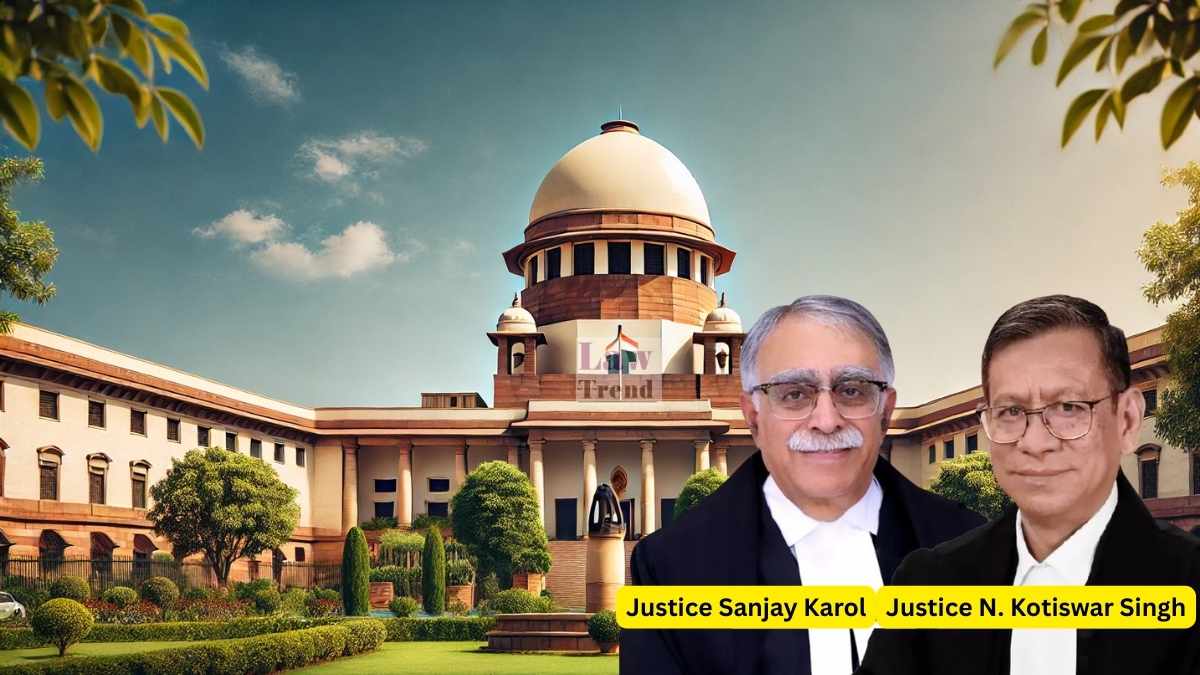
The Supreme Court of India has partly allowed an appeal filed by an employee of the Maharashtra State Electricity Distribution Company Limited (MSEDCL), setting aside her dismissal order on the grounds of procedural irregularity and disproportionality of punishment. A division bench comprising Justice Sanjay Karol and Justice Nongmeikapam Kotiswar Singh ruled that once a domestic enquiry is held to be defective and misconduct is subsequently established through a de novo adjudicatory process before the Labour Court, the employer cannot mechanically impose punishment by relying on a prior show-cause notice issued under the vitiated domestic enquiry. The court further ruled that treating an employee’s suspension period as an independent, additional punishment alongside dismissal is impermissible under the service rules, and directed the employer to pay the appellant her long-pending subsistence allowance.
Background of the Case
The appellant, Surekha Domaji Bele, was appointed as a Lower Division Clerk in the erstwhile Maharashtra State Electricity Board, O&M Circle, Chandrapur, pursuant to an appointment order dated April 1, 1985, and joined the service on April 2, 1985. She was subsequently promoted to the post of Upper Division Clerk with effect from April 11, 1988.
The record indicates that service disputes had arisen between the appellant and the MSEDCL management long before the disciplinary action in question. The appellant was reverted to the post of Lower Division Clerk on September 29, 1995, which she challenged. She was also transferred from Ballarsha to the Warora Pole Factory on January 16, 2002, a transfer she successfully challenged, leading to the order being set aside on June 24, 2003. She had also initiated proceedings under the Payment of Wages Act and other legal proceedings concerning her service grievances.
On September 4, 2006, the appellant was placed under suspension pending enquiry. The suspension order alleged acts of indiscipline, insubordination, disobedience of superior officers, tampering with official documents, and negligence. It directed her to mark her attendance once every week, on Wednesday, at the office of the Executive Engineer, O&M Division, MSEDCL, Warora, and stated she would be entitled to a subsistence allowance.
A charge-sheet dated September 19, 2006, was subsequently issued. The appellant did not file a reply but requested copies of various documents on November 26, 2006, which were eventually supplied on February 18, 2008. The domestic enquiry commenced in March 2008. On March 25, 2008, the appellant appeared before the Enquiry Officer and sought an adjournment of 8 to 10 days to participate in the proceedings. The request was declined, and the Enquiry Officer proceeded ex parte, examining five witnesses in her absence and closing the enquiry.
Based on the enquiry report submitted on April 25, 2008, MSEDCL issued a show-cause notice proposing her dismissal. The appellant challenged this by filing Complaint (ULP) No. 34 of 2008 before the Labour Court, Chandrapur. On November 29, 2014, the Labour Court held that the domestic enquiry was not fair and its findings were perverse. MSEDCL challenged this before the Industrial Court in Revision (ULP) No. 4 of 2015. On August 14, 2015, the Industrial Court set aside the Labour Court’s order and remanded the matter, allowing MSEDCL to prove the misconduct by leading fresh evidence directly before the Labour Court.
Upon remand, MSEDCL led evidence before the Labour Court. The appellant’s request to respond to the charge-sheet post-remand was declined. On June 27, 2017, the Labour Court held that the misconduct stood proved, declared the 2008 show-cause notice legal and proper, and dismissed the complaint. Following this, MSEDCL issued an order on July 12, 2017, dismissing the appellant from service and directing that her 11-year suspension period be treated as punishment.
The appellant’s subsequent revision petition challenging the misconduct finding was dismissed by the Industrial Court on June 8, 2018. She separately challenged the dismissal order by filing Complaint (ULP) No. 28 of 2017 before the Labour Court. The complaint was dismissed on August 8, 2019, and the Industrial Court affirmed this dismissal in Revision (ULP) No. 14 of 2019 on January 18, 2023. The Nagpur Bench of the Bombay High Court subsequently dismissed her writ petition on April 5, 2024, and rejected her review application on November 11, 2024. After briefly approaching the Supreme Court and withdrawing her petition with liberty to file a fresh one, the appellant filed the present appeal.
Arguments of the Parties
Appellant’s Submissions:
- Lack of Competence: The appellant argued that she was appointed by the Superintending Engineer and could not have been dismissed by an Executive Engineer, a post lower in rank, as a punishment of dismissal cannot be imposed by an authority lower than the appointing authority.
- Absence of Fresh Post-Enquiry Notice: She submitted that under Regulation 88(j) of the MSEDCL Employees Service Regulations, 2005, a show-cause notice must be issued after the enquiry is completed. Since the original domestic enquiry was held to be defective, and the misconduct was proved only through de novo proceedings before the Labour Court, MSEDCL could not mechanically act upon the old 2008 notice.
- Denial of Subsistence Allowance: The appellant urged that she was not paid any subsistence allowance during her 11-year suspension from September 4, 2006, to July 12, 2017. She argued that the complete denial of subsistence allowance was unjustified, especially when there was no finding of gainful employment elsewhere, and when the regulations required a review of suspension beyond six months.
- Severe and Double Punishment: She argued that the dismissal was grossly disproportionate, given her 21 years of service prior to the disciplinary actions, during which no charges of financial misappropriation, corruption, or moral turpitude were made. She also argued that treating the suspension period as punishment amounted to imposing double penalties for the same misconduct.
Respondent’s Submissions:
- Finality of Misconduct: MSEDCL contended that the finding of misconduct had attained finality before the Industrial Court and could not be reopened.
- Validity of the 2008 Notice: They submitted that the Labour Court and Industrial Court had already held the show-cause notice of April 25, 2008, to be legal and proper, meaning no fresh notice was required.
- Non-Compliance with Suspension Terms: On the issue of subsistence allowance, MSEDCL relied on the reporting condition in the suspension order, arguing that the appellant had failed to mark her attendance weekly at the Warora office and was therefore not eligible for the allowance.
Court’s Analysis and Observations
The Supreme Court analyzed the appeals across five key legal issues:
1. Competence of the Disciplinary Authority
The court perused the MSEDCL Employees Service Regulations, 2005, noting that the appellant was a Pay Grade-III employee. Under Sr. No. 44 of Regulation No. 25 and Schedule ‘C’ of the Service Regulations, the competent authority to dismiss or remove such employees includes “Officers of the rank of E.E./A.C.P.O./ E.E. (Stores) / A.C.O.S. or equivalent & above.” The court rejected the appellant’s reliance on Article 311(1) of the Constitution of India. Citing the Constitution Bench decision in S.L. Agarwal v. General Manager, Hindustan Steel Ltd., the court observed that employees of a government-controlled corporation having a distinct legal personality do not hold a civil post under the Union or State. It quoted:
“No person who is a member of a civil service of the Union or an all-India service or a civil service or a State or holds a civil post under the Union or a State shall be dismissed or removed by an authority subordinate to that by which he was appointed.”
Thus, the court held that the Executive Engineer was fully competent to issue the dismissal order under the governing Service Regulations.
2. Requirement of a Fresh Show-Cause Notice
On whether a fresh notice was required after the de novo proceedings, the Supreme Court closely examined the text of Regulation 88(j):
“After the enquiry is completed, the Competent Authority shall serve a notice on the employee communicating to him its findings and asking him to show cause within a specified time as to why the contemplated punishment involving dismissal, removal or reversion or withholding of increment/s should not be inflicted on him.”
The court observed that the purpose of this notice is not an empty formality. Citing Khem Chand v. Union of India, the bench summarized the elements of reasonable opportunity:
“(a) an opportunity to deny his guilt and establish his innocence…” “(b) an opportunity to defend himself by cross-examining the witnesses produced against him… and finally” “(c) an opportunity to make his representation as to why the proposed punishment should not be inflicted on him…”
The court also cited Managing Director, ECIL v. B. Karunakar, noting:
“The findings or recommended punishment by the enquiry officer are likely to affect the mind of the disciplinary authority in his concluding the guilt or penalty to be imposed. The delinquent is, therefore, entitled to meet the reasoning, controvert the conclusions reached by the enquiry officer or is entitled to explain the effect of the evidence recorded… Even if the disciplinary authority comes to the conclusion that charge or charges is/are proved, the case may not warrant imposition of any penalty. He may plead mitigating or extenuating circumstances to impose no punishment or a lesser punishment.”
While the employer has the right to lead evidence to establish misconduct before the tribunal when a domestic enquiry is found to be defective under Workmen of Firestone Tyre & Rubber Co. of India (P) Ltd. v. Management, the court clarified that this principle operates only to prove guilt. It quoted from Workmen of Firestone:
“Therefore, the position is that even now the employer is entitled to adduce evidence for the first time before the Tribunal even if he had held no enquiry or the enquiry held by him is found to be defective. Of course, an opportunity will have to be given to the workman to lead evidence contra… This right in the management to sustain its order by adducing independent evidence, before the Tribunal, if no enquiry has been held or if the enquiry is held to be defective, has been given judicial recognition over a long period of years.”
The Supreme Court ruled that once the domestic enquiry was held to be defective, the original 2008 show-cause notice lost its sustainable foundation. The disciplinary authority could not rely on the appellant’s failure to reply to that notice, and was legally obligated to issue a fresh show-cause notice in light of the findings of the Labour Court.
3. Claim for Subsistence Allowance
The court emphasised that subsistence allowance is essential for basic survival and to enable a suspended employee to defend themselves. Referring to State of Maharashtra v. Chandrabhan Tale, the court noted:
“If the civil servant under suspension, pending a departmental enquiry or a criminal trial started against him, is entitled to subsistence allowance at the normal rate which is a bare minimum required for the maintenance of the civil servant and his family, he should undoubtedly get it… Whether he is lodged in prison or released on bail on his conviction pending consideration of his appeal, his family requires the bare minimum by way of subsistence allowance.”
Under Regulation 88(a)(ii), the continuation of a suspension beyond six months requires mandatory review by a higher authority. Since MSEDCL produced no record of any such review over the eleven years, the court held that the original reporting condition to mark attendance weekly at Warora could not be utilized to deny her subsistence allowance for the entire period.
The court split the entitlement into two parts: for the first six months (September 4, 2006, to March 3, 2007), the authority must evaluate her explanation that her transfer to Warora had been previously set aside; for the remaining period (March 4, 2007, to July 12, 2017), she was declared unconditionally eligible for the allowance.
4. Treating Suspension Period as Punishment
The court found that treating the suspension period as punishment alongside dismissal amounted to an illegal amalgam of penalties. Citing Union of India v. S.C. Parashar, the court highlighted that disciplinary authorities cannot combine separate major and minor penalties for the same misconduct unless explicitly authorized by the service rules. The court held that the past suspension period could not operate as an independent, additional punishment over and above the final penalty.
5. Proportionality of Punishment
The court highlighted the devastating, permanent effects of the severest punishment of dismissal:
“Dismissal from service is the severest form of penalty which can be inflicted on a delinquent employee in service jurisprudence. It brings the relationship of employer and employee to an end permanently, and ordinarily deprives the employee of the incidents of past service, including retiral benefits. It does not lead merely to the loss of the existing source of income for the employee but also for the dependent family members.”
The bench further remarked on the permanent stigma left by dismissal:
“It further carries consequences beyond immediate cessation of employment. It leaves a permanent stigma on the service record of the employee concerned, and may impair future employment prospects, particularly in public employment, statutory bodies, public sector undertakings and other regulated establishments where antecedents and service record are material. For this reason, dismissal must remain reserved for cases where the misconduct is of the most serious nature…”
The court noted that the proved misconduct did not involve corruption, moral turpitude, financial misappropriation, or actual pecuniary loss to the employer. Under such circumstances, and considering the appellant’s long service, the court ruled that the penalty was shocking to the conscience.
Citing Ranjit Thakur v. Union of India, the bench observed:
“the sentence has to suit the offence and the offender. It should not be vindictive or unduly harsh. It should not be so disproportionate to the offence as to shock the conscience…”
The bench also referenced B.C. Chaturvedi v. Union of India, stating:
“If the punishment imposed by the disciplinary authority or the appellate authority shocks the conscience of the High Court/Tribunal, it would appropriately mould the relief, either directing the disciplinary/appellate authority to reconsider the penalty imposed, or to shorten the litigation, it may itself, in exceptional and rare cases, impose appropriate punishment…”
Finally, referencing Chairman-cum-Managing Director, Coal India Ltd. v. Mukul Kumar Choudhuri, the court noted:
“if punishment imposed on an employee by an employer is grossly excessive, disproportionately high or unduly harsh, it cannot claim immunity from judicial scrutiny, and it is always open to a court to interfere with such penalty in appropriate cases.”
Decision of the Court
The Supreme Court partly allowed the appeal, setting aside the judgment of the High Court dated April 5, 2024, and the review order dated November 11, 2024, with the following directives:
- Setting Aside of Dismissal: The dismissal order dated July 12, 2017, was set aside as being wholly disproportionate, while the findings of misconduct were left undisturbed.
- Setting Aside of Dual Punishment: The direction treating the suspension period as an independent punishment was set aside.
- De Novo Punishment Consideration: The disciplinary authority was directed to issue a proper show-cause notice within four weeks proposing a penalty other than dismissal. A reasoned order on the final penalty must be passed within eight weeks.
- Subsistence Allowance Payment: The competent authority must determine the appellant’s subsistence allowance in two parts. She is declared eligible for subsistence allowance from March 4, 2007, to July 12, 2017, and this amount must be paid to her irrespective of the nature of the fresh punishment passed.
- No Reinstatement: Since the appellant has already crossed the age of superannuation, no reinstatement was directed. Her retiral and terminal consequences shall abide by the fresh order to be passed by MSEDCL.
Case Details:
Case Title: Surekha Domaji Bele v. Executive Engineer, Testing Division, MSEDCL
Case No.: Civil Appeal No. of 2026 (Arising out of SLP(C) No. of 2026) (Diary No. 11294 of 2025)
Bench: Justice Sanjay Karol, Justice Nongmeikapam Kotiswar Singh
Date: June 11, 2026