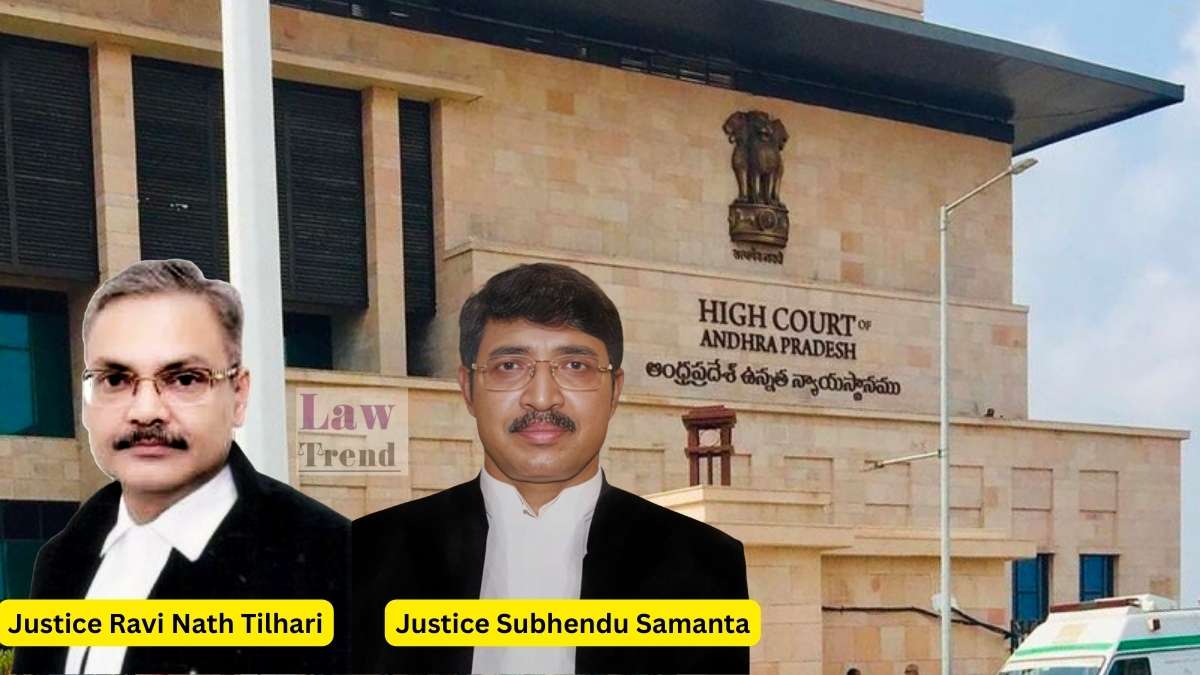
A Division Bench of the High Court of Andhra Pradesh, comprising Justice Ravi Nath Tilhari and Justice Subhendu Samanta, has held that official service of a court’s prohibitory order is not a condition precedent to initiate contempt proceedings if the party concerned had knowledge or notice of the order from other sources. Dismissing a contempt appeal filed by a Gram Panchayat Secretary who carried out a demolition despite a status quo order, the Court affirmed his two-month civil imprisonment sentence and directed him to surrender before the Registrar (Judicial) within one week.
Background of the Case
The matter originated from Writ Petition No. 7251 of 2018 filed by Nellore Sudhakar and others, challenging a notice dated February 26, 2018, issued by the Secretary of Brahmadevam Gram Panchayat in Muthukuru Mandal, SPSR Nellore District, which directed them to remove alleged encroachments on a public road.
On March 8, 2018, the High Court disposed of the writ petition by setting aside the notice and directing that it be treated as a show-cause notice. The Court recorded an undertaking from the standing counsel for the Gram Panchayat to supply a survey report to the petitioners within three days. The petitioners were given two weeks from the receipt of the survey report to file their explanation, and the Gram Panchayat was directed to maintain status quo until a decision was taken and communicated to them.
Despite this order, on March 19, 2018, the Gram Panchayat Secretary carried out the demolition of the petitioners’ compound wall with police protection. A contempt petition (Contempt Case No. 827 of 2018) was subsequently filed. By an order dated October 16, 2025, a single Judge found the Panchayat Secretary guilty of contempt, sentencing him to two months of civil imprisonment, directing him to restitute the loss by reconstructing the property, and ordering costs of Rs. 10,000 to each petitioner. The Secretary filed Contempt Appeal No. 4 of 2025 challenging this decision.
Arguments of the Parties
Appearing for the appellant (Panchayat Secretary), Additional Advocate General Sri E. Sambasiva Pratap submitted that there was no willful disobedience of the court order. He argued that the order dated March 8, 2018, was officially received by courier only on April 1, 2018, which was after the demolition occurred on March 19, 2018. It was contended that the demolition was halted as soon as the petitioners orally informed the official of the status quo order. He further submitted that the petitioners had submitted a representation on March 8, 2018, promising to remove the encroachments voluntarily by March 15, 2018. The appellant also pointed out that he had already complied with the single Judge’s direction by reconstructing the compound wall and paying Rs. 10,000 to each petitioner.
Counsel for the respondents (writ petitioners), Sri Madhavarao Nalluri, argued that the Gram Panchayat was represented through its standing counsel on March 8, 2018, when the status quo order was passed, implying full knowledge of the court’s directions. He pointed out that the Gram Panchayat had furnished the survey sketch on March 12, 2018, giving the petitioners time until March 26, 2018, to submit their explanation. Carrying out the demolition on March 19, 2018, before the expiry of the two-week explanation window, constituted a deliberate and willful violation of the Court’s order.
Court’s Analysis
The Division Bench examined whether formal service of a court order is required to prove contempt, or whether prior knowledge or intimation is sufficient.
Addressing the issue of notice, the Bench noted that the standing counsel for the Gram Panchayat was present during the hearing on March 8, 2018. The Bench reasoned that the delivery of the survey sketch to the petitioners on March 12, 2018, was done pursuant to the undertaking given in court, which conclusively proved that the Panchayat Secretary had knowledge of the order prior to the demolition on March 19, 2018.
Relying on the precedent in The Aligarh Municipal Board v. Ekka Tonga Mazdoor Union, the Court observed:
“in order to justify action for contempt of court for breach of a prohibitive order it is not necessary that the order should have been officially served on the party against whom it is granted, if it is proved that he has notice of the order aliunde and he knew that it was intended to be enforced. Official communication is not a condition precedent, provided there is no valid reason to doubt the authenticity of the order conveyed to him.”
The Court also discussed the principles laid down in Hoshiar Singh v. Gurbachan Singh, noting that in the case of prohibitory orders—such as an order to maintain status quo—formal service is not essential to ground an action in contempt if notice of the order is proved otherwise.
The Bench evaluated the Supreme Court decisions in Salauddin Ahmed v. Samta Andolan and Ashok Paper Kamgar Union v. Dharam Godha. Applying the two-pronged test from Salauddin Ahmed—knowledge of the order and deliberate violation thereof—the Bench concluded that both criteria were satisfied.
Regarding the appellant’s defense that he had subsequently restored the property and paid costs, the Court held that completing restitutive measures does not erase the offense of contempt or substitute for the sentence of imprisonment. Citing Amit Kumar Das v. Shrimati Hutheesingh Tagore Charitable Trust and State Bank of India v. Dr. Vijay Mallya, the Court emphasized:
“in addition to punishing a contemnor for disobeying its orders, the Court can also ensure that such a contemnor does not continue to enjoy the benefits of his disobedience by merely suffering the punishment meted out to him.”
The Division Bench also noted that the appellant tried to shift positions during the proceedings and endorsed the single Judge’s observation:
“The sole Respondent/Contemnor had made a futile effort before this Court in the present Contempt Proceeding to raise several inconsistent and unfounded pleas with a view to mislead this Court by showing wrong dates instead of being apologetic and showing an element of remorse.”
Decision
The High Court dismissed the contempt appeal, upholding the single Judge’s judgment dated October 16, 2025. The Bench ordered the appellant to surrender before the Registrar (Judicial) of the High Court within one week from the date of the judgment for execution of the sentence.
Case Details:
Case Title: V. Seenaiah v. Nellore Sudhakar and Others
Case No.: Contempt Appeal No. 4 of 2025
Bench: Justice Ravi Nath Tilhari and Justice Subhendu Samanta
Date: 16.07.2026