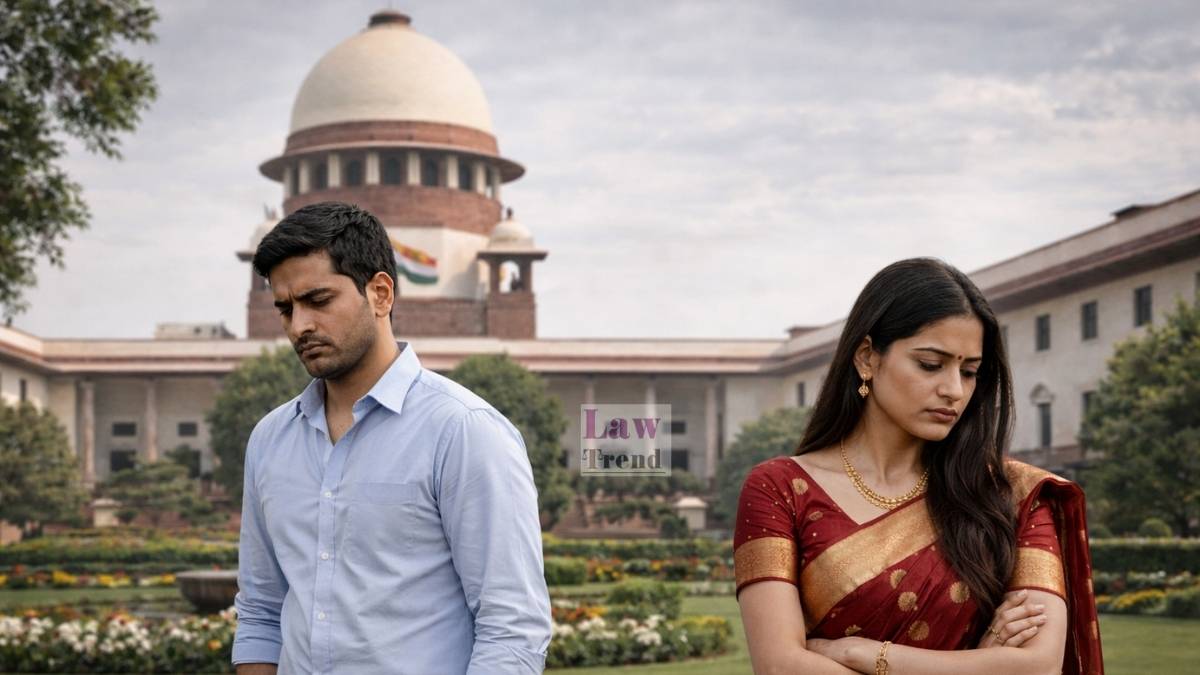
The Supreme Court has upheld a decree of divorce granted to a husband, holding that persistent denial of conjugal relations without reasonable cause amounts to mental cruelty under Section 13(1)(ia) of the Hindu Marriage Act, 1955. A Bench of Justice Sanjay Karol and Justice Augustine George Masih dismissed the wife’s appeal and further held that the marriage had irretrievably broken down, exercising its powers under Article 142 of the Constitution to dissolve the marriage.
Background of the Case
The parties, both medical professionals employed in government service, were married on December 5, 2007, according to Hindu rites. No child was born from the marriage. The wife was working as a gynaecologist in Gujarat, while the husband was serving as a doctor in Rajasthan.
According to the husband, sociocultural differences between the parties led to matrimonial discord. He alleged that the wife lived with him in the matrimonial home for only two to three months during their approximately two-year marital relationship and subjected him to cruelty. Consequently, he filed a divorce petition in 2009 under Section 13(1)(ia) of the Hindu Marriage Act.
The Family Court at Bharatpur dismissed the divorce petition, holding that the husband had failed to establish cruelty. However, the Rajasthan High Court reversed that decision and granted a decree of divorce, leading the wife to approach the Supreme Court.
Wife’s Arguments
The wife contended that she had never abandoned the husband and had always been willing to continue the matrimonial relationship. She argued that the husband could not be permitted to take advantage of his own wrong and that it was he who prevented her from performing her conjugal duties.
She further submitted that neither desertion nor irretrievable breakdown of marriage had been pleaded in the divorce petition. According to her, she had continued working in Gujarat because the husband’s family had agreed that she could do so until a nursing home was constructed in Bharatpur. She maintained that no evidence existed to establish cruelty on her part.
Husband’s Arguments
The husband argued that the wife had made no genuine effort to preserve the marriage. He pointed out that the parties had lived separately for more than fifteen years and had cohabited for only a few months.
He alleged that the wife repeatedly denied him sexual relations and failed to build mutual trust, companionship, and a shared marital life. Given the long separation and the absence of any possibility of reconciliation, he urged the Court to uphold the divorce decree.
Court’s Analysis on Mental Cruelty
The Supreme Court noted that the wife had consistently opposed dissolution of the marriage throughout the litigation and that no criminal or civil proceedings had been initiated by either party against the other. The Court also observed that the parties had lived separately for about fifteen years and that mediation efforts before the Supreme Court had failed.
The Court examined the grounds relied upon by the High Court, including allegations that the wife insulted the husband during a visit to the Taj Mahal, denied sexual relations, remained absent from the matrimonial home for long periods, and had been living separately from him for many years.
While rejecting the allegation relating to the Taj Mahal incident, the Court agreed with the Family Court’s finding that there was nothing wrong with the wife asking for a teddy bear and that the husband himself had admitted that the monument was closed on the relevant day.
However, the Court found merit in the husband’s allegation regarding denial of conjugal relations. It noted that evidence showed that during the brief period of cohabitation, the wife would sleep early, lock her room from inside, and not open the door despite knocking. The husband consequently slept in a separate room. The wife had not denied that they slept separately.
Referring to the principles laid down in Samar Ghosh v. Jaya Ghosh, the Court observed:
“Denial of conjugal rights including persistent refusal of sexual intercourse without a reasonable cause constitutes mental cruelty and is a valid ground for divorce under Section 13(1)(ia) of the HMA.”
The Court further stated:
“The courts in India have repeatedly established that withholding sexual intimacy inflicts severe emotional distress and undermines the bedrock of marriage.”
On that basis, the Court upheld the High Court’s conclusion that the husband had established cruelty.
Long Separation and Failure of Marital Obligations
The Court emphasised that matrimonial rights cannot be divorced from matrimonial duties. It observed that marriage is a partnership founded on mutual respect, shared expectations, emotional support, fidelity, responsibility and care.
In a significant observation, the Court said:
“Conjugal rights do not exist in a vacuum; they are the structural counterparts to conjugal duties. To demand the fulfilment of the former while wilfully abandoning the sanctity of the latter is to undermine the very essence of the institution.”
The Bench found that even during the short period of cohabitation, both parties failed to perform their conjugal responsibilities. Their strongly held and conflicting views regarding matrimonial life, coupled with a prolonged refusal to accommodate each other, contributed to the breakdown of the relationship.
The Court held that prolonged separation without any genuine effort at reconciliation may itself constitute mental cruelty. It observed that appellate courts are entitled to consider subsequent events occurring during litigation while assessing whether cruelty has been established.
Irretrievable Breakdown of Marriage
The Supreme Court further held that the marriage had irretrievably broken down. It noted that the parties had been living separately for over fifteen years, had no children, and all attempts at mediation and reconciliation had failed.
Relying upon the Constitution Bench decision in Shilpa Sailesh v. Varun Sreenivasan and other precedents, the Court held that it could exercise powers under Article 142 to dissolve a marriage where the relationship had become unworkable, emotionally dead, and beyond salvage.
The Bench observed:
“The parties have lived separately for far too long a period of time and there is no sanctity left in the marriage.”
The Court also noted that both parties were financially independent doctors employed in government service and that there were no children whose interests would be affected by dissolution of the marriage.
Decision
The Supreme Court upheld the High Court’s decree of divorce on the ground of cruelty. Additionally, exercising its powers under Article 142 of the Constitution, it held that the marriage had irretrievably broken down and deserved to be dissolved to do complete justice between the parties.
Accordingly, the appeal filed by the wife was dismissed, and the decree of divorce was maintained.
Case Details
Case Title: Sonal Talpada v. Veerbhan Singh
Case No.: Civil Appeal arising out of SLP (C) No. 10422 of 2025
Bench: Justice Sanjay Karol and Justice Augustine George Masih
Date: June 2, 2026