

Allahabad High Court Quashes Summoning Order Against In-Laws Citing “General and Omnibus” Allegations, Directs Husband to Face Trial
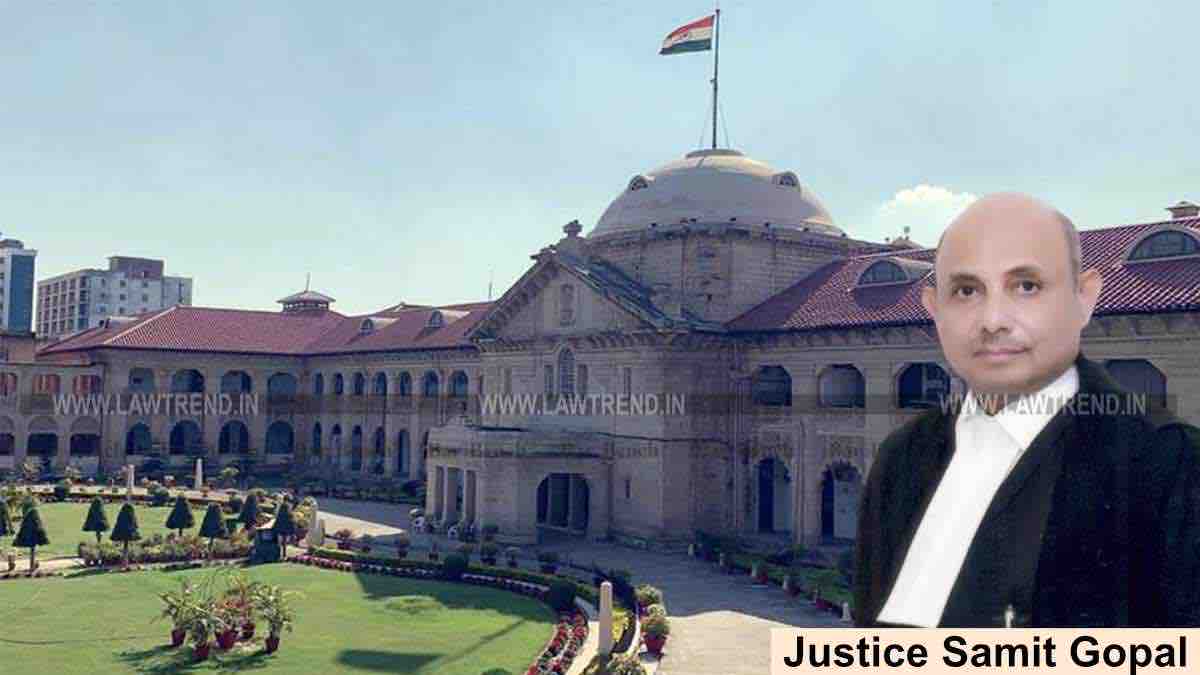

The High Court of Judicature at Allahabad has partly allowed an application filed under Section 482 of the Criminal Procedure Code (Cr.P.C.), quashing a summoning order and criminal proceedings against a husband’s parents in a complaint case alleging dowry harassment. However, the High Court declined to grant any relief to the husband, dismissing his petition and directing the trial court to proceed with his trial without granting undue adjournments.

Background of the Case

The dispute arose from the matrimonial relationship between the husband (Applicant No. 1) and the complainant (Opposite Party No. 2), who were married on November 28, 2017. According to the complaint filed by the complainant on December 16, 2021, her father had provided ₹5 lakh in cash, ornaments, and household articles at the time of the wedding.

The complainant alleged that ten days after the marriage, her father-in-law (Applicant No. 2), mother-in-law (Applicant No. 3), and brother-in-law (jeth) demanded a Swift Dzire car as dowry. She asserted that upon her father’s inability to fulfill this demand, she was subjected to physical assault, deprived of adequate food, locked in a room, and threatened. She further claimed that she was thrown out of her matrimonial home on November 5, 2019, and that her husband subsequently solemnized a second marriage with another woman on November 20, 2021, without obtaining a divorce.

Following the recording of the complainant’s statement under Section 200 Cr.P.C. and those of her sister and brother under Section 202 Cr.P.C., the Court of the Civil Judge (J.D.)/F.T.C.-II/J.M., Sant Kabir Nagar, issued a summoning order on May 16, 2023. The trial court summoned the husband under Sections 498A and 494 of the Indian Penal Code (I.P.C.) and Section $3/4$ of the Dowry Prohibition Act (D.P. Act), while the parents-in-law were summoned under Section 498A I.P.C. and Section $3/4$ of the D.P. Act. The other family members named in the complaint were not summoned.

Arguments of the Parties

The counsel for the applicants argued that the allegations in the complaint were entirely false, concocted, and motivated by bad faith. To support this, he contended that:

  • The husband had filed a petition under Section 9 of the Hindu Marriage Act for restitution of conjugal rights on July 4, 2022, to bring his wife back, but she refused to return unless they lived separately from his family.
  • The allegation regarding the husband’s second marriage was completely false, as he had not remarried.
  • There was an unexplained and fatal delay of 2 years, 1 month, and 5 days in filing the complaint (the complainant alleged she was thrown out on November 5, 2019, but only filed the complaint on December 16, 2021).
  • It was a case of “no injury” and the applicants did not possess any prior criminal history.
READ ALSO  इलेक्ट्रो होम्योपैथी का अभ्यास प्रतिबंधित नहीं है, लेकिन ऐसे चिकित्सक अपने नाम के आगे 'डॉक्टर' उपसर्ग का उपयोग नहीं कर सकते: इलाहाबाद हाईकोर्ट

The learned counsel for the State opposed the petition, arguing that the applicants were explicitly named in the complaint as well as in the statements of the victim and witnesses recorded during the inquiry, and that active allegations existed against them. Learned counsel for the complainant was absent when the matter was taken up.

Court’s Analysis and Observations

Justice Samit Gopal observed that the dispute is matrimonial in nature and noted that the trial court did not summon two other family members (the brother-in-law and another relative) despite identical allegations being leveled against them.

READ ALSO  Allahabad HC Rules: Order 8 Rule 1 CPC is Directory in Nature, Upholds Family Court Order Permitting Wife to File WS Beyond 90 Days

Reviewing the allegations against the parents-in-law, the Court observed:

“The allegations in so far as against the applicants no.2 and 3 are concerned, are general and omnibus. There is delay of 02 years 01 month and 05 days in filing of the complaint which has not been explained.”

To analyze the liability of the husband’s relatives, the High Court extensively reviewed several landmark rulings of the Supreme Court of India:

  1. Payal Sharma Vs. State of Punjab & Another (2024) (citing Preeti Gupta & Anr. v. State of Jharkhand & Anr.): The Apex Court noted that matrimonial disputes often reflect exaggerated versions and a tendency of over-implication, creating immense suffering. It ruled that courts owe an “irrecusable duty” to scrutinize allegations against close relatives with care and circumspection to determine if they are exaggerated.
  2. Geeta Mehrotra and Anr. v. State of U.P. and Anr.: The Apex Court held that:
    “…mere casual reference of the names of the family members in a matrimonial dispute without allegation of active involvement in the matter would not justify taking cognizance against them…”
  3. Kahkashan Kausar @ Sonam and Others v. State of Bihar & Ors.: The Supreme Court quashed proceedings against the husband’s family members on the ground that the allegations were general and omnibus in nature.
  4. State of Haryana v. Bhajan Lal: Established that the High Court can exercise its inherent powers under Section 482 Cr.P.C. to prevent the abuse of the process of any court or to secure the ends of justice, particularly when allegations are absurd or inherently improbable.
  5. Dara Lakshmi Narayan and others vs. State of Telangana (2024) and Geddam Jhansi vs. The State of Telangana (2025): Reaffirmed that making the entire family accused with general and omnibus allegations points to an exaggerated version driven by ulterior motives.
  6. Charul Shukla vs. State of U.P. and others (2026): Held that there is a tendency of exaggeration in matrimonial matters involving the husband’s family, and that delay in filing a complaint can be fatal.
READ ALSO  GST Appellate Tribunal For UP shall not be established without leave of the Court: Allahabad HC at Lucknow

The Decision

Applying these legal principles, the High Court concluded that the proceedings against the parents-in-law could not be sustained. The Court held:

“…since common, general and omnibus allegations against the applicants no.2- [the father-in-law] and the applicant no.3- [the mother-in-law] of the opposite party no. 2 who are the family members of the applicant no. 1 [the husband] of the opposite party no.2, have been levelled, the present petition deserved to be allowed…”

Consequently, the High Court:

  1. Allowed the petition in respect of the father-in-law and mother-in-law, thereby quashing the summoning order dated May 16, 2023, against them.
  2. Dismissed the petition in respect of the husband.
  3. Directed the trial court to proceed with the trial of the husband expeditiously, instructing that no undue adjournments be granted to either party.

Case Details

  • Case Title: Sarvesh Rai And 2 Others Versus State Of U.P. And Another
  • Case No.: Application U/S 482 No. 24532 of 2023
  • Bench: Justice Samit Gopal
  • Date: May 19, 2026

Law Trend
Law Trendhttps://lawtrend.in/
Legal News Website Providing Latest Judgments of Supreme Court and High Court

Related Articles

Latest Articles

