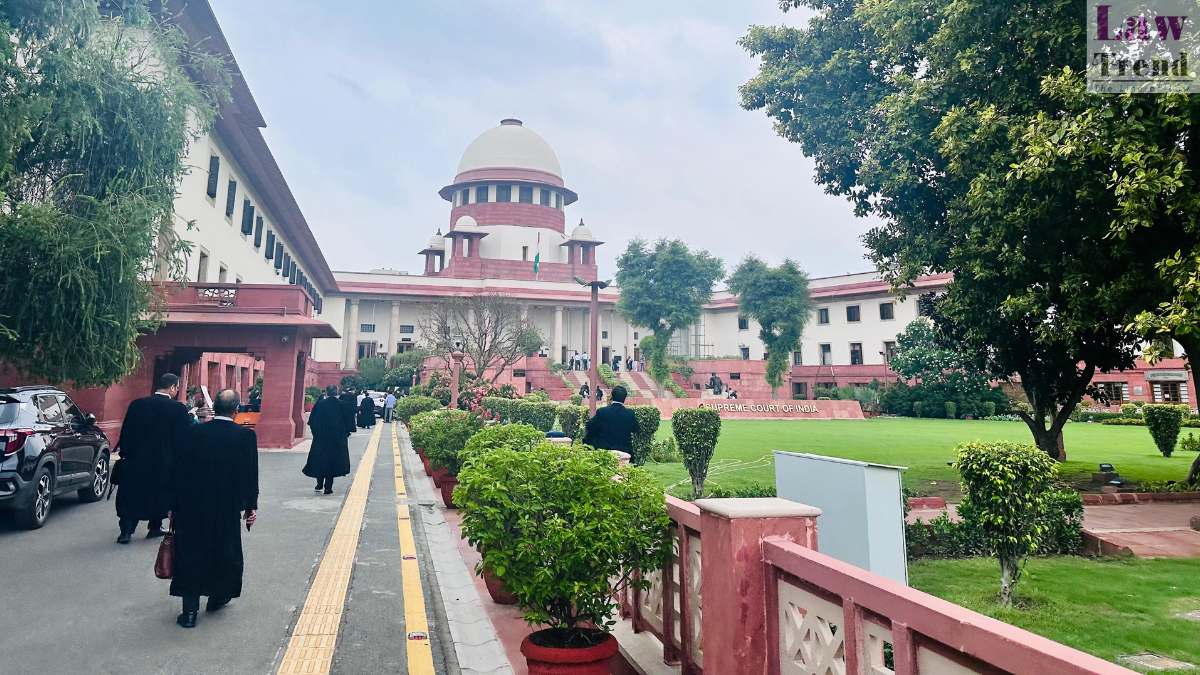
The Supreme Court of India has ruled that a High Court or a Court of Session, while exercising its statutory bail jurisdiction, cannot issue far-reaching administrative or departmental directions to the State executive. The Court clarified that a High Court’s jurisdiction under bail provisions is limited to deciding whether an individual should be incarcerated or released pending trial, and its statutory powers cannot usurp or expand beyond the scope of the enabling statute.
The division bench of Justice Sanjay Karol and Justice Prasanna B. Varale set aside the directions of the High Court of Judicature at Allahabad, which had mandated the execution of a highly structured departmental accountability system within the State of Uttar Pradesh. However, in the interest of justice, the Supreme Court directed that the administrative steps already taken by the State authorities independent of the Court’s orders shall remain unaffected.
Background of the Case
The appellant, Rambalak, had approached the High Court of Judicature at Allahabad by filing his second bail application (CRMBA No. 9700 of 2025) in a case arising out of Case Crime No. 175/2002 under Sections 419, 420, 467, 468, and 471 of the Indian Penal Code, 1860 (IPC) at Police Station Hamirpur.
By an order dated April 1, 2025, the High Court rejected the bail application. While dismissing the application, the High Court additionally directed the Trial Court to issue summons under Sections 62 and 69 of the Code of Criminal Procedure (Cr.P.C.) and to take coercive measures against individuals who delay or impede proceedings.
The High Court further mandated that the Trial Court follow directions issued in previous cases, namely Bhanwar Singh @ Karamvir v. State of U.P. (CRMBA No. 16871 of 2023) and Jitendra v. State of U.P. (CRMBA No. 9126 of 2023), alongside instructions issued by the Director General of Police (DGP) and the Home Secretary, Government of Uttar Pradesh, in compliance with those rulings.
Rambalak appealed the High Court’s order before the Supreme Court. Via an interim order dated November 26, 2025, the Supreme Court released the appellant on bail and posted the matter to specifically consider the scope of a Court’s power to issue administrative directions while exercising bail jurisdiction.
The High Court’s Departmental Accountability Directions
The directions that formed the core of the appeal originated from an order dated September 14, 2023, passed by a learned Single Judge of the Allahabad High Court in Jitendra v. State of U.P. The High Court had observed that the criminal justice system within Uttar Pradesh suffered from significant difficulties due to delays in executing summons and producing witnesses.
To address this, the High Court called for personal affidavits from the Additional Chief Secretary (Home) and the Director General of Police (DGP), Lucknow, on issues concerning the “failed” statutory accountability of officials tasked with summons service and coercive execution.
In response, the DGP and Principal Secretary (Home) filed affidavits detailing various structural reforms, which the High Court subsequently adopted as its own orders. These directions included:
- Nodal Officers: Appointing a Superintendent of Police (SP) rank officer as a Nodal Officer in every district and Commissionerate for the effective execution of summons, warrants, and notices.
- Registers and Tracking: Compulsory maintenance of a “witness register” with the ‘Court Moharrir’ containing the name, address, mobile number, and Aadhaar number of every prosecution witness.
- Summons Desks: Creating central registers and establishing specialized “summon/warrant desks” within the offices of the Nodal Officers to record processes and enter service reports.
- Accountability and Penalties: Conducting weekly audits of registers, warning subordinate officers for laxity, and initiating show-cause notices against officers and station-in-charges for consecutive months of neglect.
The Allahabad High Court ordered that these administrative circulars and government orders “shall be treated as orders of this Court for purposes of implementation,” a mandate that was reiterated in the impugned order rejecting Rambalak’s bail.
Arguments of the Parties
The Supreme Court heard submissions from the learned counsel representing the appellant, the State of Uttar Pradesh, and the amicus curiae, Ms. Akriti Chaubey, and perused the written submissions. The central legal query was whether the High Court possessed the authority under Section 483 of the Bharatiya Nagarik Suraksha Sanhita, 2023 (BNSS) to issue such systemic directions.
The Court’s Analysis
The Supreme Court began its analysis by examining the text of Section 483 of the BNSS, 2023, which details the “Special powers of High Court or Court of Session regarding bail.” The provision states:
“483. Special powers of High Court or Court of Session regarding bail. (1) A High Court or Court of Session may direct,— (a) that any person accused of an offence and in custody be released on bail, and if the offence is of the nature specified in sub-section (3) of section 480, may impose any condition which it considers necessary for the purposes mentioned in that sub-section; (b) that any condition imposed by a Magistrate when releasing any person on bail be set aside or modified: Provided that the High Court or the Court of Session shall, before granting bail to a person who is accused of an offence which is triable exclusively by the Court of Session or which, though not so triable, is punishable with imprisonment for life, give notice of the application for bail to the Public Prosecutor unless it is, for reasons to be recorded in writing, of opinion that it is not practicable to give such notice: Provided further that the High Court or the Court of Session shall, before granting bail to a person who is accused of an offence triable under section 65 or sub-section (2) of section 70 of the Bharatiya Nyaya Sanhita, 2023, give notice of the application for bail to the Public Prosecutor within a period of fifteen days from the date of receipt of the notice of such application. (2) The presence of the informant or any person authorised by him shall be obligatory at the time of hearing of the application for bail to the person under section 65 or sub-section (2) of section 70 of the Bharatiya Nyaya Sanhita, 2023. (3) A High Court or Court of Session may direct that any person who has been released on bail under this Chapter be arrested and commit him to custody.”
The Bench relied heavily on the precedent established in the recent Supreme Court judgment State of U.P. ν. Anurudh (2026 SCC OnLine SC 40). In Anurudh, the Allahabad High Court, while sitting in its bail jurisdiction, had issued far-reaching orders mandating scientific age determination of victims in POCSO Act cases. The Supreme Court in that case had held such directives to be impermissible despite arguments invoking Article 21 and the High Court’s constitutional powers.
Quoting the ruling in Anurudh, the Bench highlighted the strict limits of bail jurisdiction:
“The upshot of the above discussion is that a Court’s jurisdiction, i.e., either the Court of Sessions or the High Court under Section 439CrPC is limited to adjudicating the question of the person concerned being released into society pending trial or whether they should continue to be incarcerated.”
The Supreme Court emphasized the critical distinction between a High Court’s constitutional powers and its statutory powers when executing a specific code, noting:
“It is unquestionable that High Court is a constitutional Court. However, in the instant case the error of jurisdiction by the High Court was in exercise of a statutory power and not under the Constitution. The powers arising from the Constitution and those flowing from a statute are distinct and separate. A constitutional power is the one which emanates directly from the text and spirit of the Constitution of India, the supreme and fundamental charter of governance, and inheres in those institutions or functionaries whose existence and competence are defined by it…
In contrast, a statutory power is derivative and conditional, drawing its vitality from a law duly enacted by the Parliament or a State Legislature. Such power exists only within the four corners of the enabling statute and is circumscribed by its language, purpose, and legislative intent…
The constitutional power cannot overshadow the statutory power, enlarging its scope beyond what has been envisaged by the statute. In other words, while both powers rest with the High Court, one power cannot usurp the ambit of another, unless otherwise permitted by law.”
The Decision of the Court
Concluding that the High Court committed a jurisdictional error, the Supreme Court held that the directions incorporating administrative reforms into a bail order could not stand.
The Court ordered:
“In view of this short discussion alone, we are of the considered view that the impugned judgment in so far as it directs following what has been laid in the earlier bail orders, cannot be sustained and has to be set aside. Ordered accordingly.”
However, acknowledging that the administrative reforms initiated by the state executive are beneficial, the Court clarified:
“However, in the interest of justice we direct that the steps that have been taken by the State authorities shall remain unaffected and continue to function independent of the orders in which they stood issued. The State shall be at liberty to modify the same to be in consonance with the prevalent laws of the land should the need so arise.”
The Supreme Court also clarified that its decision on the jurisdictional question did not comment on or alter the grant or denial of bail in any of the prior orders.
Finally, the Court confirmed its interim order of November 26, 2025, which had released the appellant, Rambalak, on bail. The appeal was allowed, and all pending applications were disposed of.
Case Details
- Case Title: Rambalak v. State of U.P.
- Case No.: Criminal Appeal No. 2647 of 2026 (Arising out of Special Leave Petition (Crl.) No. 16332 of 2025)
- Bench: Justice Sanjay Karol and Justice Prasanna B. Varale
- Date: May 19, 2026