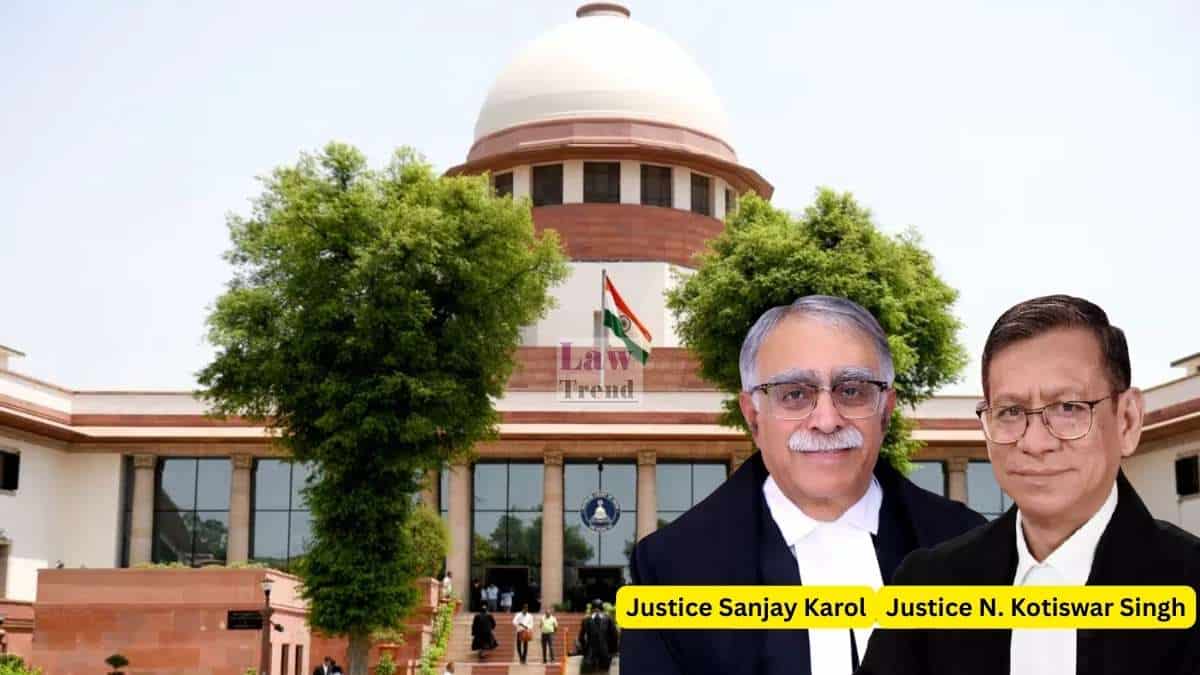
The Supreme Court of India has upheld the conviction and life imprisonment of a father-son duo, Adalat Yadav and Anirudh Yadav, in a 2008 murder case. The Court held that a conviction can legally rest on the sole testimony of a “sterling witness” and that minor contradictions or delays in filing a First Information Report (FIR) do not necessarily vitiate the prosecution’s case.
Background of the Case
The appeals arose from a December 4, 2008, incident where Ram Sharan Yadav was shot dead in Balia, Bihar. According to the prosecution, the deceased and his brother, Sunil Kumar Yadav (PW-5), were returning from the Begusarai Court when they were surrounded by the appellants and others. Adalat Yadav (A-1) allegedly fired a pistol at the deceased’s head, killing him instantly, as a retaliation for the deceased’s refusal to stop testifying in a separate murder case. Anirudh Yadav (A-2) also fired at the deceased, while others fired at the complainant and his companions, resulting in a leg injury to Sunil Yadav.
The Trial Court convicted the appellants in 2011 for offenses under Sections 302, 307, 149, and 120B of the Indian Penal Code (IPC), and Section 27 of the Arms Act. The High Court later confirmed these findings, relying primarily on the testimony of the injured complainant (PW-5) while dismissing the presence of other alleged eyewitnesses (PW-1 to PW-4).
Arguments of the Parties
Learned Senior Counsel for the appellants challenged the findings on several grounds:
- FIR Delay: The incident occurred between 5:00 and 6:00 PM, but the FIR was lodged at 10:30 PM, which the defense claimed suggested the suppression of the original version.
- Place of Occurrence: Discrepancies were noted between the FIR and the Investigating Officer’s testimony regarding the exact location and the presence of a grocery shop.
- Medical vs. Ocular Conflict: The defense argued that the post-mortem report (PW-7) inverted the fatal injury by placing the entry wound at the base of the skull and the exit wound at the nose, contradicting PW-5’s statement that the deceased was shot in the head.
- Lack of Independent Witnesses: No villagers were examined despite the incident occurring in a public area.
Conversely, the State argued that the testimony of an injured witness (PW-5) carries higher evidentiary weight and that all prosecution witnesses converged on the same general area as the spot of the crime.
The Court’s Analysis
A Bench comprising Justice Sanjay Karol and Justice Nongmeikapam Kotiswar Singh examined whether the concurrent findings were compromised by manifest error.
1. Reliability of a Single Witness The Court reiterated that under Section 134 of the Evidence Act, the quality of evidence matters more than the quantity. Citing Rai Sandeep v. State (NCT of Delhi) (2012), the Bench defined a “sterling witness” as one of very high quality whose version is unassailable. The Court observed:
“The court considering the version of such witness should be in a position to accept it for its face value without any hesitation… Under no circumstance should [it] give room for any doubt as to the factum of the occurrence, the persons involved, as well as the sequence of it.”
2. FIR Delay Referring to State of H.P. v. Gian Chand (2001), the Court held that delay in lodging an FIR is not a “ritualistic formula” for doubting a case. It noted that in rural settings, ignorance, lack of transport, or the need to regain “tranquillity of mind” after a trauma are valid reasons for delay.
3. Medical vs. Ocular Conflict The Bench found no real conflict, noting that both the witness and the doctor confirmed a headshot. The Court stated:
“If it was the case that there had been some contradictions between the testimonies, the generally applicable rule that eyewitness testimony would be superior to the medical opinion which is in the nature of expert testimony, would be applicable.”
4. Absence of Independent Witnesses Addressing the lack of independent villagers, the Court noted:
“In this case particularly the Court cannot lose sight of societal realities where, allegedly at the command of an ill-reputed person, witness in his trial had been gunned down. Hesitation on the part of the common person is but natural, not wanting to be entangled…”
Decision of the Court
The Supreme Court concluded that the testimony of the injured complainant (PW-5) was of sterling quality and unimpeachable. It found that both appellants possessed the common intention to kill. Consequently, the appeals were dismissed, and the life sentences were affirmed.
Case Details:
- Case Title: Adalat Yadav Etc. v. The State of Bihar
- Case No.: Criminal Appeal Nos. 1788-1789 of 2019
- Bench: Justice Sanjay Karol, Justice Nongmeikapam Kotiswar Singh
- Date: April 22, 2026