

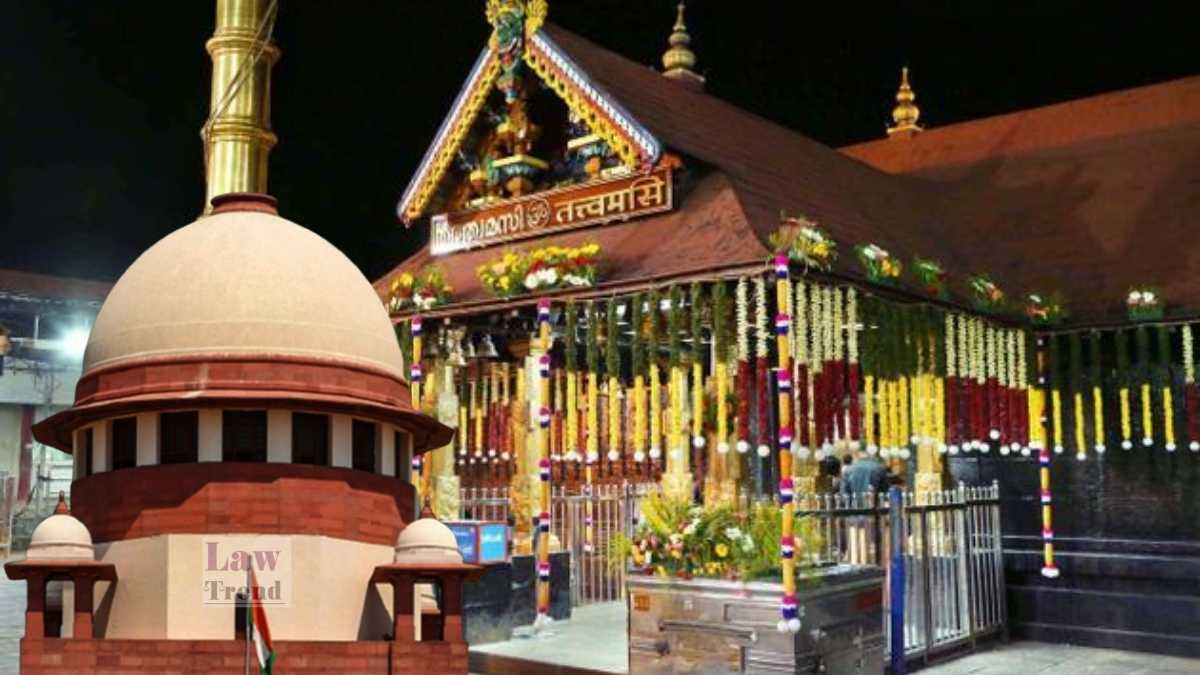
The Supreme Court of India on Tuesday raised pivotal questions regarding the intersection of constitutional rights and essential religious practices, asking the chief priest of the Sabarimala Ayyappa Temple whether the Constitution would “come to the rescue” of a devotee barred from touching a deity based on lineage or birth.
The observations were made by a nine-judge Constitution bench, led by Chief Justice Surya Kant, which is currently adjudicating a cluster of petitions concerning discrimination against women at religious places. The proceedings seek to define the ambit and scope of religious freedom under the Indian Constitution across multiple faiths.
The exchange began when senior advocate V Giri, representing the temple’s ‘thantri’ (chief priest), argued that a devotee’s worship cannot be in “antagonism” to the specific characteristics of the deity. He maintained that ceremonies and rituals are integral to religion and that a devotee must accept the “essential characteristics” of the deity, such as the Naishtika Brahmachari (perennial celibate) nature of Lord Ayyappa.
Responding to this line of reasoning, Justice Ahsanuddin Amanullah posed a fundamental constitutional query.
“When I go to a temple, my fundamental belief is that he is the Lord, he is my creator… I go there with one hundred percent belief. I am totally devoted, absolutely nothing impure in my heart,” Justice Amanullah remarked. “And there, I am told that because of a birth, a lineage, a certain situation, permanently you are not allowed to touch the deity. Now, will the Constitution not come to the rescue?”
The Justice further emphasized that there should be no distinction between the “creator and creation” in the eyes of the law.
Advocate Giri contended that the right to practice religion under Article 25 is protected, provided it aligns with the deity’s nature. He argued that since the deity at Sabarimala is a permanent celibate, the restriction on women of a certain age group is in synchronization with that religious concept. He further claimed that the petitioners had failed to prove that the concept of Naishtika Brahmachari is ill-founded or not an essential part of the faith.
Regarding the exclusion from priesthood or service (seva) based on birth, Giri suggested that such issues could be addressed through legislation under Article 25(2)(b) or by State intervention, rather than being seen as an inherent violation of the right to worship if the practice is rooted in the Shastras.
The current hearing is the latest chapter in a long-standing legal battle. In September 2018, a five-judge bench had lifted the ban on women aged 10 to 50 entering the temple, declaring the practice unconstitutional. However, in November 2019, the matter was referred to a larger bench to examine broader issues of discrimination in various places of worship.
The court had previously observed on April 17 that denominational practices are subject to judicial scrutiny. The bench noted that judges must “rise above personal religious beliefs” and be guided by the “freedom of conscience and the broader constitutional framework.”
The nine-judge bench hearing the matter includes Chief Justice Surya Kant and Justices B V Nagarathna, M M Sundresh, Ahsanuddin Amanullah, Aravind Kumar, Augustine George Masih, Prasanna B Varale, R Mahadevan, and Joymalya Bagchi. The hearing is set to continue.


