

Divorce Cannot Be Granted Merely on WhatsApp Chats Without Opportunity for Rebuttal: Bombay High Court
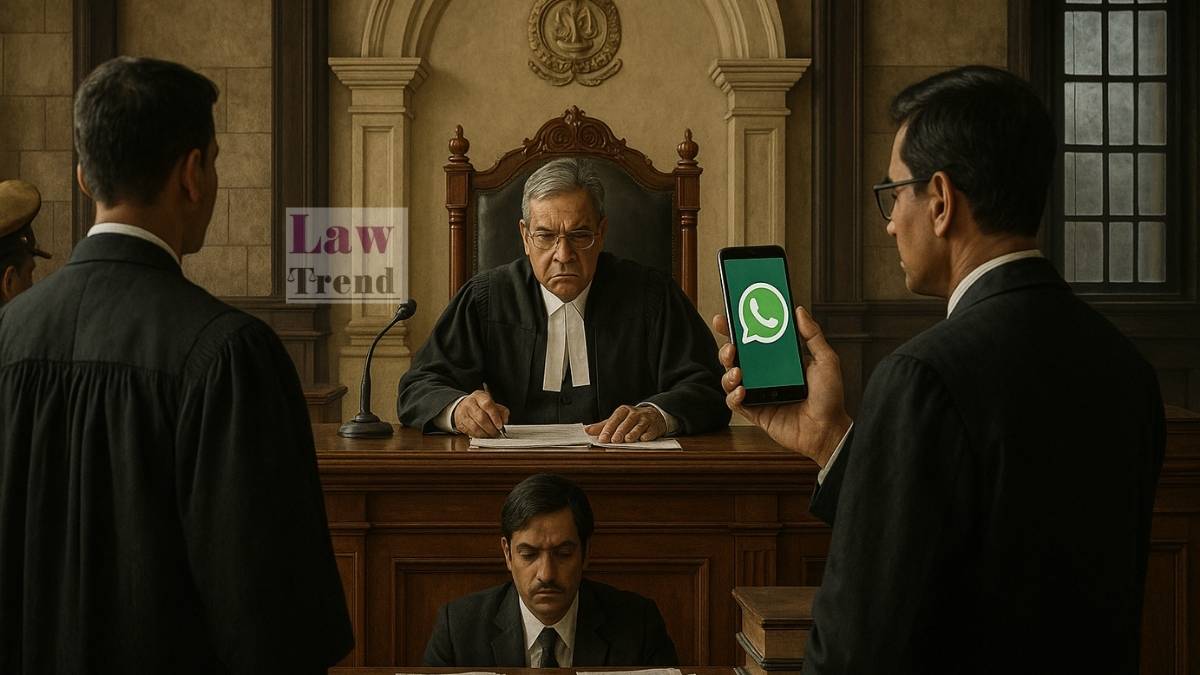

The Bombay High Court has set aside an ex-parte divorce decree granted by the Nashik Family Court, ruling that a decree of divorce cannot be granted merely by relying on WhatsApp chats without following the proper procedure of proving evidence. A Division Bench comprising Justice Bharati Dangre and Justice Manjusha Deshpande observed that such electronic evidence must be proved through proper legal testimony and that the wife must be given an opportunity to rebut the allegations of cruelty.

Background of the Case

The appellant (wife) challenged the Judgment and Order dated May 27, 2025, passed by the Family Court, Nashik, in Petition No. A-185 of 2024. The original petition was filed by the husband under Section 13(1)(ia) of the Hindu Marriage Act, 1955, seeking divorce on the ground of cruelty. The Family Court had allowed the petition ex-parte, granting a decree of divorce in favor of the husband based primarily on the evidence of WhatsApp and SMS communications.

The Family Court’s Analysis

The Family Court had concluded that the husband was subjected to mental cruelty by the wife. In its findings, the lower court judge noted:

“The unchallenged testimony of the petitioner is supported by WhatsApp Chat and SMS chat between the parties. The Chat clearly show insistence on the part of the respondent-wife to migrate to Pune rather than stay at Nashik Dist. Nashik. Some of the Chat show derogatory messages used for sister in law, mother in law by the respondent.”

The lower court further remarked that a wife telling her husband that his sister would “role play as his wife” constituted “serious mental cruelty.” It also held that the wife’s use of “pressure tactics, emotional black mail and intemperate language” regarding the husband’s refusal to migrate to Pune despite working in a “work from home mode” entitled the husband to a divorce.

READ ALSO  Section 376(2)(n) IPC | Prosecutrix Is a Major Lady and Went to Hotel Room With Her Consent; Allegation of Rape is Not Sustainable: Madhya Pradesh HC

High Court’s Observations

Upon perusal of the record, the Bombay High Court noted that the Family Court’s decision was based on an unchallenged testimony where the wife was not given an opportunity to rebut the evidence.

The Bench emphasized that the reliance on electronic messages as the sole basis for a divorce decree was legally unsustainable without the evidence being formally proved. The Court held:

“Merely relying on the WhatsApp Chat, the divorce decree cannot be granted, since it is not proved by leading evidence. Therefore, according to us, the Judgment & Decree of Divorce needs to be set aside by remanding the matter back to the Family Court, by granting opportunity to the Appellant-Wife to be heard and liberty to lead evidence.”

The Decision

The High Court set aside the Family Court’s order dated May 27, 2025, and remanded the matter back to the Nashik Family Court for a fresh determination of all issues. The Court directed that both parties be given the opportunity to lead evidence.

READ ALSO  Consideration Need Not Always Be Monetary: Supreme Court Upholds Right to Family Property

Additionally, the Bench noted a suggestion from the respondent’s counsel and granted the parties liberty to “explore the possibility of settlement through Mediation” while the matter is pending. The Family Court Appeal, along with the connected interim application, was disposed of accordingly.

Law Trend
Law Trendhttps://lawtrend.in/
Legal News Website Providing Latest Judgments of Supreme Court and High Court

Related Articles

Latest Articles

