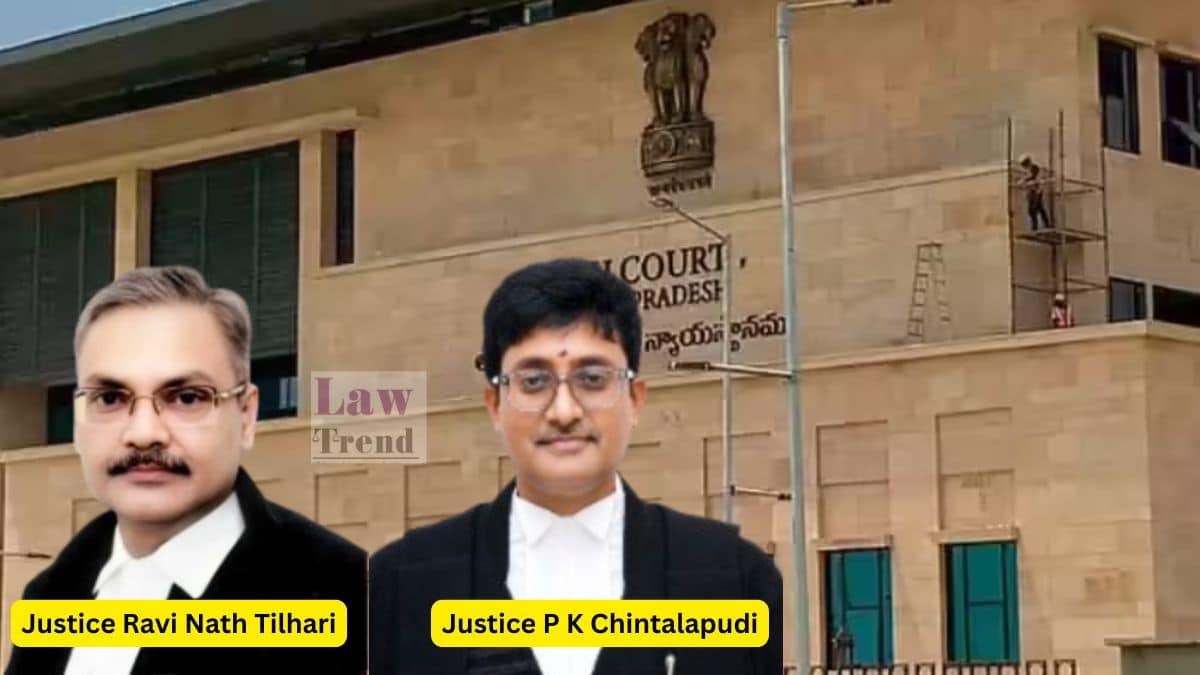
The High Court of Andhra Pradesh, in a judgment delivered by Justice Ravi Nath Tilhari and Justice Purushottam Kumar Chintalapudi, has held that 50 percent of the service rendered by a commission vendor prior to regularization must be counted toward calculation of pensionary benefits. Dismissing a writ petition filed by the Union of India and South Central Railway, the Court upheld an order of the Central Administrative Tribunal (CAT), Hyderabad Bench, and directed the Railway authorities to implement the relief without further delay.
Background of the Case
The respondent, M. Venkateswara Rao, was initially appointed as a vendor on a temporary commission basis on November 25, 1980, at VRR/SLO. On March 11, 1997, while working on Train No. 7007, he sustained a severe injury to his right thumb after being hit by a train door and was sent for medical treatment.
Screening committees were subsequently constituted on May 25, 1998, and November 18, 2002, for the absorption of commission vendors. Following a special medical examination on August 22, 2005, the respondent’s services were regularized on February 13, 2006, as a Hospital Attendant at the Health Unit, Eluru Railway Station.
On July 16, 2019, the respondent submitted a representation requesting the Railway authorities to grant him benefits under the General Provident Fund (GPF) and the Old Pension Scheme by calculating his temporary service from November 25, 1980. The authorities rejected his representation on August 2, 2019. Aggrieved by the rejection, the respondent filed Original Application (OA No. 020/00093/2022) before the CAT, Hyderabad Bench, seeking to quash the rejection memorandum and count his casual labour service for pensionary benefits on par with similarly situated employees.
On April 2, 2024, the CAT allowed the OA, quashed the rejection order, and directed the Railways to count 50 percent of the respondent’s service rendered as a Commission Vendor/Bearer prior to regularization for pensionary benefits, restricting monetary benefits to three years prior to the filing of the OA. The Union of India and South Central Railway challenged this order before the High Court.
Arguments of the Parties
The Union of India and South Central Railway argued that the respondent was regularized in the year 2006 and was therefore covered under the New Pension System (NPS). They contended that the appointment order issued in 2005 was a fresh appointment on a temporary basis, confirmed in 2006. The petitioners submitted that once the respondent accepted the fresh appointment order, he could not claim his earlier service as a commission vendor toward pensionary benefits. The petitioners also relied upon Clause-B of the Railway Establishment Manual concerning casual labour acquiring temporary status.
Court’s Analysis and Observations
The High Court observed that Clause-B of the Railway Establishment Manual relates to an entirely different aspect concerning recruitment and selection, rather than the counting of casual service for pensionary benefits.
Examining the merits, the Court held that the issue is squarely covered by the Supreme Court judgments in Union of India v. Munshi Ram (2022) and Union of India v. Rakesh Kumar (2017).
Referencing Union of India v. Munshi Ram, the High Court highlighted the Apex Court’s ruling that employees working under the Railway Board across different zones and divisions must be treated equally without discrimination under Articles 14 and 16 of the Constitution of India. The Supreme Court in that decision observed:
“Therefore, the employees working under the same employer Railway Board working in different Zones/Divisions are required to be treated similarly and equally and are entitled to similar benefits and are entitled to the same treatment. As rightly submitted on behalf of the respondents, there cannot be any discrimination inter se.”
The Supreme Court had further ruled:
“To deny similar benefits would tantamount to discrimination and in violation of Articles 14 and 16 of the Constitution of India.”
Addressing the calculation of casual service, the High Court cited Union of India v. Rakesh Kumar, where the Supreme Court interpreted Rules 20 and 31 of the Railway Services (Pension) Rules, 1993, along with Indian Railway Establishment Manual provisions, holding:
“We, however, are of the view that the period of casual labour prior to grant of temporary status by virtue of Note 1 of Rule 31 has to be counted to the extent of 50% for pensionary benefits.”
“The casual worker after obtaining temporary status is entitled to reckon 50% of his services till he is regularised on a regular/temporary post for the purposes of calculation of pension.”
“The casual worker before obtaining the temporary status is also entitled to reckon 50% of casual service for the purposes of pension.”
The High Court noted that the respondent was appointed in 1980 as a commission vendor, appointed on a temporary basis, and confirmed in 2006, demonstrating that he had acquired temporary status. The Court observed that the respondent had rendered 22 years of service from 1980 until his absorption in 2006. Calculating 50 percent of this period yields 13 years, which must be added to his regular service following absorption. Furthermore, noting that in Munshi Ram, benefits were extended even to employees who had not completed 10 years of service post-absorption before retirement, the High Court affirmed the Tribunal’s finding that the respondent stands on a better footing.
Decision of the Court
The High Court held that the Tribunal had correctly quashed the rejection order dated August 2, 2019, and directed the counting of casual service in accordance with the binding precedents of the Supreme Court.
Consequently, the High Court dismissed the writ petition filed by the Railways, made no order as to costs, and directed the petitioners to implement the order of the Tribunal without any further delay.
Case Details
Case Title: Union of India & 3 others v. M. Venkateswara Rao
Case No.: Writ Petition No. 21009 of 2026
Bench: Justice Ravi Nath Tilhari and Justice Purushottam Kumar Chintalapudi
Date: 29.07.2026