

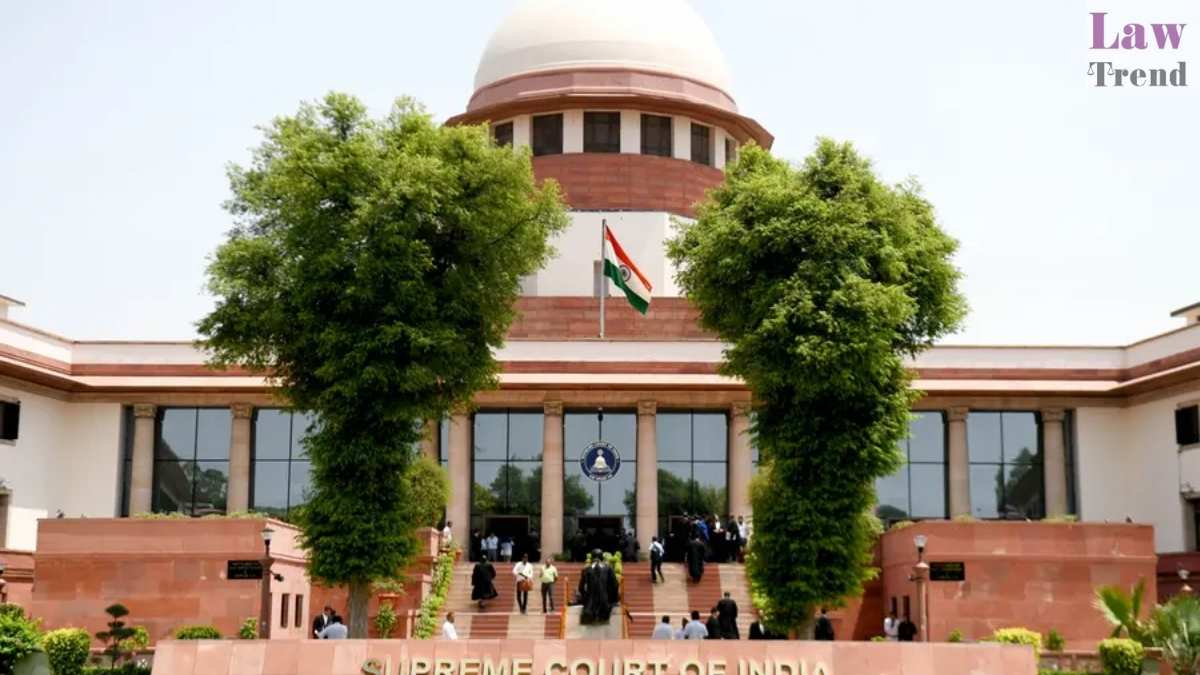
Reiterating that the proof of demand and acceptance of illegal gratification is indispensable to sustain a conviction under the Prevention of Corruption Act, 1988, a Supreme Court bench comprising Justice Ujjal Bhuyan and Justice Atul S. Chandurkar set aside the conviction of a former education department assistant. The top court held that mere recovery of tainted money from an accused person, in the absence of independent proof of demand, cannot establish guilt beyond reasonable doubt. Even though the appellant had already served out his four-year sentence and paid the fine, the Court cleared him of all charges to restore his reputation.
Background of the Case
The case dates back to 2010 when the complainant, Durgapad Singh Munda (PW-1), was appointed as an orderly at the Government High School in Sirum. With his salary remaining unpaid, Munda approached the District Education Office in Saraikella. There, the appellant, Ajit Kumar, who worked as an Assistant, allegedly demanded a bribe of Rs. 5,000 to facilitate the release of the salary.
Unwilling to pay the bribe, Munda filed an application on April 19, 2010, with the Superintendent of Police, Vigilance Bureau, Ranchi. A verification was entrusted to Police Inspector Shyamlal Champiya (PW-2), who submitted a verification report a month later, on May 19, 2010, affirming the allegations. Following this, Vigilance Case No. 17 of 2010 was registered.
A trap was organized on May 20, 2010. Phenolphthalein-dusted currency notes were handed to the complainant. According to the prosecution, the complainant accompanied Kumar to his rented residence, where the money was handed over and placed under a bed or pillow. The vigilance team subsequently apprehended Kumar, recovered the currency notes from his room, and recorded that his fingers turned pink when dipped in a chemical solution.
Investigating Officer DSP Ramashish Raut (PW-11) filed a chargesheet on July 10, 2010, and charges were framed under Sections 7, 13(2), and 13(1)(d) of the Prevention of Corruption Act. On February 27, 2021, the Special Judge, Anti-Corruption Bureau, West Singhbhum at Chaibasa convicted Kumar and sentenced him to four years of rigorous imprisonment alongside a fine of Rs. 10,000 for each offense. The High Court of Jharkhand dismissed Kumar’s appeal on July 21, 2022.
When the Supreme Court issued notice on July 24, 2026, Kumar’s counsel informed the bench that the appellant had already undergone the entire term of imprisonment and paid the fine, but wished to pursue the appeal to clear his name. Leave was subsequently granted on September 23, 2026.
Arguments of the Parties
Appearing for the appellant, Advocate Shambo Nandy argued that both the trial court and the High Court fell into grave error by basing the conviction entirely on the uncorroborated testimony of the complainant. He contended that the prosecution failed to prove the demand for illegal gratification, which is the foundational prerequisite for offenses under Sections 7 and 13 of the Act.
The defense highlighted that the alleged bribe exchange took place inside Kumar’s private residence without any member of the trap team, shadow witness, or independent witness present to verify the demand or receipt. Counsel further argued that mere recovery of currency notes and a positive phenolphthalein test cannot substitute for substantive proof of demand, and pointed out uncurable procedural infirmities, including contradictory accounts from trap team members and belated testing.
Opposing the appeal, counsel for the State of Jharkhand, Mr. Mukherjee, argued that the findings of the trial court and the High Court were founded on an accurate appreciation of the evidence. He submitted that minor discrepancies among witnesses do not dilute the core proof of demand and acceptance. The State also contended that because the appellant had already served out his sentence, the appeal had been reduced to a purely academic exercise and deserved dismissal.
Court’s Analysis and Precedents
Reviewing the depositions of all twelve prosecution witnesses, the Supreme Court identified glaring contradictions in the prosecution story. While some members of the trap team deposed that the appellant was arrested at his rented residence, others maintained that he was apprehended in his office after returning on a motorcycle. More crucially, clerk witnesses called to substantiate the search (PW-8 and PW-9) testified in cross-examination that they did not witness any recovery and had merely signed blank or prepared documents under directions from vigilance officers.
The bench emphasized that across the entire record, not a single witness—apart from the uncorroborated word of the complainant—actually saw the accused demand the bribe or witness the money being handed over.
To reiterate the established legal principles, the Court discussed several authoritative precedents:
In P. Satyanarayana Murthy Vs. State of A.P. (2015), the Supreme Court ruled:
“The proof of demand of illegal gratification, thus, is the gravamen of the offence under Sections 7 and 13(1)(d)(i) and (ii) of the Act and in absence thereof, unmistakably the charge therefor, would fail. Mere acceptance of any amount allegedly by way of illegal gratification or recovery thereof, dehors the proof of demand, ipso facto, would thus not be sufficient to bring home the charge under these two sections of the Act. As a corollary, failure of the prosecution to prove the demand for illegal gratification would be fatal and mere recovery of the amount from the person accused of the offence under Section 7 or 13 of the Act would not entail his conviction thereunder.”
The Court also referenced the Constitution Bench judgment in Neeraj Dutta Vs. State (Government of NCT of Delhi) (2023), which declared:
“88.1. (a) Proof of demand and acceptance of illegal gratification by a public servant as a fact in issue by the prosecution is a sine qua non in order to establish the guilt of the accused public servant under Sections 7 and 13(1)(d) (i) and (ii) of the Act.”
“88.2. (b) In order to bring home the guilt of the accused, the prosecution has to first prove the demand of illegal gratification and the subsequent acceptance as a matter of fact. This fact in issue can be proved either by direct evidence which can be in the nature of oral evidence or documentary evidence.”
Similarly, the bench drew upon Aman Bhatia Vs. State (2025), which held:
“52. It is well-settled that mere recovery of tainted money, by itself, is insufficient to establish the charges against an accused under the PC Act. To sustain a conviction under Sections 7 and 13(1)(d) of the Act respectively, it must be proved beyond reasonable doubt that the public servant voluntarily accepted the money, knowing it to be a bribe. The courts have consistently reiterated that the demand for a bribe is sine qua non for establishing an offence under Section 7 of the PC Act.”
“55. From the above exposition of law, it may be safely concluded that mere possession and recovery of tainted currency notes from a public servant, in the absence of proof of demand, is not sufficient to establish an offence under Sections 7 and 13(1)(d) of the PC Act respectively. Consequently, without evidence of demand for illegal gratification, it cannot be said that the public servant used corrupt or illegal means, or abused his position, to obtain any valuable thing or pecuniary advantage in terms of Section 13(1)(d) of the PC Act.”
The bench noted that these principles were further reiterated in Jaswinder Singh Vs. State of Punjab (2026), where it was observed:
“21. Under such circumstances, it is evident that neither the demand nor acceptance of the bribe can be said to have been proved. As a matter of fact, no one saw the appellant making the demand for bribe and no one saw PW-1 handing over the bribe money to the appellant nor acceptance of the same by the appellant. The fact situation of this case, thus, is squarely covered by the judgments of this Court in Satyanarayana Murthy, Neeraj Dutta and in Aman Bhatia.”
The Decision
Applying these settled principles, the Court held that the prosecution had failed to establish the fact in issue—the demand and acceptance of illegal gratification—beyond reasonable doubt. Consequently, the conviction could not be sustained.
Allowing the appeal, the Supreme Court set aside the judgments and orders of the Special Judge dated February 27, 2021, and the Jharkhand High Court dated July 21, 2022. The Court declared that the charges framed against Ajit Kumar under Sections 7 and 13 of the Prevention of Corruption Act remained unproved, and formally cleared him of all charges.
Case Title: Ajit Kumar Versus State of Jharkhand
Case No.: Criminal Appeal No. 4573 of 2026
Bench: Justice Ujjal Bhuyan and Justice Atul S. Chandurkar
Date: October 05, 2026




