

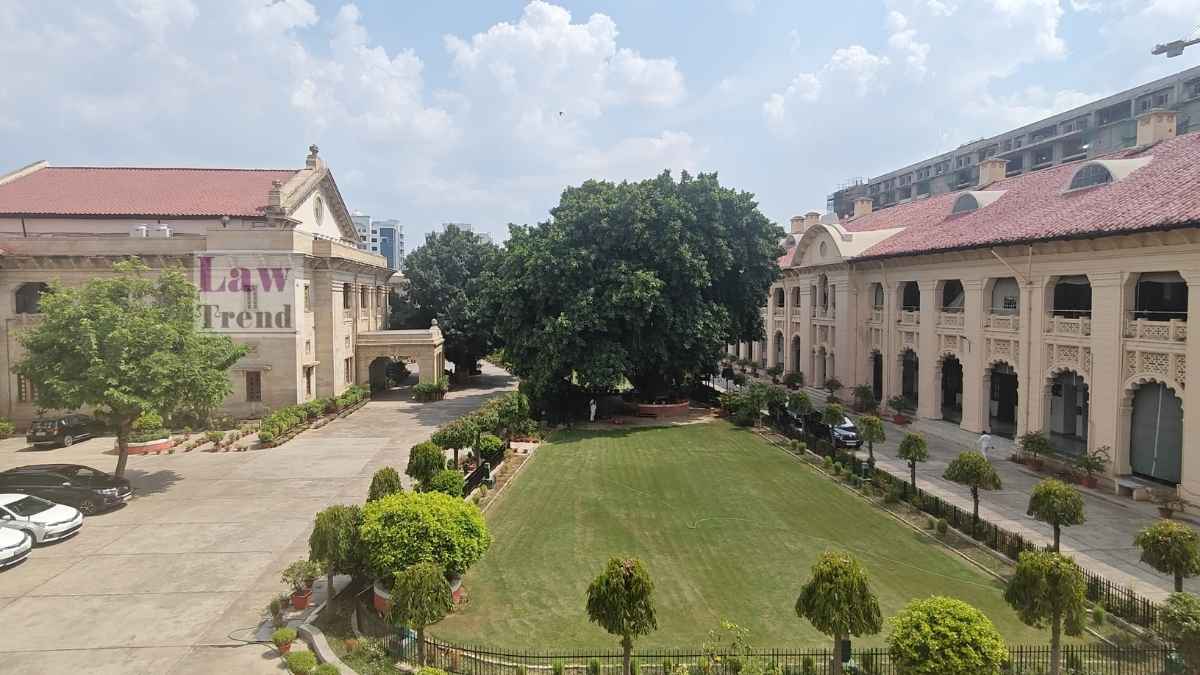
In a comprehensive verdict determining the statutory procedure for appointing institutional heads across Uttar Pradesh, the High Court of Judicature at Allahabad, presided over by Justice Siddharth Nandan, has held that selections to the post of Principal must adhere strictly to the merit mechanism prescribed under the Uttar Pradesh Secondary Education Services Selection Board Rules, 1998, rather than older administrative guidelines. The Court ruled that senior-most officiating teachers cannot claim an automatic preference over direct recruits contrary to the statutory framework and affirmed that under the doctrine of necessity, the Chairman of the Selection Board was legally competent to declare the final select panel despite the retirement of all Board members. With these findings, the Court dismissed a batch of 115 writ petitions challenging the select lists notified in November 2022, directing that the recruitment process initiated in 2013 be brought to its logical end.
Background of the Dispute
The controversy stemmed from Advertisement No. 3 of 2013, published on December 31, 2013, by the Uttar Pradesh Secondary Education Services Selection Board for filling vacancies of Principals and Headmasters across Intermediate and High School institutions (both Boys and Girls categories). Following verification of vacancies, an amended advertisement fixed February 25, 2014, as the last date for submitting applications.
After multiple rounds of litigation and an interim order, the Board issued corrigenda on January 1 and January 2, 2022, transitioning the process online and permitting candidates to verify details and submit three institution preferences by January 8, 2022. The eligibility cut-off date was affirmed by the Court in Mohan Singh and others v. State of U.P. and others. The Board subsequently notified the interview schedule on February 22, 2022, and interviews were conducted in March 2022 across various divisions.
On November 11 and November 13, 2022, the Board notified region-wise select panels. This prompted 115 writ petitions, led by Dr. Sanjay Kumar Mishra, filed primarily by senior-most lecturers serving as officiating Principals who had participated in the selection but failed to secure appointment.
The Court categorized the writ petitions into three distinct classes:
- Category-A: Officiating Principals/Headmasters who were ineligible on the cut-off date of February 25, 2014 (Petitions 1 to 20).
- Category-B: Officiating Principals/Headmasters who attained the age of superannuation during the pendency of their petitions (Petitions 21 to 37).
- Category-C: Candidates and officiating Principals who participated in the interview but were not selected due to lower aggregate marks (Petitions 38 to 115).
Preliminary Objection on Estoppel
At the outset, the respondents raised a preliminary objection, asserting that the petitioners, having participated in the interview without demur, were estopped from challenging the selection criteria after being declared unsuccessful.
The petitioners countered this objection by relying on the Supreme Court judgments in Ramjit Singh Kardam and others v. Sanjeev Kumar and others, Rajasthan High Court and another v. Rajat Yadav and others, and Dr. (Major) Meeta Sahai v. State of Bihar, arguing that estoppel does not bar a challenge when a candidate is unaware of an undisclosed departure in criteria or where the procedure suffers from patent statutory illegality.
Rejecting the preliminary objection, the Court held that the petitioners could not be shut out at the threshold without an examination of their core grievance—namely, whether the Board had departed from binding procedural guidelines earlier approved by the High Court in Indra Raj Singh Yadava v. U.P. Madhyamik Shiksha Sewa Ayog and others.
Arguments on Behalf of the Parties
1. Validity of Declaration of Results by the Chairman Alone Senior Counsel Shri Ashok Khare and other counsels appearing for the petitioners contended that under Section 4 of the Uttar Pradesh Secondary Education (Services Selection Boards) Act, 1982, the Board is a multi-member body consisting of a Chairman and ten members. Citing Regulation 4(6) of the 1998 First Regulations—which stipulates a quorum of one-half of the total members—and “Shackleton on the Law and Practice of Meetings,” they submitted that a valid meeting requires more than one person. Consequently, they argued that the Chairman acted without jurisdiction in declaring results after all other members had retired.
The respondents, placing reliance on Deepak Kumar Agarwal v. State of U.P., Charan Lal Sahu v. Union of India, Election Commission of India v. Dr. Subramanian Swamy, Lalit Kumar Modi v. Board of Control for Cricket in India, and Babasaheb Wasade and others v. Manohar Gangadhar Muddeshwar and others, argued that the interviews were duly conducted when the Board was fully functional. The subsequent declaration was an administrative act saved by the “doctrine of necessity,” without which the decade-long recruitment process would collapse into a complete vacuum.
2. Application of the Indra Raj Singh Yadava Guidelines On the substantive selection method, the petitioners argued that under the longstanding procedure approved in Indra Raj Singh Yadava, the Board was required to call the two senior-most teachers along with the top five direct applicants from a graded list for each institution. Under that mechanism, if the senior-most teacher secured the highest marks among those seven, they were selected; only if they failed was the institution thrown open to general direct candidates. By preparing a single overall merit list and factoring in all applicants who gave the institution as their first preference, the Board allegedly eliminated the senior-most teachers unfairly, violating legitimate expectations and altering the rules of the game midway under Tej Prakash Pathak v. Rajasthan High Court.
In response, counsel for the Board and selected candidates demonstrated that the Indra Raj Singh Yadava guidelines were formulated under the old 1983 Rules, which lacked provisions for Quality Point Marks and structured interviews. Following U.P. Act No. 25 of 1998, the U.P. Secondary Education Services Selection Board Rules, 1998, created a complete self-contained code. Under Rule 11(2)(b) and Rule 12(8), selections are strictly direct recruitment based on total merit (Quality Point Marks plus interview marks) prepared institution-wise according to candidate preferences, leaving no statutory room for the old 1:5 ratio mechanism.
The Court’s Analysis and Findings
1. On the Doctrine of Necessity and the Chairman’s Action Examining Issue No. 1, the Court observed that when interviews were conducted in March 2022, the members were present and actively participated in grading. The retirement of members prior to the final publication created an administrative exigency.
Rejecting the argument that the doctrine of necessity applies strictly to situations involving bias, the Court observed:
“…the doctrine of necessity cannot be curtailed, to have its applicability only when there is a facet of bias; but it has also to be seen in a proper spectrum, when in cases of administrative exigencies and in performance of a public duty by any authority, a situation arises when there is a possibility of a vacuum and the entire administrative exercise to be rendered as a futile exercise, in order to save the process, the doctrine of necessity can very well be invoked, as has been done in the present case, where though at the time of interview, members were available and only by the time Select Panel was to be declared, the exigency arose and the Chairman alone had to declare the same; and merely the presence of ministerial and administrative staff, alone would not vitiate the entire exercise.”
The Court concluded that in the absence of an express prohibitive clause in the Act or Regulations, the Chairman’s declaration saved the process initiated in 2013 from becoming futile and decided the issue in favour of the Board.
2. On the Primacy of the 1998 Rules Over Old Guidelines Turning to Issue No. 2, the Court analyzed the shift from the 1983 regime to the 1998 Rules, whose constitutional validity had already been upheld by the Supreme Court in Balbir Kaur and another v. U.P. Secondary Education Services Selection Board.
The Court noted that while Rule 11(2)(b) obligates the management to forward the names and service records of the two senior-most teachers to ensure they are interviewed, Rule 12 governs the direct recruitment process. Under Rule 12(8), the Board must prepare an institution-wise panel in order of merit, aggregating the Quality Point Marks with the marks obtained in the interview, while respecting candidates’ exercised preferences.
Addressing the petitioners’ claim for preference, the Court held:
“…in view of Rule 12(8) of the Rules, 1998, the Board is required to prepare a panel of candidates in order of merit, as determined on basis of the marks obtained by them, after adding the marks obtained under Sub-Clause (iv) or Sub-Clause (v), as the case may be; and therefore no preference can be accorded vis-a-vis the direct applicants, for the said preference contrary to the Rule 12 of the Rules, 1998 as claimed by the petitioners, who are amongst the two senior-most Lecturers and any interpretation to the contrary shall do violence to the statutory provision.”
The Court underscored that restricting the interview pool to only five candidates against the senior-most teachers would contravene the mandate of Rule 12(8) and exclude higher-scoring candidates. The Court held that the guidelines approved in Indra Raj Singh Yadava applied solely under the 1983 framework and ceased to operate once the comprehensive statutory code of the 1998 Rules came into force.
3. Disposal of Categories A and B Addressing the specific categories:
- For Category-A, the Court held that eligibility must strictly be assessed on the application cut-off date (February 25, 2014); hence, ineligible candidates had no locus standi.
- For Category-B, citing Committee of Management, Jagdish Saran Rajvanshi Kanya Inter College v. Joint Director of Education, R.L. Prasad v. State of U.P., Kumari Chitra Ghosh v. Union of India, Dr. N.C. Singhal v. Union of India, and Khalid Hussain (Minor) v. Commissioner and Secretary to Government of Tamil Nadu, the Court affirmed that teachers who have reached superannuation possess no vested right to continue or receive appointment letters once regular selections are completed.
Final Decision
Finding no illegality in the procedure adopted by the Board, the High Court held that no case was made out for judicial interference under Article 226 of the Constitution of India.
The Court ordered:
“In view of the above, the entire batch of Petitions, stand dismissed; and the consequences shall follow, while the selection which was initiated in the year 2013, shall be brought to it’s logical end. However, there shall be no order as to costs.”
The Court also placed on record its appreciation for the research undertaken by Ms. Pratibha Verma, Research Associate.
Legal Representation and Appearances
Arguing Counsels Heard by the Court:
- For the Petitioners: Shri Ashok Khare, Senior Advocate assisted by Shri Mohd. Yaseen, Advocate, holding brief of Shri Siddharth Khare, Advocate; Shri P.K. Mishra, Advocate; Shri Sanjay Kumar Kushwaha, Advocate; Shri Anurag Shukla, Advocate; Shri Raghvendra Tripathi, Advocate; Shri Rahul Jain, Advocate; Shri Sandeep Kumar, Advocate; Shri Ram Sakal Yadav, Advocate; Shri Narendra Singh, Advocate; Shri Mahesh Sharma, Advocate; Shri P.K. Singh, Advocate; Shri Nand Lal Pandey, Advocate and Shri Suyash Pandey, Advocate; Shri M.M. Sahai, Advocate; and Shri Bheem Singh, Advocate and Shri Aalok Singh, Advocate.
- For the Respondents: Shri G.K. Singh, Senior Advocate, assisted by Shri Sheetendra Kumar Mishra, Advocate; Shri Satyendra Pratap Singh, Advocate, holding brief of Shri Vishal Tandon, Advocate; Shri Umesh Vats, Senior Advocate, assisted by Shri Sheetendra Kumar Mishra, Advocate; Shri Umesh Vats, Senior Advocate, assisted by Shri Vikrant Pratap Singh, Advocate; Shri Vijay Kumar Sharma, Advocate; Shri V.K. Singh, Senior Advocate, assisted by Shri Triloki Nath, Advocate; Shri K. Shahi (Kushmondeya Shahi), Advocate (for the UP Secondary Education Services Selection Board); and the learned Chief Standing Counsel / Standing Counsel for the State-respondents.
Complete List of Counsels on Record:
- Counsel for Petitioner(s): Siddharth Khare, Sr. Advocate, A.K.S. Parihar, Alok Singh, Abhishek Mishra, Achal Singh, Adarsh Singh, Aditendra Singh, Akhilendra Singh, Alok Dwivedi, Anand Vikram Singh, Anirudh Singh, Anjani Kumar, Anmol Ratan, Anshul Pathak, Anubhav Dwivedi, Anurag Parihar, Anurag Shukla, Arvind Kumar Verma, Awadhesh Kumar Malviya, Bachchu Lal Yadav, Bajrang Bahadur Singh, Bhawesh Pratap Singh, Bheem Singh, Brijesh Kumar, Brijesh Kumar Verma, Dinesh Kumar Pandey, Gaurang Dwivedi, Grijesh Tiwari, H.K. Asthana, Himanshi Srivastava, Himanshu Upadhyay, Indra Raj Singh, Jai Prakash Rao, Jitendra Pratap Singh, Kailash Pati Singh Yadav, Kunwar Aditya Pratap Singh, Kunwar Akhilendra Singh, Madhukar Maurya, Mahendra Singh, Mahesh Sharma, Man Mohan Singh, Manoj Kumar Dwivedi, Mritunjay Mohan Sahai, Mukesh Kumar, Nand Lal Pandey, Narendra Singh, Neha Roy Choudhury, Om Prakash Pandey, Pooja Kusum, Prabhakar Awasthi, Prabhat Chandra Sharma, Prabhat Kumar Singh, Prashant Shukla, Praveen Kumar Mishra, Purnendu Bajpai, Raghvendra Tripathi, Rahul Jain, Rahul Mishra, Rahul Singh Dahiya, Rajendra Prasad Dubey, Ram Krishna Yadav, Ram Prakash Upadhyay, Ram Sakal Yadav, Ramesh Chandra Dwivedi, Ravi Pratap Singh, Rohit Singh, S.M. Mishra, Sandeep Kumar, Sanjay Kumar Kushwaha, Sanjay Kumar Singh, Satish Chandra Dubey, Satya Prakash Singh, Satyam Mishra, Satyendra Chandra Tripathi, Saurabh Tripathi, Shailesh Pandey, Shashi Kant Mishra, Shilpi Singh, Shivendu Ojha, Shyam Lal, Sneh Pandey, Sunil Kumar Srivastava, Suyash Pandey, Vijay Singh Sengar, Vinod Kumar Singh, Yogendra Kumar Srivastava.
- Counsel for Respondent(s): Chief Standing Counsel (C.S.C.), Krishna Kumar Chand, Ramesh Kumar Tiwari, A.K.S. Parihar, Aditi Pandey, Anand Kumar Srivastava, Anil Kumar Yadav, Anubhav Dwivedi, Anurag Kumar, Arvind Prabodh Dubey, Ashish Malhotra, Babita Upadhyay, Bajrang Bahadur Singh, Braj Bhushan Singh Chauhan, D.K. Ojha, Hari Kant Shukla, Harikesh, Harish Chandra Yadav, Hridai Narain Pandey, Hritudhwaj Pratap Sahi, Jagannath Maurya, Krishna Kumar, Kushmondeya Shahi, Manish Tiwari, Nikhil Pandey, P.K. Upadhyay, Prabhakar Awasthi, Prabhat Kumar Singh, Pradyumn Kumar, R.R. Pandey, Rajendra Prasad Dubey, Rakesh Kumar Patel, Rakesh Kumar Singh, Rohit Upadhyay, Samarath Singh, Sanjeev Kumar Gaur, Sankalp Narain, Santosh Kumar Yadav, Satya Prakash Singh, Sharad Chandra Upadhyay, Sheetendra Kumar Mishra, Shiv Sagar Singh, Shobhit Chauhan, Sr. Advocate, Triloki Nath, Umesh Vats, Vashishtha Tiwari, Vijay Kumar Sharma, Vibhanshu Vaibhav, Vikrant Pratap Singh, Vishal Tandon.
Case Title: Dr. Sanjay Kumar Mishra Versus State of U.P. and 6 others
Case No.: Writ – A No. 19537 of 2022 (along with connected matters)
Bench: Justice Siddharth Nandan
Date: October 5, 2026




