

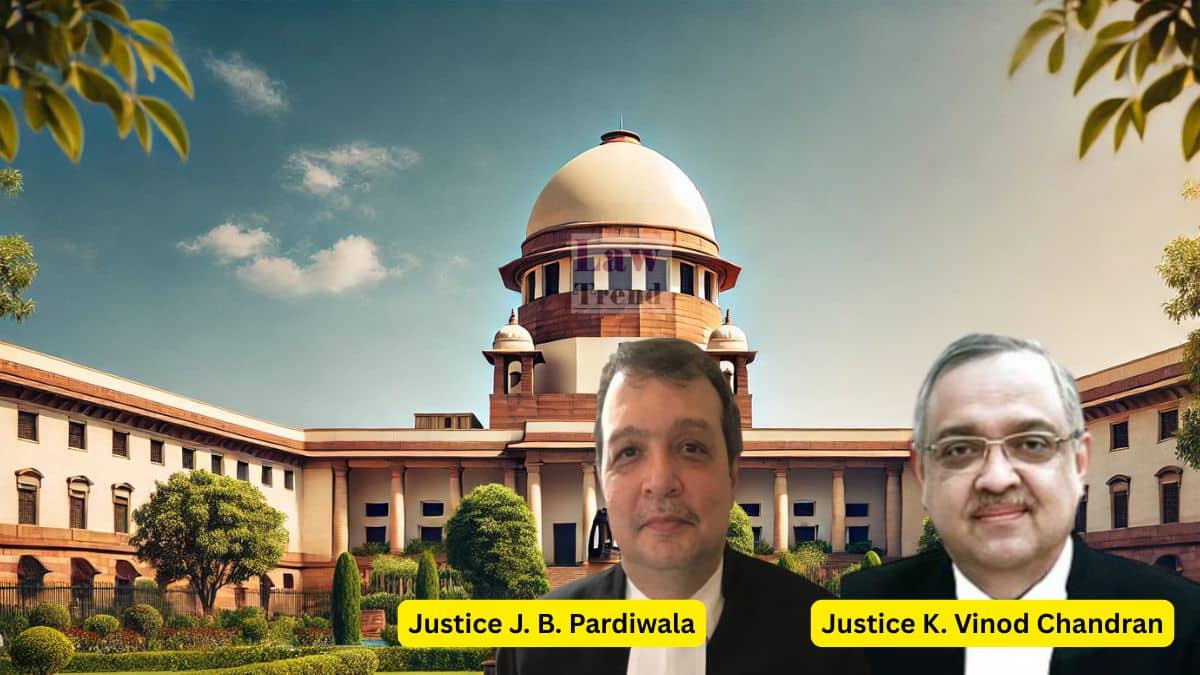
In a significant ruling addressing the interplay between the Insolvency and Bankruptcy Code, 2016 (IBC) and the Arbitration and Conciliation Act, 1996, the Supreme Court of India held that an Operational Creditor who suffered a massive haircut during the Corporate Insolvency Resolution Process (CIRP) is entitled to set off its extinguished claims against any recovery sought by a Successful Resolution Applicant (SRA) in an arbitration arising out of the very same contract. A Bench comprising Justice J. B. Pardiwala and Justice K. Vinod Chandran modified a Karnataka High Court order, ruling that while the SRA can pursue pre-CIRP dues against debtors, arbitration remains a “two-way street” where equities must be balanced, permitting the creditor to raise a counterclaim strictly for the purpose of a set-off without seeking any positive recovery.
The central question before the bench, as framed by Justice K. Vinod Chandran, was “whether an Operational Creditor (OC) who suffered a major haircut in the Corporate Insolvency Resolution Process (CIRP) can be proceeded against by the Successful Resolution Applicant (SRA) for pre-CIRP dues due from the OC, to the entity which had fallen into CIRP.”
Background of the Case
The dispute originated from a contract dated July 9, 2018, executed between Modern Asset (the appellant) and KNK Construction Private Limited (the respondent) for civil and structural construction work of an office building valued at Rs. 133.68 Crores. The agreement contained an arbitration clause (Clause 19.13). The appellant disbursed mobilization advances, while the respondent furnished a bank guarantee of Rs. 1,56,13,250 towards the completion of the work.
Work commenced on June 1, 2018, with an extension granted until December 31, 2019. While the respondent claimed to have completed 95% of the work, the appellant issued a 14-day defect rectification notice and subsequently terminated the contract on February 25, 2020. Prior to this termination, the respondent had already been admitted into CIRP on December 11, 2019, under Section 9 of the IBC. Following admission into insolvency, the respondent was registered as a small enterprise under the Micro, Small and Medium Enterprises Development Act.
During the CIRP, the appellant submitted a claim of Rs. 12,26,30,840 before the Resolution Professional (RP). However, under the resolution plan submitted by the respondent’s erstwhile promoters—who utilized the MSME exemption under Section 240A(1) of the IBC—the appellant suffered a 99.28% haircut. Only 0.72% of the claim, amounting to Rs. 8,82,942 with interest, was admitted and subsequently paid. The National Company Law Tribunal (NCLT) approved the resolution plan on April 5, 2022, placing the erstwhile promoters back at the helm of the Corporate Debtor (CD) as the SRA.
After the resolution plan took effect, the respondent invoked arbitration against the appellant on March 13, 2023, claiming outstanding amounts under the very same construction contract. The respondent then moved a Section 11 petition under the Arbitration and Conciliation Act before the High Court of Karnataka. The High Court appointed an arbitrator (initially referring the parties to mediation) and held that questions regarding the substantive effect of the resolution plan and the “clean slate” doctrine should be determined by the arbitral tribunal under Section 16. Aggrieved by this reference, Modern Asset approached the Supreme Court.
Arguments of the Parties
Appearing for the appellant, Senior Counsel Sri Shyam Divan argued that allowing the arbitration would turn the dispute into an impermissible “one-way street.” He submitted that the appellant’s monetary claims under the contract had been settled for a paltry amount during CIRP, extinguishing the balance by statute. Under the “clean slate” doctrine, the appellant was barred from asserting any counterclaim, yet the SRA—comprising the very same erstwhile promoters—was seeking to recover money under the same bipartite agreement. The appellant contended that the agreement and its arbitration clause had worked themselves out in the CIRP, leaving no surviving arbitral dispute.
Opposing the appeal, Senior Counsel Sri Nikhil Nayyar for the respondent contended that law permits erstwhile promoters of an MSME to submit a resolution plan and assume charge as an SRA. Relying on Swiss Ribbons Pvt. Ltd. v. Union of India, he submitted that the RP only collates claims without adjudicating them. Citing Ghanshyam Mishra & Sons (P) Ltd. v. Edelweiss Asset Reconstruction Co. Ltd., the respondent argued that while Section 31 of the IBC extinguishes claims against the Corporate Debtor to provide a clean slate, it does not extinguish the debts owed to the Corporate Debtor. Relying on SBI General Insurance v. Krish Spinning and In Re: Interplay between Arbitration Agreements, he submitted that Section 11 is confined to examining the prima facie existence of an arbitration agreement, which is separable from the main contract. Furthermore, citing New Delhi Municipal Council v. Minosha India Limited, the respondent argued that the limitation period stood extended under Section 60(6) by excluding the moratorium period.
The Court’s Analysis and Precedents
The Supreme Court examined the statutory scheme of the IBC, observing that the erstwhile promoters were actively involved during the CIRP under Section 19 and were fully aware of the appellant’s claim as recorded in the Information Memorandum under Section 29. By proposing to pay 0.72% in their resolution plan, the promoters had effectively accepted the claim while subjecting it to a liquidation-value haircut.
The Bench disagreed with the High Court’s approach of leaving the scope of the “clean slate” doctrine to the Arbitral Tribunal under Section 16:
“The High Court’s observation that the liberty to decide as to whether the ‘clean slate’ principle would apply equally to the SRA, is left to the Arbitrator, cannot be accepted in view of the clear legal position; that, as against the SRA, the ‘clean slate’ principle applies, while the SRA could proceed for the dues of the CD. Nothing remains to be considered by the Arbitrator on those aspects.”
However, the Court emphasized that arbitration is fundamentally a two-way street and that gross inequities would arise if the SRA were allowed to pursue recovery while shielding itself entirely behind the clean slate principle against the same contractor under the same transaction.
To resolve this impasse, the Court drew direct guidance from its recent decision in Ujaas Energy Ltd. v. West Bengal Power Development Corporation Ltd. (2026), where an arbitral tribunal was directed to consider a counter claim solely for the purpose of a defensive set-off without granting affirmative recovery. The Bench found that the compelling factors present in Ujaas Energy Ltd. applied with even greater force here, especially since the SRA consisted of the erstwhile promoters who had admitted the operational creditor’s claim during the CIRP:
“In fact in admitting 0.72% of the claim, the SRA had accepted the entire claim and provided for a major haircut @ 99.28%, and the balance amounts were agreed to be paid by the SRA in the resolution plan submitted by itself. The claim raised for arbitration arises from the very same contract on which a claim was raised by the appellant, as an OC during the CIRP process…”
The Decision
Balancing the “clean slate” principle with equitable considerations, the Supreme Court affirmed the appointment of the Arbitral Tribunal but modified the High Court’s directions.
The Bench ruled that:
“the appellant should be permitted to raise a counterclaim for the sole purpose of claiming set-off and the appellant would not derive any positive or affirmative relief of recovery on the basis of the counterclaim.”
The Court directed that should the Arbitral Tribunal find any sums payable by the appellant to the respondent, those sums shall be set off against the entire claim originally raised by the appellant before the RP during the CIRP. If the respondent’s monetary claim fails, the appellant cannot pursue recovery of any surplus balance from the SRA, as its independent right to claim against the Corporate Debtor stands extinguished.
Explaining the rationale, the Bench observed:
“The benefit granted of the set-off, is only to ensure equity and further the process of preservation of assets of CD in the hands of the SRA, within the contours of the IBC.”
The Court also directed the Arbitral Tribunal to determine the validity of the encashment of the bank guarantee furnished by the respondent, and formally disposed of the appeal with these modifications.
Case Details
Case Title: Modern Asset v. KNK Construction Private Limited
Case No.: Civil Appeal No. of 2026 (@Special Leave Petition (C) No. 25068 of 2026)
Bench: Justice J. B. Pardiwala and Justice K. Vinod Chandran
Date: October 08, 2026




