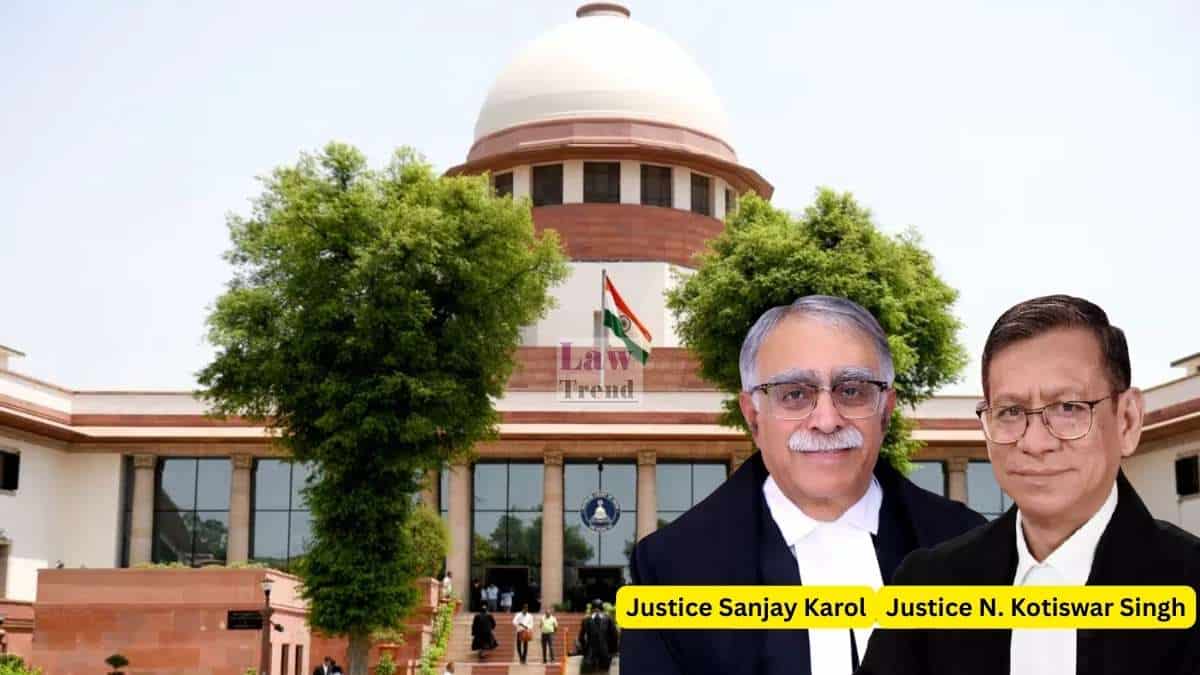
In a ruling concerning writ jurisdiction and tortious liability in electrocution cases, the Supreme Court of India held that writ petitions under Article 226 of the Constitution seeking compensation for electrocution are not maintainable when disputed questions of fact are involved, determining that the doctrine of strict liability—rather than absolute liability—applies to power utilities. A Bench comprising Justice Sanjay Karol and Justice Nongmeikapam Kotiswar Singh allowed the appeals filed by Karnataka Power Transmission Corporation Limited (KPTCL), setting aside orders of the High Court of Karnataka that had entertained writ petitions and awarded compensation using the Motor Vehicles Act, 1988 framework.
Background of the Case
The matter arose out of two separate electrocution incidents in Karnataka. In the first case, Rekha (Respondent No. 1), the widow of N. Subramanya, filed a writ petition following her husband’s death by electrocution on February 22, 2018. A Single Judge of the High Court of Karnataka entertained the petition as a remedy for a tortious act of the State, rejecting KPTCL’s objections regarding maintainability and disputed facts. Applying the framework of the Motor Vehicles Act, 1988, the Single Judge awarded compensation of Rs. 25,52,500 with 6% interest, which was subsequently confirmed by a Division Bench in writ appeal.
In the second connected case, Muizz Ahmad Shariff sustained severe injuries after coming into contact with a 66KV line while jumping onto the roof of a neighboring building to retrieve a cricket ball. The Single Judge awarded compensation of Rs. 44,32,050, which was likewise upheld by the Division Bench. KPTCL challenged both judgments before the Supreme Court.
Arguments of the Parties and Disputed Facts
KPTCL opposed the writ petitions on grounds of maintainability, lack of fault, and the presence of disputed questions of fact. The apex court identified specific factual disputes in both matters:
In the first appeal, the disputed facts included:
- Whether using an aluminium ladder in a coffee plantation in a manner that it contacted an 11 KV line constituted negligence on the part of the respondent.
- Whether the owner of the coffee plantation was negligent for providing the aluminium ladder.
- Whether backup relays were in satisfactory condition as reported by the Assistant Executive Engineer.
- Whether KPTCL escaped liability because it was responsible only for maintaining electric lines above a certain voltage, placing liability on Respondent No. 2.
In the second appeal, the disputed facts included:
- Whether the statutorily mandated 4-metre distance between the electric line and the building was complied with.
- Whether an undertaking dated April 19, 2000, made the building owner solely liable for compensation.
- Whether negligence could be imputed to KPTCL for providing an electric connection if the statutory distance was maintained.
The Court’s Analysis
Maintainability of Writ Petitions
Addressing maintainability, the Supreme Court referred to Radha Krishan Industries v. State of H.P. and T.N. Cements Corpn. Ltd. v. Unicon Engineers to outline the discretionary nature of writ jurisdiction under Article 226 when alternative remedies exist. Specifically in electrocution cases involving factual disputes, the Court placed reliance on Chairman, Grid Corpn. of Orissa Ltd. (Gridco) v. Sukamani Das, reiterating:
“where disputed questions of facts are involved a petition under Article 226 of the Constitution is not a proper remedy.”
Strict Liability vs. Absolute Liability
The High Court had applied the doctrine of absolute liability to bypass disputed facts. The Supreme Court rejected this approach, examining the distinction between absolute and strict liability.
Referring to the Constitution Bench decision in M.C. Mehta v. Union of India (Shriram – Oleum Gas), the Court observed that absolute liability leaves no scope for exceptions and applies to hazardous or inherently dangerous industrial enterprises. Quoting from M.C. Mehta:
“where in enterprise is engaged in a hazardous or inherently dangerous activity and harm results to anyone on account of an accident in the operation of such hazardous or inherently dangerous activity resulting, for example, in escape of toxic gas the enterprise is strictly and absolutely liable to compensate all those who are affected by the accident and such liability is not subject to any of the exceptions which operate vis-a-vis the tortious principle of strict liability under the rule in Rylands v. Fletcher”
Conversely, the Court reviewed the rule of strict liability established in Rylands v. Fletcher, alongside Rajkot Municipal Corpn. v. Manjulben Jayantilal Nakum, Quebec Railway, Light, Heat & Power Co. Ltd. v. Vandry, Union of India v. Prabhakaran Vijaya Kumar, and M.P. Electricity Board v. Shail Kumari. The Court further cited Kaushnuma Begum & Ors. v. New India Assurance Co. Ltd. regarding recognized exceptions to strict liability, including consent of the plaintiff (volenti non fit injuria), common benefit, act of a stranger, exercise of statutory authority, act of God (vis major), default of the plaintiff, and remoteness of consequences.
Determining the applicable legal standard for electricity distributors, the Bench observed:
“to impose strict liability would be more appropriate, for not in all cases can it be said that the electricity boards are liable.”
The Court explained that while transmission of electricity is inherently dangerous and entities carrying out such activities operate on loss distribution mechanisms, they are liable under strict liability provided none of the recognized exceptions apply.
Yardstick for Calculating Compensation
Regarding compensation calculation, the Bench held that the High Court erred in adopting the multiplier method from the Motor Vehicles Act, 1988. Citing Raman v. Uttar Haryana Bijli Vitran Nigam Ltd. and Balram Prasad v. Kunal Saha, the Court noted that while Section 57 of the Electricity Act, 2003 recognizes a licensee’s liability to pay compensation, it does not prescribe a calculation formula. The Court affirmed that the overarching principle of “just and reasonable, fair compensation” must govern calculations based on income and related claims, rather than applying the motor accident multiplier paradigm.
Court Decision
The Supreme Court concluded that because disputed questions of fact were involved, the writ petitions filed before the High Court were not maintainable. Consequently, the Court:
- Quashed and set aside the impugned judgments of the Single Judge and Division Bench of the Karnataka High Court.
- Allowed both Civil Appeals.
- Granted liberty to the respondents to pursue appropriate alternate remedies (such as civil suits) before the concerned forum on an expeditious basis, uninfluenced by observations in this judgment.
- Directed that the interim compensation of Rs. 5 Lakhs already paid pursuant to the Supreme Court’s order dated December 18, 2025, shall not be recovered from the respondents, nor shall it influence any final compensation awarded in future proceedings.
- Directed parties to bear their own costs.
Case Details:
Case Title: Karnataka Power Transmission Corporation Limited v. Rekha & Ors. (With connected appeal)
Case No.: Civil Appeal No(s). of 2026 (Arising out of SLP(C) No(s). 24849 of 2025) with Civil Appeal No(s). of 2026 (Arising out of SLP(C) No(s). 24854 of 2025)
Bench: Justice Sanjay Karol and Justice Nongmeikapam Kotiswar Singh
Date: August 12, 2026