

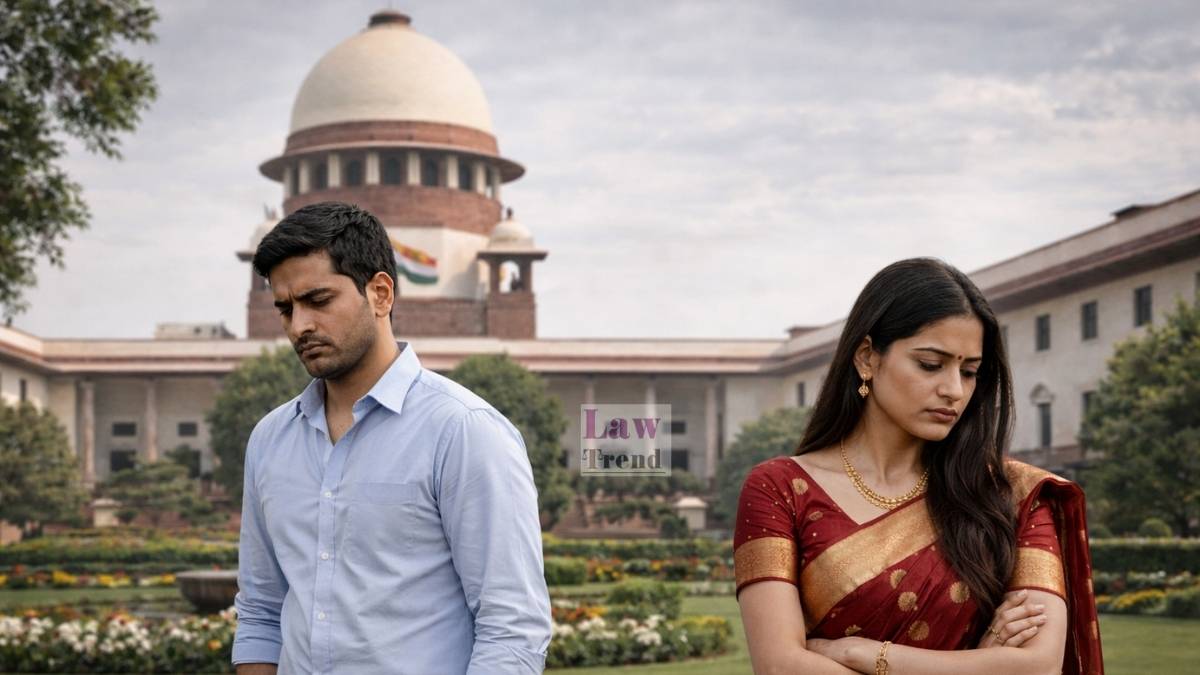
The Supreme Court of India has invoked its extraordinary powers under Article 142 of the Constitution to dissolve a decade-long matrimonial dispute that has remained “dead for all practical purposes.” In a judgment delivered by a Bench comprising Justice Vikram Nath and Justice Sandeep Mehta, the Court observed that a wife’s professional qualifications do not exempt a husband from his legal and moral obligations to provide maintenance.
The Bench quashed more than 80 legal proceedings initiated by the respondent-husband, characterizing his litigation strategy as “relentless, vindictive and oppressive.” The Court ordered a consolidated settlement of ₹5 Crores to be paid to the appellant-wife as a final resolution of all claims.
Background of the Dispute
The appellant-wife and respondent-husband were married on January 20, 2010, and have two minor sons. Following severe differences, the parties separated on October 9, 2016. The Court noted that since the separation, the parties have been “embroiled in a vicious spate of litigation spanning nearly a decade.”
The conflict intensified over the enforcement of an interim maintenance order passed by the Family Court in 2019, which directed the husband to pay ₹80,000 per month. The respondent, a practicing advocate, consistently defaulted on these payments, leading to numerous execution petitions and appeals. The present appeal arose from a 2024 High Court order that had dismissed the wife’s plea for expeditious disposal of execution proceedings as infructuous.
Arguments of the Parties
For the Appellant-Wife: Senior Counsel Shri Amit Rawal contended that the marriage had irretrievably broken down with no prospects of reconciliation. He highlighted that the respondent had misused his legal expertise to target the wife, her family, and even her legal representatives across various forums. It was argued that the respondent willfully evaded maintenance orders by resigning from corporate directorships to project financial incapacity.
For the Respondent-Husband: The respondent, appearing in person, vehemently opposed the alimony claims. He alleged that the wife had filed false criminal complaints under Section 498A IPC and the Domestic Violence Act, which resulted in his “traumatic” incarceration. He further argued that the wife was a highly qualified professional with substantial income and had suppressed material facts to secure an “inflated” maintenance award. He also claimed the matrimonial home was his father’s self-acquired property and sought ₹20 Crores in compensation for “mental agony.”
Court’s Observations and Analysis
The Court meticulously reviewed the “hostile and cantankerous” conduct of the respondent. The Bench observed:
“The respondent-husband has, at every stage, tried to multiply and complicate the proceedings by filing innumerable applications and complaints not only against the appellant-wife and her relatives but also against her advocates. Most of these proceedings appear to be vindictive and vexatious.”
Addressing the husband’s primary defense regarding the wife’s earning capacity, the Court held:
“Even if the appellant-wife is highly educated and professionally qualified, that by itself cannot be a reason to absolve the respondent-husband from his matrimonial, paternal, moral and legal responsibility to provide for his wife and children.”
The Bench found the husband’s claim of financial incapacity to be a “subterfuge” to escape liability. Citing the “relentless” nature of the litigation, the Court compared the dispute to a “matrimonial battle of Mahabharata.” It concluded that invoking Article 142 was essential “to do complete justice and provide a quietus to this decade-long dispute which has crossed all limits.”
The Decision
In exercise of its jurisdiction under Article 142, the Supreme Court issued the following directions:
- Dissolution of Marriage: The marriage stands dissolved on the ground of irretrievable breakdown.
- Quashing of Litigations: All pending civil, criminal, and miscellaneous proceedings between the parties, including FIRs and disciplinary complaints against the wife’s advocates before the Bar Council, stand quashed.
- Financial Settlement: The respondent-husband is directed to pay ₹5 Crores as a consolidated sum for permanent alimony, maintenance (past, present, and future), child support, and litigation expenses within one year.
- Custody and Visitation: The wife is granted absolute custody of both sons. The husband is entitled to visitation on the second weekend of every month and temporary custody for half of the summer and winter vacations.
- Passport Cooperation: The respondent-father must cooperate in the renewal of the son’s Canadian passport; failure to do so will invite contempt proceedings.
- Property Vacated: Upon receipt of the full settlement amount, the wife must vacate and hand over the possession of the flat owned by the respondent’s father within two weeks.
The Court further directed the respondent to furnish an undertaking that he will not initiate any further proceedings against the wife or her legal team.
Case Details
- Case Title: XXX v. YYY
- Case Number: Civil Appeal arising out of SLP (Civil) No. 28311 of 2024
- Date: April 07, 2026
- Bench: Justice Vikram Nath and Justice Sandeep Mehta




