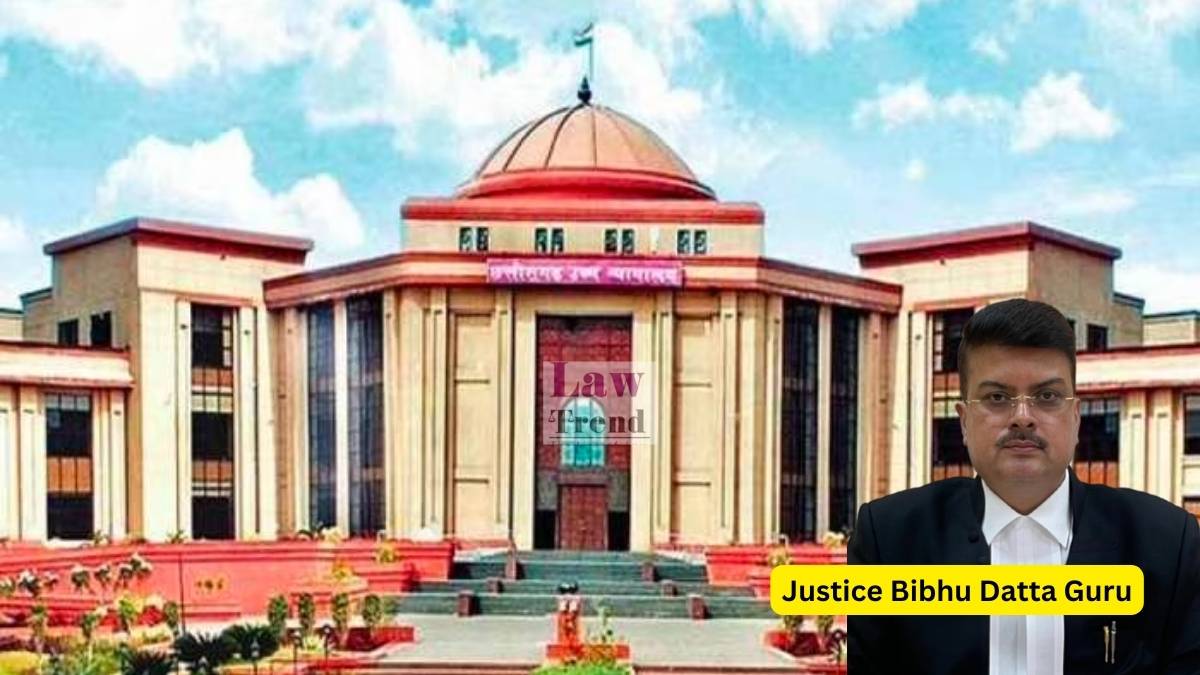
The High Court of Chhattisgarh has held that the determination of wages under the Employees’ Compensation Act, 1923, should aim to arrive at “realistic and fair compensation” rather than being artificially restricted to outdated statutory ceilings, especially when contemporaneous evidence indicates higher prevailing wages.
The Court, presided over by Justice Bibhu Datta Guru, delivered this ruling while deciding two cross-appeals—one filed by the claimants seeking enhancement and statutory interest, and another by the Oriental Insurance Company Limited challenging the compensation awarded by the Commissioner for Employees’ Compensation (Labour Court), Jagdalpur.
Background of the Case
The matter originated from a fatal accident on December 15, 2017. Satyendra Singh, employed as a driver on a truck owned by Bankelal Yadav (Non-applicant No. 1), was driving a vehicle loaded with iron grit from Jagdalpur to Raipur. Near Village Dahikonga, another truck collided with his vehicle, resulting in his immediate death.
The claimants (wife, children, and mother of the deceased) filed for compensation, stating the deceased earned ₹10,000 monthly. The Commissioner, vide judgment dated March 29, 2019, assessed the monthly wages at ₹9,880 based on Collector rates for skilled workers and awarded ₹9,49,171.60. The award stipulated that interest at 12% per annum would only be payable if the amount was not deposited within 45 days.
Arguments of the Parties
Insurance Company’s Contentions: The Oriental Insurance Company argued that the Commissioner erred by ignoring the Central Government notification dated May 31, 2010, which capped the monthly wage ceiling at ₹8,000 for the purpose of calculating compensation under Section 4(1B) of the Act. They contended that the adoption of the Collector’s rate of ₹9,880 was perverse and that a subsequent 2020 notification increasing the ceiling to ₹15,000 could not be applied retrospectively.
Claimants’ Contentions: Counsel for the claimants argued that the ₹8,000 ceiling was outdated by 2017. They supported the Commissioner’s reliance on the Bastar District Collector’s order of October 2017, which reflected the actual prevailing wage structure. Furthermore, they challenged the “conditional interest” granted by the Commissioner, asserting that under Section 4A(3) of the Act, interest is mandatory from the date the compensation falls due—namely, the date of the accident.
Court’s Analysis and Observations
The Court addressed two primary substantial questions of law: the validity of the wage assessment exceeding the 2010 statutory ceiling and the legality of awarding conditional interest.
On Wage Determination: The Court observed that the Employees’ Compensation Act is a “beneficial social welfare legislation” and its provisions cannot be interpreted in a narrow manner. While the 2010 notification mentioned ₹8,000, the Court stated:
“The determination of wages in a given case is not a mechanical exercise restricted only to statutory ceiling, particularly where the evidence on record indicates a higher and more realistic wage structure prevailing at the relevant time.”
The Court found that the Commissioner’s reliance on the District Collector’s order was not arbitrary but aligned with the principle of substantive justice. It noted that the Central Government’s 2020 increase to ₹15,000 reinforced the fact that the earlier ceiling had become “unrealistic in the changed economic context.”
On Statutory Interest: Regarding the interest, the Court found the Commissioner’s “conditional” award to be legally flawed. Citing Supreme Court precedents in Shobha Vs. The Chairman, Vitthal Rao Shinde (2022) and Ajay Kumar Das Vs. Divisional Manager (2022), the Court clarified:
“The liability to pay the interest on the amount of arrears/compensation shall be from the date of accident and not from the date of the order passed by the Commissioner.”
The Court emphasized that interest serves as a safeguard against the financial hardship caused by delayed payments to the dependents of a deceased employee.
Decision
The High Court dismissed the Insurance Company’s appeal (MAC No. 1308/2019), upholding the wage assessment of ₹9,880. It partly allowed the claimants’ appeal (MAC No. 1368/2019) by setting aside the condition on interest.
The Court directed that the awarded compensation shall carry statutory interest at 12% per annum from the date of the accident (December 15, 2017) until the date of actual realization. The amount already deposited by the Insurance Company is to be adjusted, with the balance to be deposited within 45 days.
Case Details Block
Case Title: Meera Devi & Ors. v. Bankelal Yadav & Anr
Case No.: MAC No. 1368 of 2019 and MAC No. 1308 of 2019
Bench: Justice Bibhu Datta Guru
Date: April 30, 2026