

Taking Mediation to the Roots: Durg District Court Takes Mediation 3.0 to Law Campus
Durg, Chhattisgarh: What does it mean to take mediation beyond the courtroom?

For the District and Sessions Court, Durg, the answer is not limited to referring more cases to mediation. It is to introduce the culture and method of mediation before a dispute reaches the courtroom at all.

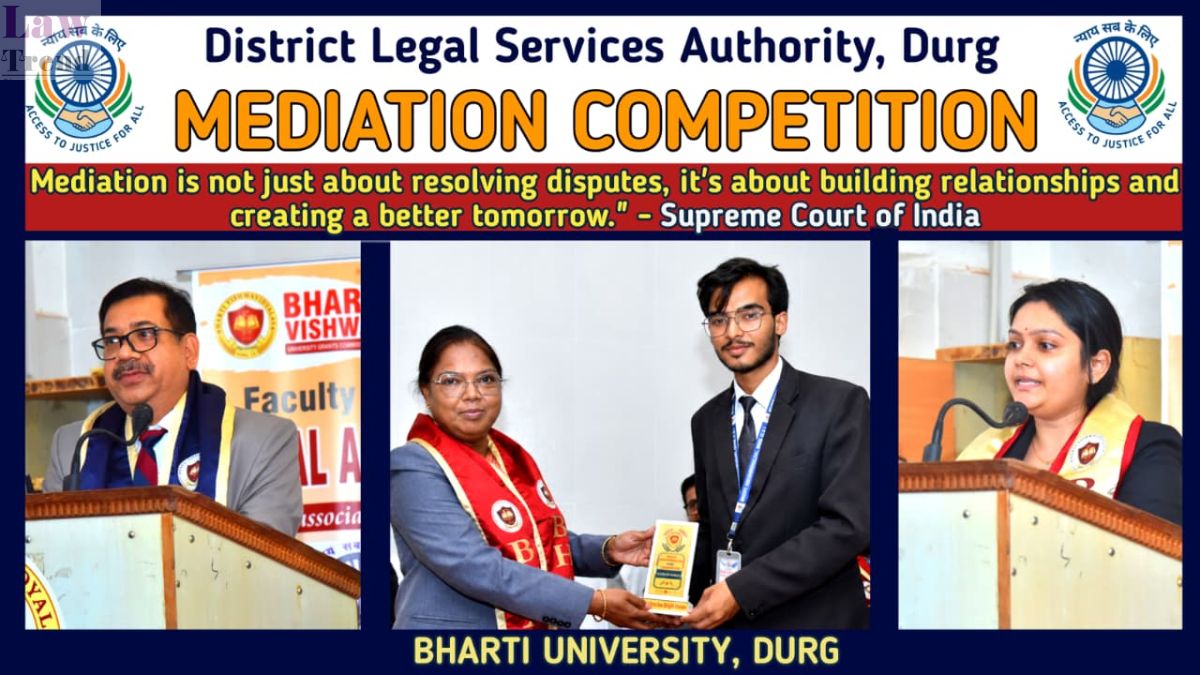
Pursuing this approach, the District and Sessions Court, Durg, in association with the District Legal Services Authority (DLSA), Durg, organised a Student Mediation Competition at Bharati University, Durg, under the theme “Taking Mediation to the Roots Through Campus-Based Mediation Competitions – An Initiative under Mediation 3.0 Drive.”

The initiative is part of the broader vision and leadership of Hon’ble Mr. Justice Ramesh Sinha, Chief Justice, High Court of Chhattisgarh, towards strengthening mediation as an integral component of contemporary justice delivery. With the institutional guidance of Hon’ble Mr. Justice P.P. Sahu, the effort seeks to translate the larger objectives of Mediation 3.0 into sustained ground-level engagement.

The programme reflects a broader vision of Mediation 3.0—to take mediation beyond disputes that have already entered the judicial system and develop a culture in which dialogue and consensual resolution are considered before adversarial litigation becomes the inevitable response to conflict.

The idea is bigger than reducing pendency

One of the significant aspects of the initiative is that it does not treat mediation merely as a mechanism for reducing the number of pending cases.

That distinction is important.

If mediation is viewed only as a procedural device for settling cases after litigation has commenced, its role remains largely reactive. A campus-based mediation initiative attempts to address the issue at a different level—by developing an understanding of dialogue, negotiation, listening and consensual problem-solving before a dispute reaches the courtroom.

The initiative proceeds on the premise that mediation awareness should begin before an individual becomes a litigant or enters the legal profession.

In that sense, taking mediation to a university campus is not merely an awareness exercise. It is an attempt to influence the professional culture of the next generation of lawyers.

From “Who is right?” to “What actually needs to be resolved?”

The competition was structured around two simulated disputes, both designed to move participants away from a purely adversarial understanding of conflict.

READ ALSO  Bombay High Court Rules Mediclaim Cannot Be Deducted From Accident Compensation

The first involved two neighbouring families whose eighteen-year relationship had been disturbed by a dispute concerning the construction of a window.

On the surface, the disagreement concerned the construction of a window. But the underlying interests were considerably more complex.

One family required light and ventilation for the room of an elderly mother, while the other family had genuine concerns relating to privacy and security.

The second proposition involved two brothers and a family business established by their late father.

One brother had continued to manage and invest in the business, while the other sought his share because of an immediate financial requirement for his daughter’s higher education. At the same time, neither brother wanted the family business to close.

These propositions illustrate one of the central intellectual differences between mediation and conventional litigation: the position asserted by a party does not necessarily reveal the interest that the party is actually seeking to protect.

The competition therefore encouraged students to look beneath the apparent dispute.

A demand relating to a window could actually involve a need for ventilation, dignity and care for an elderly family member. A demand for a share in a family business could simultaneously involve financial necessity, education, livelihood and preservation of family relationships.

That shift—from positions to interests—is at the heart of effective mediation.

Why law students are an important audience

The decision to take the programme to a university is significant because lawyers are traditionally trained primarily through the framework of adjudication and adversarial advocacy.

Students learn to identify facts, formulate issues, marshal evidence and construct arguments in support of a client’s case.

Mediation requires an additional set of professional instincts.

A future lawyer must also be able to identify when a client’s stated position may conceal a larger concern; when a seemingly irreconcilable dispute contains room for accommodation; and when preserving a relationship may be more valuable to the parties than obtaining a purely legal victory.

The programme accordingly sought to develop communication, patience, empathy, negotiation and creative problem-solving skills among participating students.

This is particularly relevant to contemporary legal practice, where the question confronting a lawyer is not always simply, “Can this case be won?”, but sometimes, “Is litigation actually the best way to solve this client’s problem?”

Mediation as access to justice, not merely case management

The programme also situated mediation within the broader constitutional objective of access to justice.

READ ALSO  Not Every time the Husband is Wrong, Courts Should Listen the Male Side Also

Article 39A of the Constitution of India embodies the constitutional commitment towards equal justice and access to legal aid, while the Mediation Act, 2023 has further strengthened the statutory framework for mediation in India.

Against this background, strengthening mediation cannot be viewed solely as an administrative response to judicial pendency.

Disputes consume more than judicial time.

A prolonged family dispute can permanently damage relationships. A commercial dispute can affect continuing business relationships. A property dispute can divide families across generations. The financial and emotional costs of litigation may therefore extend well beyond the eventual judgment.

Mediation, where appropriate, offers a different model of dispute resolution: the parties themselves participate in constructing a solution rather than leaving the outcome entirely to an adjudicatory determination.

The programme accordingly emphasised that the value of mediation extends beyond statistics relating to case disposal.

Developing a different professional skill-set

The competition also highlighted that mediation requires a professional skill-set distinct from conventional adversarial advocacy.

Students were encouraged to develop communication, patience, empathy, negotiation and creative problem-solving, while understanding that the effectiveness of a mediator does not necessarily depend upon how much the mediator speaks.

Rather, it depends upon the ability to listen effectively, understand the dispute, identify underlying interests and facilitate meaningful communication between the parties.

The programme thus sought to convey a broader message to participating students: a contemporary legal professional must know not only how effectively a dispute can be contested, but also when it can be more meaningfully resolved.

This represents an important shift in the conception of the lawyer—from a professional primarily trained to win an adversarial contest to one equally capable of identifying pathways towards resolution.

Judicial and institutional participation

While Shri K. Vinod Kujur, Principal District and Sessions Judge and Chairman, District Legal Services Authority, Durg, has been guiding its implementation at the district level, taking the idea of mediation beyond institutional settings and into the grassroots.

READ ALSO  Court Acquits Father Who Was Framed For Rape by Step Daughter After Watching Crime Show- Know More

The programme was attended by Shri Anish Dubey, District and Additional Sessions Judge, Durg; Smt. Sushma Lakra, Chairman, Permanent Lok Adalat, Durg; Shri Bhupesh Kumar Basant, Chief Judicial Magistrate, Durg; Shri Umesh Kumar Bhagwatkar, Secretary, District Legal Services Authority, Durg; Smt. Kamini Jaiswal, Civil Judge (Senior Division), Durg; and Smt. Aishwarya Diwan, Civil Judge (Junior Division), Durg.

Bharati University, Durg, including its administration and faculty members, also extended cooperation in providing a platform for the campus-based initiative.

From courtroom to campus—and eventually to community

The larger significance of the initiative lies in its attempt to treat mediation not merely as a mechanism of post-litigation settlement, but as a culture of conflict resolution.

A statutory framework can provide the architecture for mediation. Courts can make referrals. Institutions can create mediation centres. But long-term acceptance of mediation ultimately depends upon whether lawyers, litigants and communities begin to regard dialogue and consensual resolution as legitimate and effective responses to conflict.

That is why the campus becomes an important site for Mediation 3.0.

The initiative seeks to take mediation from courtrooms to campuses and, progressively, from campuses to communities, with the objective of building greater awareness, confidence and acceptance of dialogue-based dispute resolution at the grassroots level.

The larger question, therefore, is not whether every dispute can or should be mediated.

It is whether the legal system can cultivate a generation of lawyers who, before turning every conflict into litigation, are trained to ask a more fundamental question:

What is the real problem—and can the parties themselves be helped to solve it?

Law Trend
Law Trendhttps://lawtrend.in/
Legal News Website Providing Latest Judgments of Supreme Court and High Court

Related Articles

Latest Articles


