

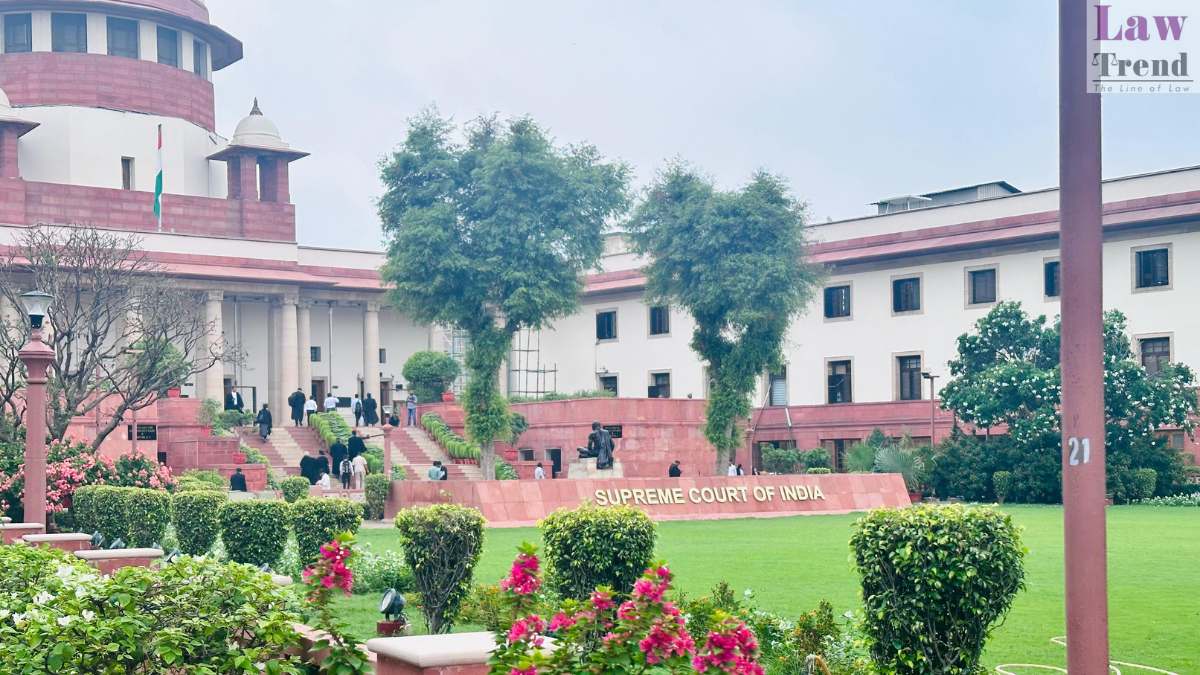
The Supreme Court has pulled up the Uttar Pradesh government for failing to invoke appropriate hate crime provisions in a 2021 Noida assault case, despite the complainant’s claim of religiously motivated abuse. The bench questioned the rationale behind not registering the FIR under IPC sections 153-B, 295-A, and 298, and granted one week for the state to respond.
The Supreme Court on Tuesday grilled the Uttar Pradesh government over the failure to register appropriate hate crime offences in a 2021 FIR relating to an alleged assault on a senior citizen in Noida, which the petitioner claimed was motivated by his religious identity.
A bench comprising Justices Vikram Nath and Sandeep Mehta was hearing a writ petition filed by a senior citizen alleging that he was “abused, tortured, and systematically stripped of his dignity” by a group of individuals in Noida on July 4, 2021. The petitioner contends that the attack was targeted due to “his beard and ostensible Muslim identity”.
Appearing for the state government, Additional Solicitor General K M Nataraj informed the bench that an inquiry had been initiated against the investigating officer for not registering the case under the appropriate provisions of the Indian Penal Code (IPC). However, the bench was unsatisfied with the explanation.
“Does that solve the problem of non-registration of the case for the appropriate provisions?” the bench asked, pressing for a more substantive response.
Senior advocate Huzefa Ahmadi, representing the petitioner, submitted that the FIR should have included offences under Sections 153-B (assertions prejudicial to national integration), 295-A (acts intended to outrage religious feelings), and 298 (words intended to wound religious sentiments) of the IPC.
He argued that the authorities’ refusal to invoke these provisions reflected a broader reluctance to acknowledge such acts as hate crimes.
“I am showing a pattern of a reluctance on the part of the state authorities to take cognisance of the fact that this kind of a thing has actually happened,” Ahmadi said.
The bench urged restraint in politicising the matter but emphasized that legal provisions must be properly applied.
“Let us not give it that colour. It is an individual incident before us for which you have come to this court. We have entertained your writ petition and we expect the government to take action. Let it remain at that,” the court observed.
When Nataraj reiterated that an inquiry against the investigating officer had been launched, the bench countered:
“Initiating an inquiry is not the answer to the question as to why the offences were not registered.”
The court also raised concerns about how the investigation could be deemed fair if the appropriate sections were never invoked.
“Unless the case was registered under the appropriate provisions and an investigation was done whether the offences were made out or not, how the case would proceed?” it asked.
Referring to Section 196 of the CrPC, which mandates prior sanction for prosecution under certain offences, the bench questioned whether the state could bypass FIR registration altogether.
“Be little objective. You may refuse sanction, that is a different thing. But can you refuse registration of an FIR?” the bench remarked.
When the law officer conceded that the FIR should have invoked the proper sections, the court responded bluntly: “Give a direction right now.”
The bench granted one week for the law officer to seek further instructions and posted the matter for hearing on February 13.
The petition also seeks departmental and punitive action against police officials of Gautam Buddh Nagar district for allegedly failing to comply with preventive and remedial measures mandated by the apex court in its prior rulings concerning hate crimes.




