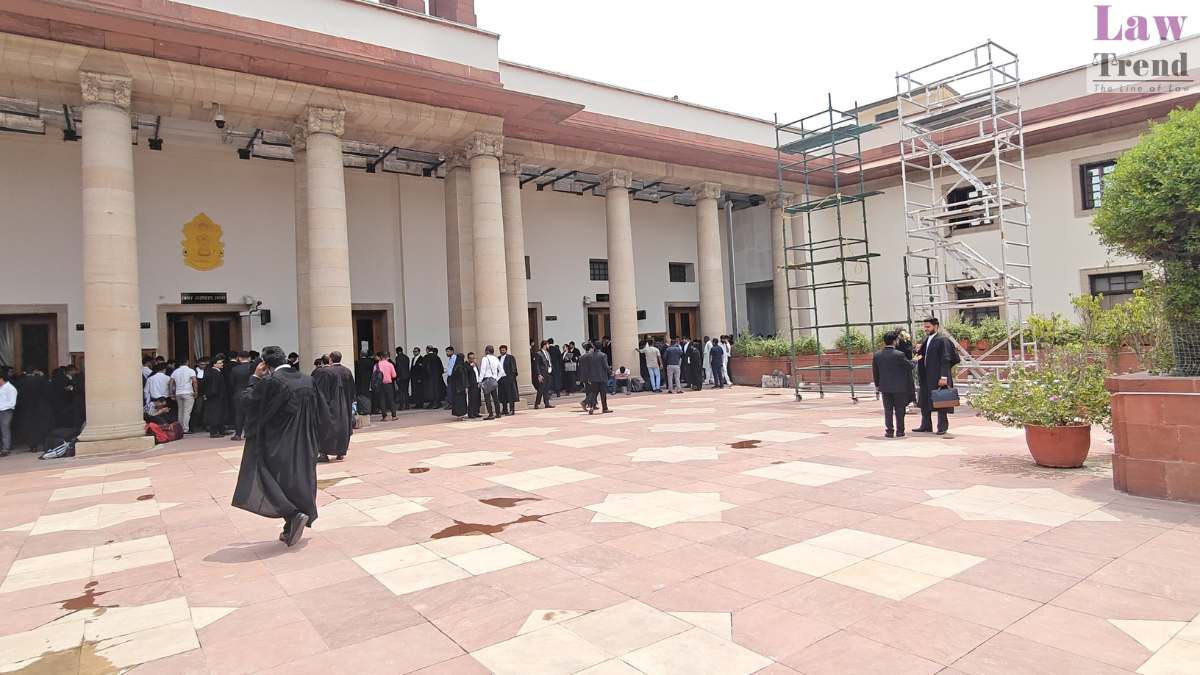
The Supreme Court of India has partly modified a judgment of the High Court of Punjab and Haryana regarding the regularisation of contractual, ad hoc, and daily wage employees in the State of Haryana. The Court upheld the Notifications dated June 16, 2014, and June 18, 2014—which sought to regularize employees left out of a previous 1996 policy—but declared the futuristic Notifications dated July 7, 2014, to be arbitrary and illegal. However, invoking Article 142 of the Constitution, the Court directed that ad hoc employees already benefiting from the July 2014 policies should not be disturbed, provided they are placed at the lowest admissible pay scale.
Legal Issue
The central legal issue was the correctness of the High Court’s decision to quash four policy notifications issued by the State of Haryana in 2014 for regularising Group ‘B’, ‘C’, and ‘D’ employees. The Supreme Court concluded that the notifications reviving the 1996 policy were valid as they addressed past irregularities for eligible candidates, whereas the notifications with a future cut-off date were arbitrary. Consequently, the High Court’s judgment was partly modified to protect specific classes of employees.
Background of the Case
The State of Haryana, through its General Administration Department, had engaged numerous employees on a contractual or ad hoc basis. Following the judgment in Secretary, State of Karnataka vs. Umadevi, a notification dated July 29, 2011, was issued to regularise those with ten years of service as of April 10, 2006.
In 2014, the State issued further notifications:
- June 16 & 18, 2014: To regularise Group ‘B’, ‘C’, and ‘D’ employees who were eligible under a 1996 policy that had been withdrawn in 1997.
- July 7, 2014: To regularise employees who would complete ten years of service by a future date, December 31, 2018.
These 2014 notifications were challenged in the High Court, which quashed them on May 31, 2018, holding them to be in violation of the law laid down in Umadevi. The High Court noted that the notifications appeared intended to achieve political objectives ahead of the 2014 elections.
Arguments of the Parties
Appellants (State of Haryana and Affected Employees): The Appellants argued that the policies were a valid exercise of executive power under Article 162 of the Constitution to address an acute shortage of staff. They contended that the employees were qualified, appointed against sanctioned posts, and that the regularisation was an “irregular” rather than “illegal” process. They further argued that the High Court misinterpreted Umadevi, as “one-time measures” can be undertaken looking at prevailing contingencies.
Respondents (Original Petitioners): The Respondents supported the High Court’s judgment, asserting that the notifications granted benefits not intended by Umadevi. They argued that regularisation cannot be a mode of recruitment and that the State should have conducted regular recruitment on vacant sanctioned posts instead of regularising “backdoor entries.”
The Court’s Analysis
The Supreme Court bench, comprising Justice Pamidighantam Sri Narasimha and Justice Atul S. Chandurkar, examined the notifications in two categories.
1. Validity of June 16 and June 18, 2014 Notifications: The Court found that these notifications were intended to cover employees deprived of the 1996 policy benefits. It observed that the criteria required possessing prescribed qualifications and working on sanctioned posts. The Court noted:
“The exercise undertaken by the General Administration Department in issuing these Notifications, therefore, cannot be questioned on the ground of arbitrariness, illegality or as being the outcome of a mala fide exercise of executive power.”
Citing State of Karnataka vs. M.L. Kesari, the Court clarified that the “one-time measure” direction in Umadevi ensures that those with long service are considered and the one-time exercise is concluded only when all entitled employees are so considered.
2. Validity of July 7, 2014 Notifications: The Court took a different view of these notifications, noting they sought to regularise employees whose original appointments were not made through advertisements or interviews and relied on a future cut-off date (2018).
“We see no justifiable reason to uphold the validity of the two Notifications dated 07.07.2014 since they intend to regularise the services of such ad hoc employees, who were engaged without any advertisement and without being interviewed.”
The Decision
The Supreme Court partly modified the High Court’s judgment:
- Revival of 1996 Policy: The Notifications dated June 16, 2014, and June 18, 2014, were held valid. The services of employees satisfying these criteria are to be protected and regularised.
- Future Cut-off Policies: The Notifications dated July 7, 2014, were declared arbitrary and illegal and were struck down.
- Article 142 Relief: In the interest of justice, the Court directed that Group ‘B’, ‘C’, and ‘D’ ad hoc employees who secured benefits under the July 7 notifications and continue in service shall not be disturbed. However, they must be placed in the “lowest pay scale” admissible to their post, per the decision in State of Punjab vs. Jagjit Singh.
The Court acknowledged the assistance of Amicus Curiae Mr. Nidhesh Gupta and other counsel in resolving the complex factual matrix.
Case Details:
- Case Title: Madan Singh and Others vs. State of Haryana and Others
- Case No.: Civil Appeal No. 1996 of 2024 (and connected appeals)
- Bench: Justice Pamidighantam Sri Narasimha and Justice Atul S. Chandurkar
- Date: April 16, 2026