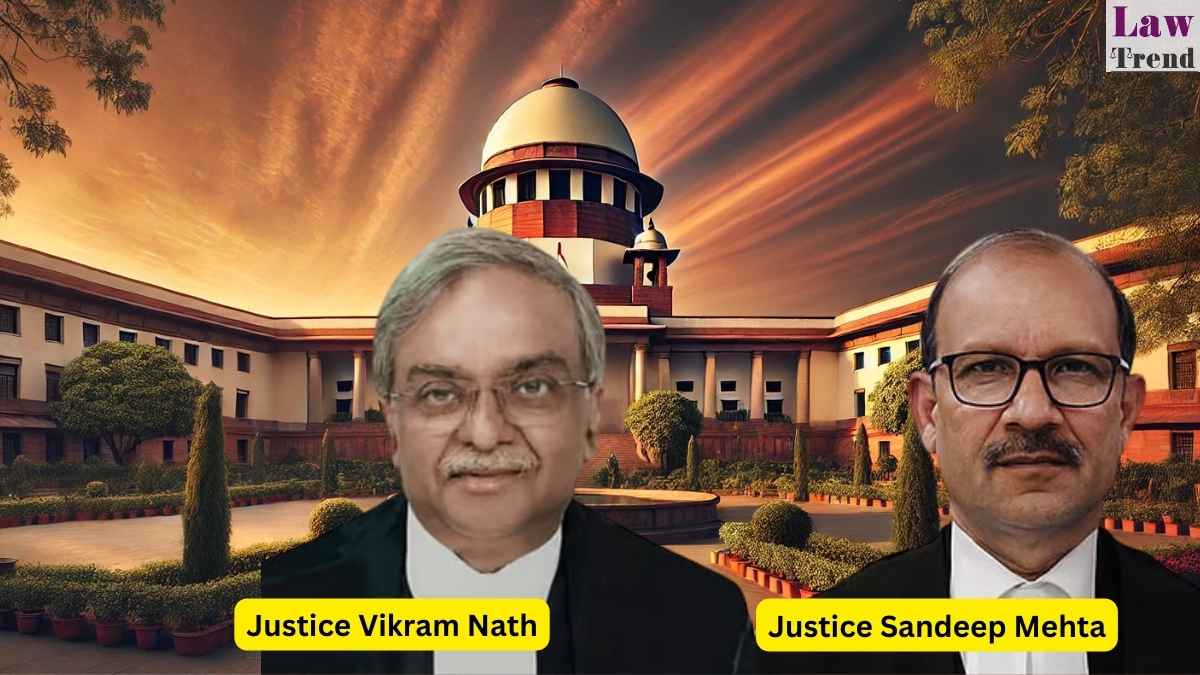
Addressing systemic regulatory failures and severe environmental degradation across Rajasthan’s river basins, a Supreme Court bench comprising Justice Vikram Nath and Justice Sandeep Mehta has directed the State of Rajasthan to constitute a high-level “Integrated Coordination Group” and an independent “River Commission/River Rejuvenation Authority.” The Court issued a series of binding directions to address widespread water body contamination, illegal industrial effluent discharges, floodplain encroachments, and groundwater depletion, while mandating deeper criminal probes by a Special Investigation Team into public servants and industrial operators.
Background of the Case
The proceedings arise out of a suo moto writ petition alongside connected civil appeals concerning grave environmental damage to the Jojari, Bandi, and Luni river systems in Rajasthan. On July 21, 2026, the Supreme Court evaluated the Second Status Report of the High-Level Ecosystem Oversight Committee, the First Status Report of the Special Investigation Team (SIT), and multiple newspaper reports detailing severe ecological crises across the State.
The initial findings disclosed widespread water contamination, illegal discharge of untreated industrial effluents from Common Effluent Treatment Plants (CETPs), agricultural land and wildlife habitat degradation, and deficiencies in defining High Flood Lines and buffer zones. In response, the Court had previously issued interim directions requiring the State to explain non-invocation of graver penal provisions, enforce accountability, transfer ecologically sensitive lands near Dhawa and Doli to the Forest Department, and ensure personal compliance through the Chief Secretary.
Progress Reports and Submissions by Parties
Pursuant to the July 21 order, the State of Rajasthan and the SIT submitted compliance reports:
- SIT Investigation: The SIT reviewed 16 criminal cases related to riverine pollution in Jodhpur, Pali, and Balotra, registering four new FIRs. Offenses under the Bharatiya Nyaya Sanhita, 2023 (including Sections 272, 326(a), and 326(c)) and the Prevention of Damage to Public Property Act, 1984 were invoked where prima facie evidence existed. Arrests were made, and surveillance tools—including SCADA inflow/outflow data analysis, CCTV footage, and Quick Response Teams—were deployed. The SIT reported prima facie evidence of connivance between CETP officials and member industrial units to bypass treatment processes.
- State Compliance & Remedial Actions:
- Tanawada Pond (Jojari River): Addressing reports of pink-colored water, preliminary analysis by IIT Jodhpur indicated that saline textile wastewater and organic contamination coupled with evaporation caused the coloration, recommending a 10–12 week detailed study.
- Sanganer-Dravyavati-Nevta Region: Out of 1,767 textile units in Sanganer, 892 belong to the 12.3 MLD Zero Liquid Discharge (ZLD) CETP, while 875 remain outside. Closure directions under Section 33A of the Water (Prevention and Control of Pollution) Act, 1974 were issued against 814 units, 65 units were sealed, and prosecutions were initiated against 37 illegal units and CETP management.
- Morel Dam: Inspection by the Rajasthan State Pollution Control Board (RSPCB) showed algal bloom and water hyacinth without animal mortality. Lab tests indicated Biochemical Oxygen Demand (BOD) and Chemical Oxygen Demand (COD) presence without heavy metal excess.
- Hazardous Sludge Removal: At the Ambey Valley HRTS site, 1,105.08 Metric Tonnes of hazardous sludge were disposed of at an authorized Common Treatment, Storage and Disposal Facility (CTDF). At Khed HRTS, four out of nine ponds were dismantled, and 332 Metric Tonnes of hazardous sludge were removed. Technical guidance from IIT Madras was sought for in-situ remediation of Nehda Dam.
- White Category Industries: Counsel appearing for White Category units submitted that representations for de-sealing and recommencing operations had been submitted following physical inspections, requesting expeditious decisions to protect workers’ livelihoods.
Court’s Observations and Analysis
Upon reviewing the record, the Supreme Court observed that the primary material on record “clearly demonstrates severe degradation of the riverine ecosystem, contamination of water bodies, illegal discharge of industrial effluents, deficiencies in land-use regulation, challenges related to the protection of wildlife habitats and restoration of the affected ecology.”
Critically examining the SIT’s performance, the Bench noted that steps for invoking graver offenses and making arrests were taken primarily as the hearing date approached. The Court observed that it “superficially appears that the SIT has taken substantial steps in furtherance of the mandate entrusted to it by this Court. However, it is noteworthy that the steps for invocation of graver offences and the arrests were effected only when the matter was nearing the date fixed by this Court. This puts a question mark on the bona fides of the SIT’s actions.”
Emphasizing the need for an uncompromised investigation, the Court stated that “extensive investigation is necessary to completely unearth the entire conspiracy and, therefore, a more deeper probe must be carried out by the SIT.” The Justices directed that “The investigation shall not remain confined to the immediate acts of illegal discharge of untreated industrial effluents but shall go to the root of the matter by identifying the complete chain of events, the decision-making processes, the financial and institutional mechanisms employed, and the involvement of all persons, whether private individuals, industrial entities or public officials.”
The Court further identified serious concerns regarding the proposed RIICO Industrial Area at Kakani (where 12.805 hectares fall within the High Flood Area close to the Luni River) and the Ambey Valley Industrial Park, noting irregularities in land-use conversions, Master Plan deviations, and missing official records. On groundwater conservation, the Court laid down a strict prohibition, holding that “no industries which are water intensive shall be henceforth permitted in areas which have been identified as dark zones (over-exploited zones) with reference to the groundwater availability.”
Additionally, addressing statutory accountability, the Bench pulled up the administration, observing: “report submitted by the State Government is totally silent regarding the action taken, if any, against the responsible officers of the RSPCB.”
Directions Issued by the Court
To secure comprehensive and cohesive environmental governance, the Supreme Court issued the following major binding directions:
- Integrated Coordination Group: The State of Rajasthan must constitute an “Integrated Coordination Group” headed by the Chief Secretary within seven days to ensure inter-departmental synergy across Environment, Forest, Water Resources, Urban Development, Revenue, and RSPCB authorities.
- Comprehensive Resolution Plan: The Integrated Coordination Group, in consultation with the Oversight Committee, must formulate and submit a Comprehensive Resolution Plan within three weeks, specifying actionable milestones, timelines, and deployment of digital tools (GIS, satellite mapping, AI surveillance).
- River Rejuvenation Authority: The State shall establish an independent River Commission/River Rejuvenation Authority, chaired for the present by the Chief Secretary, to oversee river basin management and High Flood Line demarcations statewide.
- Moratorium on Development in Corridors: Pending scientific determination and demarcation of High Flood Lines and ecological buffer zones, no fresh permissions for industrial, commercial, or residential developments within river corridors shall be granted.
- Decentralized Effluent Treatment: The State and RSPCB must promote Captive Effluent Treatment Plants (ETPs) for units generating 100 Kilo Litres per Day (KLD) or more, while strengthening existing CETP capacity and infrastructure.
- SIT Mandate & Public Servants: The SIT must intensify investigations across all pending cases without fear or favour, examining the roles of industrial owners, CETP office-bearers, and public servants.
- White Category Representations: The High-Level Committee is directed to decide on pending representations of White Category industries within seven days.
- Public Grievance & QR-Code Mechanism: The State shall establish a QR Code-based digital platform across RSPCB websites, industrial zones, Gram Panchayats, and public offices for confidential reporting of environmental violations, complete with a complaint tracking framework and an incentive scheme for informants.
- RSPCB Officer Accountability: The details of action taken or proposed against responsible RSPCB officers must be submitted to the Committee within three days.
The Supreme Court directed that the matter be listed as part-heard on September 22, 2026, to review the Comprehensive Resolution Plan submitted by the Integrated Coordination Group.
Case Title: In Re: 2 Million Lives at Risk, Contamination in Jojari River, Rajasthan With Civil Appeal No(s). 5517-5519 of 2022, Civil Appeal No(s). 8748 of 2022, Civil Appeal No(s). 9057-9058 of 2022, Civil Appeal No(s). 9010-9011 of 2022
Case No.: Suo Moto Writ Petition (Civil) No(s). 8 of 2025
Bench: Justice Vikram Nath, Justice Sandeep Mehta
Date: August 07, 2026