

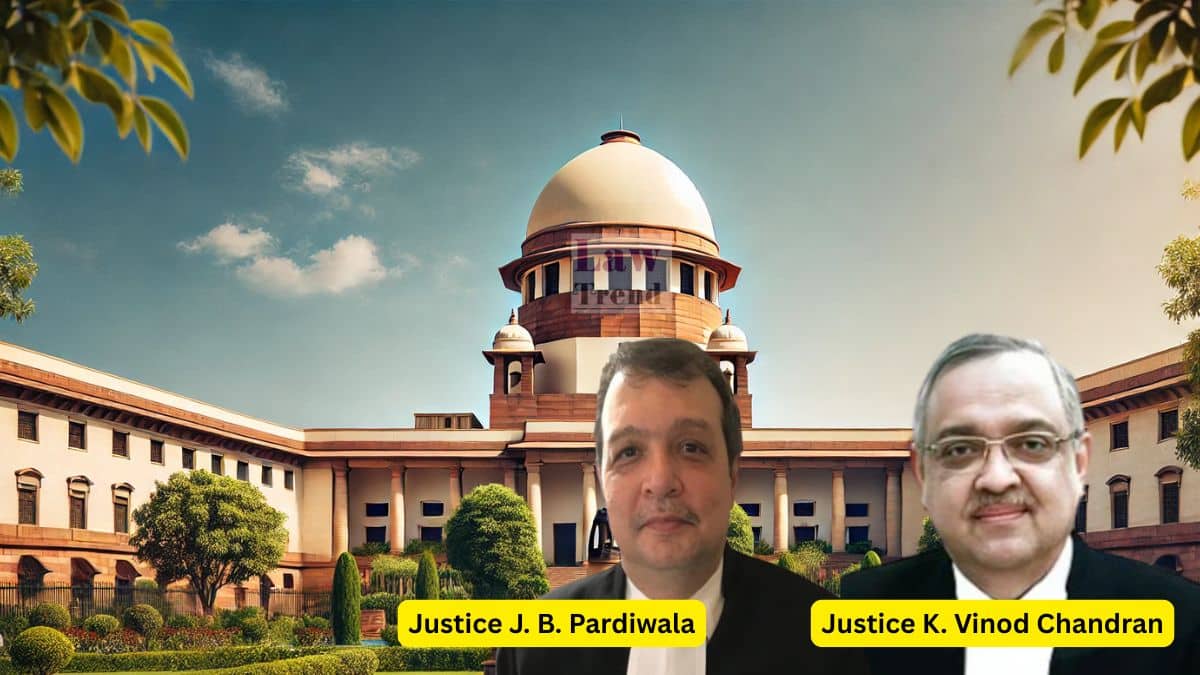
The Supreme Court has set aside a review order of the Appellate Tribunal for Electricity (APTEL) that reopened the treatment of Damodar Valley Corporation’s (DVC) Sinking Fund in tariff, an issue already settled by the apex court. Restoring the Tribunal’s original order of 17.05.2019, the Court imposed costs of ₹2 lakh on Maithan Alloys Limited and ₹1.5 lakh on the Steel Authority of India Limited (SAIL).
A Bench of Justice J.B. Pardiwala and Justice K. Vinod Chandran opened the judgment by noting, “It is not often, but we do come across orders akin to the one impugned, which is in blatant breach of judicial discipline and in clear violation of Article 141 of the Constitution of India.”
Background
The dispute concerned DVC’s tariff for 2009 to 2014, fixed by the Central Electricity Regulatory Commission (CERC) under the Electricity Act, 2003, the Damodar Valley Corporation Act, 1948 and the CERC Tariff Regulations of 2009. The question was whether the Sinking Fund, a portion of profits set aside to redeem bonds issued by DVC, could be factored into tariff.
The same issue had been considered and upheld by the Supreme Court in Bhaskar Shrachi Alloys Limited & Ors. v. Damodar Valley Corporation & Ors., (2018) 8 SCC 281, for an earlier tariff period. Relying on that decision, APTEL upheld the CERC order. No appeal was filed, but a review petition remained pending before the Tribunal for five years.
In 2024, APTEL allowed the review, holding that DVC could claim only one of two elements: the Sinking Fund contribution, or depreciation on capital assets created using the bond amount.
Arguments
Senior Advocates Vikas Singh and Dr. Abhishek Manu Singhvi, appearing for DVC, objected to the review of a five-year-old order passed after noticing a binding precedent. They submitted that the Sinking Fund is a permissible expense under the statutory provisions, and that DVC is also statutorily enjoined to ensure flood control, irrigation and development of the area. Senior Advocate Rajiv Shakdher appeared for SAIL, which had intervened.
Advocate-on-Record Rajiv Yadav, appearing for the first respondent, the review petitioner, argued that allowing both depreciation and the Sinking Fund conferred a double benefit on DVC, placing an undue burden on consumers. It was contended that a reserve fund for bond redemption can only be appropriated from profits and cannot be treated as an expense for tariff.
Supreme Court’s Findings
Examining the fourth proviso to Section 14 of the Electricity Act, the Court agreed with Bhaskar Shrachi Alloys that the DVC Act continues to apply to the extent it is not inconsistent with the 2003 Act, and found “absolutely no reason to doubt the earlier decision.”
The Bench noted that Regulation 43 of the Tariff Regulations of 2009 specifically permits funds established under Section 40 of the DVC Act to be treated as items of expenditure recovered through tariff. It held that although the words “duplication” or “double allowance” were not used earlier, the Court had found the Sinking Fund recoverable through tariff while accepting depreciation, both under Section 40 of the DVC Act.
The Court also noted that the review petitioner had itself stated in its review that the issue of Sinking Fund was no more res integra after Bhaskar Shrachi Alloys. Applying the principles in State of West Bengal v. Kamal Sengupta, (2008) 8 SCC 612, it held that an erroneous order cannot be corrected in the guise of review.
Expressing its displeasure, the Bench said, “We cannot but observe that the Tribunal has gone haywire; we are apologetic for the expression but we find no substitute to express our angst in allowing the review”. It held the review “clearly illegal, totally misplaced and blatantly in breach of the principles of judicial discipline.”
On Article 141, the Court observed that it is “a Constitutional imprimatur which ensures the decisions of the highest court of the land to be followed, without which there will be mayhem.”
Outcome
The Court termed the filing of a review and waiting five years for its hearing an abuse of process of law, and imposed costs of ₹2 lakh on the first respondent. Observing that SAIL, a Public Sector Undertaking claiming Maharatna status, had been “ill-advised” in supporting the review order, it imposed costs of ₹1.5 lakh on SAIL.
The costs are payable to DVC within one month, failing which interest at 18% per annum will apply. The appeal was allowed with costs, in addition to the exemplary costs.
Case Title: Damodar Valley Corporation vs. Maithan Alloys Limited & Ors.
Case No.: Civil Appeal No. 11106 of 2024
Bench: Justice J.B. Pardiwala and Justice K. Vinod Chandran
Date: October 30, 2026


