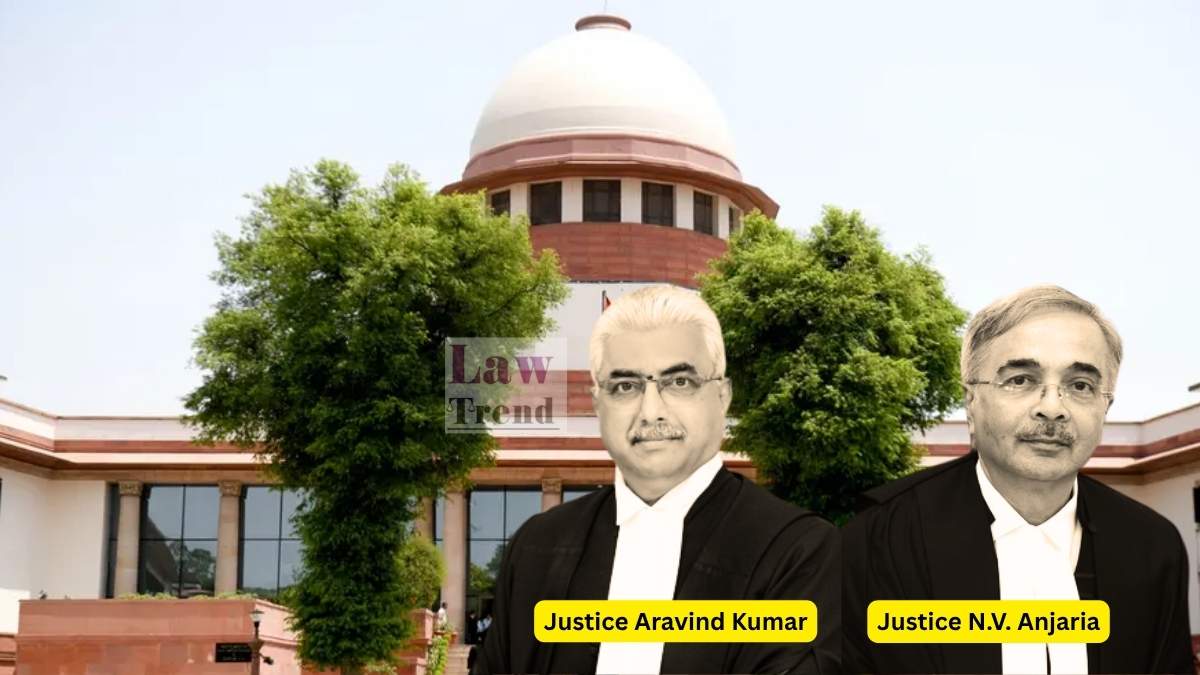
A Supreme Court bench comprising Justice Aravind Kumar and Justice N.V. Anjaria has held that oil marketing corporations providing infrastructure, site, and manpower to facilitate the sale of Compressed Natural Gas (CNG) supplied by a gas distribution company act as commission agents rendering a “Business Auxiliary Service” under Section 65(19) read with Section 65(105)(zzb) of the Finance Act, 1994. Setting aside a 2014 order of the Customs, Excise & Service Tax Appellate Tribunal (CESTAT), the apex court ruled that the arrangement between the oil companies and the gas utility is based on a principal-and-agent relationship rather than an outright sale on a principal-to-principal basis, thereby attracting service tax liability.
Background of the Case
Mahanagar Gas Limited (MGL) is engaged in manufacturing and distributing CNG. MGL received natural gas from Gas Authority of India Limited (GAIL), transported it through gas grids, and compressed it into CNG using gas compressors, dispensers, storage cascades, and meters installed at various retail outlets across Mumbai and Thane, including those owned by Bharat Petroleum Corporation Limited (BPCL) and Hindustan Petroleum Corporation Limited (HPCL).
MGL entered into agreements with BPCL on March 30, 1998 (subsequently renewed and amended in 2004 and 2008) and with HPCL on June 1, 1999. Under these agreements, BPCL and HPCL earmarked space at their retail outlets, provided utility connections such as water and electricity, constructed necessary structures, and deployed trained staff to dispense CNG to vehicular consumers at retail prices fixed by MGL.
Show Cause Notices and Adjudication
Following intelligence inputs from the Director General of Central Excise Intelligence (DGCEI), Mumbai Zone, show-cause notices were issued to BPCL and HPCL. The Department contended that the oil marketing corporations were rendering “Business Auxiliary Service” by providing marketing, site, and manpower facilities for selling MGL’s CNG and receiving a commission/profit margin per kilogram of CNG sold.
Demands were raised against BPCL for Rs. 7,20,78,037/- (April 2005 to March 2010) and Rs. 1,40,03,174/- (April 2010 to March 2011). Similarly, demands were served on HPCL for Rs. 6,86,65,245/- (April 2005 to March 2010) and Rs. 1,21,11,933/- (April 2010 to March 2011).
By Orders-in-Original dated August 16, 2012, the Commissioner of Customs (TAR), Mumbai, confirmed the service tax demands along with interest and penalties. The adjudicating authority held that the transaction was on a “Principal-to-Agent” basis, as title and ownership of CNG remained with MGL until dispensation to end consumers.
CESTAT’s Reversal
BPCL and HPCL challenged the adjudicating orders before the CESTAT, West Zonal Bench, Mumbai. On June 4, 2014, CESTAT allowed their appeals, holding that the oil corporations were buying goods from MGL on a principal-to-principal basis and paying VAT/sales tax thereon. CESTAT held that merely because goods were sold at retail sales prices fixed by MGL, the profit margin could not be treated as a commission for rendering service.
Arguments Before the Supreme Court
Appealing CESTAT’s order, the Revenue argued that the contracts explicitly provided for payment of “commission/profit margin” in consideration of services provided. The Revenue emphasized that neither title nor risk in the CNG passed to BPCL or HPCL at any point, and price control remained entirely with MGL. The Revenue contended that CESTAT erred in relying on Mahanagar Gas vs. Commissioner of Central Excise, which pertained to central excise valuation under Section 4(1)(a) of the Central Excise Act, 1944, and had no relevance to service tax payability.
On the other hand, BPCL and HPCL submitted that the transactions were outright purchases and sales under Section 4 of the Sale of Goods Act, 1930. They argued that the term “commission” in the agreement was a misnomer for a trade discount or profit margin. They maintained that property in goods transferred to them before ultimate retail sale, relying on decisions including Bhopal Sugar Industries Ltd. vs. Sales Tax Officer, Commissioner of Central Excise, New Delhi vs. DCM Textiles, Moped India Ltd. vs. Asstt. Collector of Central Excise, Union of India vs. Future Gaming Solutions (P) Ltd., Kafila Hospitality and Travels Pvt. Ltd. vs. Commissioner of Service Tax, and Vishnu Agencies (Pvt.) Ltd. vs. Commissioner Tax Officer.
Supreme Court’s Legal Analysis
The Supreme Court examined the statutory provisions of the Finance Act, 1994, the Sale of Goods Act, 1930, and the Contract Act, 1872, alongside the specific contractual clauses governing the parties.
Distinguishing a contract of sale from an agency agreement, the Court cited its decision in Sri Tirumala Venkateswara Timber and Bamboo vs. Commercial Tax Officer, Rajahmundry, observing:
“The essence of a contract of sale is the transfer of title to the goods for a price paid or promised to be paid. The transferee in such a case is liable to the transferor as a debtor for the price to be paid and not as agent for the proceeds of the sale. The essence of agency to sell is the delivery of the goods to a person who is to sell them, not as his own property but as the property of the principal who continues to be the owner of the goods and will therefore be liable to account for the sale proceeds.”
Analyzing the agreements between MGL and the oil corporations, the Court highlighted several decisive features:
- Provision of Services and Facilitation: BPCL and HPCL acted as facilitators providing sites, infrastructure, utility connections, and trained manpower to enable MGL to sell CNG to vehicle owners.
- Control over Price and Equipment: MGL retained absolute ownership of all compressors, dispensers, cascades, and equipment installed at the outlets. MGL alone held the authority to fix and revise CNG retail prices.
- Retention of Title and Stock: The risk and title in the CNG never passed to the oil corporations. Upon termination of the contract, all unsold stock of CNG was required to be returned to MGL or disposed of as per MGL’s directions.
Citing M/s Snow White Industrial Corporation, Madras vs. Collector of Central Excise, Madras and Hafiz Din Mohammad Haji Abdulla vs. State of Maharashtra, the bench reiterated that contractual nomenclature is not conclusive and the court must examine the true substance of the transaction. The Court quoted Hafiz Din:
“The designation which a party chooses to give to the relation, especially in cases of liability to pay tax, is of little consequence. The Court has in each case, having regard to the terms and the attendant circumstances, to ascertain the true relation between the parties without giving undue importance to the special expressions used by them.”
Rejecting the argument that the payment was a trade discount, the Court observed that trade discounts apply to principal-to-principal sales (Union of India vs. Bombay Tyre International Ltd.). Here, Clause 8.4 of the Agreement expressly provided for commission based on the actual quantity sold. Referring to Future Gaming Solutions (P) Ltd., the Court quoted:
“The distinction between an agent and the buyer for resale normally turns on whether the person concerned acts personally to make such profit as can be made, or is remunerated by pre-arranged commission. A supplier who fixes the resale price is likely to be a buyer for resale. If a party takes a profit on the resale, it will make him a seller. On the other hand, if a commission is paid on the resale, then, he is likely to be an agent.”
The Court also referenced Bharti Cellular Limited vs. CIT regarding the exercise of principal control in agency relationships, and K. Arumugam vs. Union of India regarding the scope of Business Auxiliary Services.
Decision of the Court
The Supreme Court concluded that BPCL and HPCL acted as commission agents providing promotional and auxiliary services for the marketing and sale of CNG belonging to MGL. Their activities fall squarely under Section 65(19) and constitute taxable services under Section 65(105)(zzb) of the Finance Act, 1994.
Accordingly, the Supreme Court allowed all appeals, set aside the common order of CESTAT dated June 4, 2014, and restored the Orders-in-Original dated August 16, 2012 passed by the Commissioner of Customs (TAR), Mumbai. The Revenue was held entitled to enforce the service tax demands against BPCL and HPCL.
Case Title: Commissioner of Service Tax Mumbai v. M/s Bharat Petroleum Corporation Ltd. Etc.
Case No.: Civil Appeal Nos. 2471-2473 of 2015
Bench: Justice Aravind Kumar and
Justice N.V. Anjaria
Date: July 20, 2026