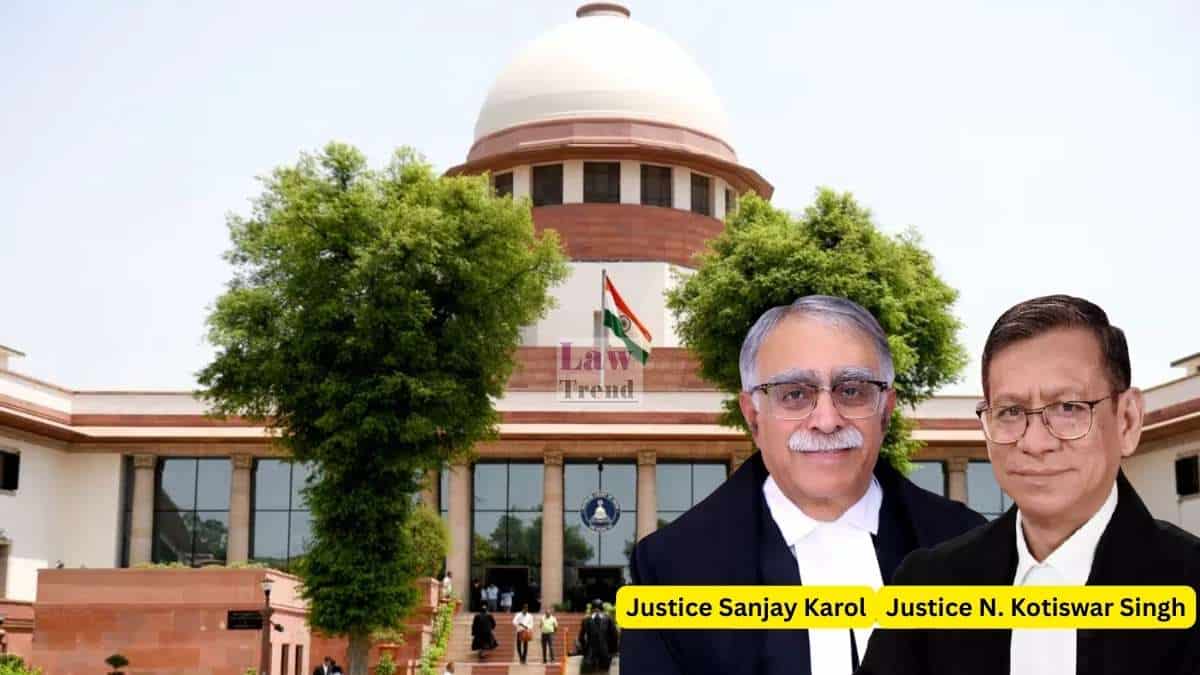
The Supreme Court of India has dismissed an appeal filed by The Oriental Insurance Co. Ltd., holding that an insurer cannot deny liability for a motor accident occurring outside the territorial limits of India if the vehicle was operating under a valid special transit permit covered by the insurance policy. The division bench of Justice Sanjay Karol and Justice N. Kotiswar Singh ruled that standard-form insurance policies must be interpreted in a manner that aligns with the beneficial purposes of the Motor Vehicles Act, 1988, and any ambiguity arising from sloppy drafting by the insurer must be resolved in favor of the insured.
Background of the Case
The dispute arose from a fatal road accident in 2010 involving a passenger bus (bearing registration number CG-07/LP-0344) owned by Durg Roadways Private Limited. The vehicle was chartered for a religious tour from Durg, Chhattisgarh, to several destinations in Nepal. While traveling in Nepal, the bus collided with a hill, leading to the deaths of three individuals, including the driver, Riaz Khan, and a passenger named Harish Yadav.
The family of Harish Yadav subsequently filed a claim petition before the Motor Accident Claims Tribunal seeking compensation of Rs 48,99,776. The Tribunal awarded compensation of Rs 32,67,000 with 6% interest from October 22, 2011, but fastened the liability solely on the vehicle owner. On appeal, the High Court of Chhattisgarh set aside this direction, shifting the liability to pay the compensation onto the appellant-insurer. The High Court relied on a precedent set by the Punjab and Haryana High Court in Anil Kumar v. Roop Kumar Sharma, which has been widely adopted by various High Courts across India. The insurer then appealed to the Supreme Court.
Arguments of the Parties
The appellant-insurer, Oriental Insurance, primarily argued that it was not liable to cover an accident that occurred outside the territorial limits of India. They pointed to the policy’s “Geographical Area” clause, which specified “India” and left the “Area of Extension” blank. The insurer argued that under General Regulation 4 (GR.4) of the India Motor Tariff 2002, geographical coverage could only be extended to neighboring countries like Nepal through the payment of a flat additional premium, which the owner did not pay. They further contended that the deceased driver did not hold a valid driving license authorizing him to drive within Nepal, thereby breaching the terms of the insurance policy.
Conversely, the respondent-owner asserted that they had obtained a valid special permit under Section 88(8) of the Motor Vehicles Act, 1988, specifically authorizing the vehicle to ply on the Durg-Nepal route. They also emphasized that at the India-Nepal border, all documents, including the driver’s license, had been verified and approved by competent authorities, who then issued the necessary clearances, including the “Bhansar Pragna Patra” and the “Indian Tourist Passenger Checking Card.”
The Court’s Analysis and Interpretation
The Supreme Court rejected the insurer’s arguments, emphasizing that an insurance policy must be read as a whole rather than by isolating individual clauses, a principle previously established in National Insurance Co. Ltd. v. Chief Electoral Officer and Export Credit Guarantee Corpn. of India Ltd. v. Garg Sons International.
While the “Geographical Area” clause specified “India,” the “Limitation as to Use” clause in the policy explicitly stated that coverage applied to any use under a permit within the meaning of the Motor Vehicles Act, 1988. Since the Chhattisgarh transport authorities had issued a valid special permit for the transit into Nepal, the Court ruled that the “Limitation as to Use” clause successfully extended the policy’s coverage.
Addressing the insurer’s drafting of the contract, the Court highlighted that the insurer unilaterally drafts standard-form contracts and must bear the consequence of any ambiguity. To support this, the Court noted:
“Cover what you want. Exclude what you want. But make sure you do it clearly. Sloppy drafting could cost you something.”
The Court reiterated that the Motor Vehicles Act is a beneficent piece of legislation intended to protect victims and should be interpreted liberally, as established in Syed Mehaboob v. New India Assurance Co. Ltd. and subsequent cases like Ningamma, K. Ramya, and Nidhi Bhargava. Applying the rule of contra proferentem, the Court quoted United India Insurance Co. Ltd. v. Pushpalaya Printers (followed in Sangrur Sales Corpn.):
“… It is also settled position in law that if there is any ambiguity or a term is capable of two possible interpretations, one beneficial to the insured should be accepted consistent with the purpose for which the policy is taken, namely, to cover the risk on the happening of certain event…”
On the issue of the unpaid additional premium under GR.4 of the India Motor Tariff, the Court analyzed Section 147(5) of the Motor Vehicles Act. It observed that the section starts with a non-obstante clause, giving it an overriding effect over general tariff regulations. Citing Mohd. Abdul Samad v. State of Telangana, the Court explained the statutory nature of such clauses:
“A non obstante clause is usually appended to a section in the beginning with a view to give the enacting part of the section, in case of a conflict, an overriding effect over the provision or the Act mentioned in the non obstante clause.”
Citing A.G. Varadarajulu v. State of T.N. and the landmark ruling in Madhav Rao Jivaji Rao Scindia v. Union of India, the Court concluded that the non-obstante clause in Section 147(5) overrides the tariff regulations. Therefore, the non-payment of the additional premium does not invalidate the permit or the policy’s liability coverage.
The Court also affirmed the extraterritorial applicability of the Motor Vehicles Act. Under Article 245(2) of the Constitution of India, parliamentary laws cannot be deemed invalid for having extraterritorial operations. The bench pointed to Sections 139 and 149 of the Motor Vehicles Act, which govern rules for taking vehicles temporarily out of India and mandate insurers to satisfy foreign judgments from reciprocating countries, confirming that the statute is legally designed to apply beyond national borders.
Addressing the driver’s licensing issue, the Court observed that the driver held a valid Indian driving license, which was officially verified by Nepal’s border authorities. The Court highlighted that under Article 7 of the India-Nepal Treaty of Peace and Friendship (1950), nationals of both countries enjoy equal privileges regarding movement, meaning valid licenses issued in India are recognized in Nepal.
Final Decision and Guidelines for the Future
The Supreme Court dismissed the appeal and directed the insurer to deposit the determined compensation amount with interest within four weeks directly into the claimants’ bank accounts.
Before concluding, the Court expressed concern over the lack of statutory clarity regarding cross-border motor insurance. It noted that the Insurance Regulatory and Development Authority of India (IRDAI) recently de-notified the India Motor Tariff 2002, effective April 1, 2024, leaving a regulatory vacuum. To avoid future disputes and timely resolve motor accident claims, the Court issued three recommendations:
- Insurance policy language must be clear, unambiguous, and explicitly mention whether extraterritorial jurisdictions are covered.
- If cross-border coverage is excluded, policies must say so explicitly and clearly advise policyholders to purchase separate endorsements.
- IRDAI should consider issuing a master circular standardizing cross-border coverage clauses across all motor insurance policies.
The Court also criticized the Motor Accident Claims Tribunal’s handling of the case, noting that its lack of clear correlation between facts and legal reasoning unnecessarily leads to prolonged appeals.
Case Details
Case Title: The Oriental Insurance Co. Ltd. v. Durg Roadways Private Limited & Ors.
Case No.: Civil Appeal No. of 2026 (Arising out of SLP (Civil) No. 20645 of 2025)
Bench: Justice Sanjay Karol and Justice N. Kotiswar Singh
Date: July 20, 2026