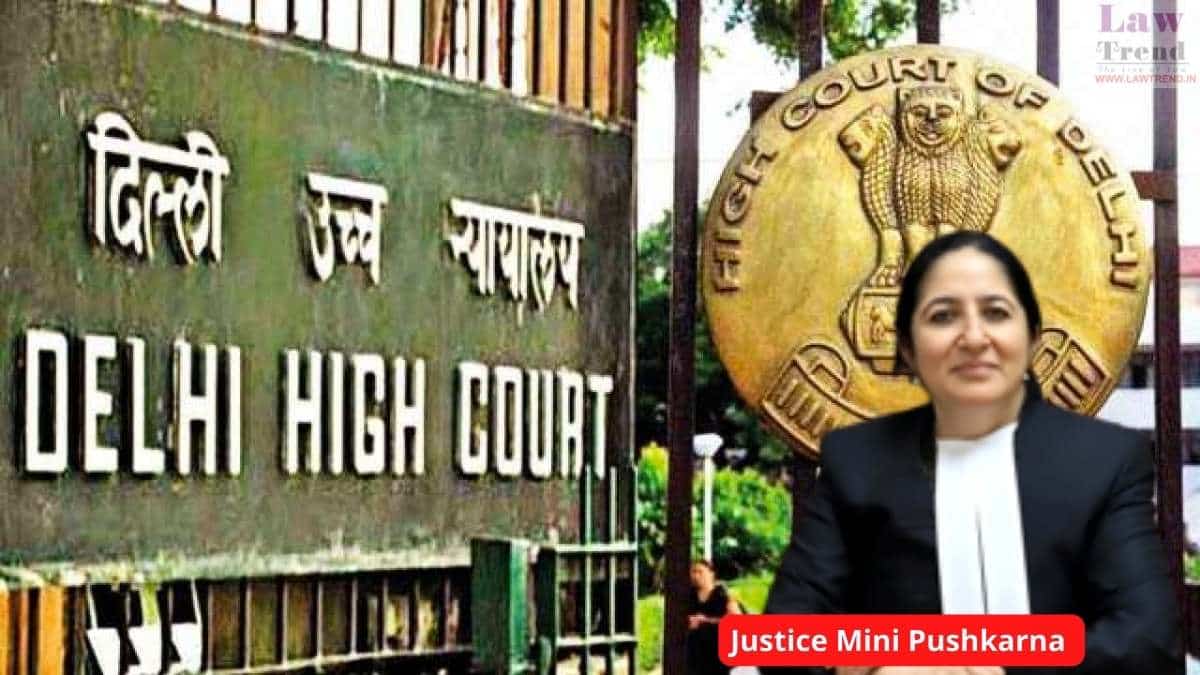
The High Court of Delhi, in a bench comprising Justice Mini Pushkarna, has held that a buyer seeking specific performance of an Agreement to Sell must establish “continuous” readiness and willingness to fulfill their obligations from the date of the contract until the decree, ruling that reliance on third-party account-payee cheques with insufficient funds fails to meet this statutory requirement. While upholding the dismissal of a suit seeking the transfer of a Delhi property, the High Court directed the property owner to refund Rs. 10 lakhs held as earnest money within four weeks, following an undertaking offered by the seller’s counsel during the appeal.
Background of the Case
The dispute arose from a transaction involving a built-up property bearing No. 7, Gobind Park, Village Khureji Khas, Shahdara, Delhi. The appellant, Chander Pal Singh (buyer), entered into an initial Agreement to Sell dated May 25, 2008, with the respondent, Kamlesh Nagpal (seller), for a total consideration of Rs. 55.5 lakhs, paying Rs. 5 lakhs as advance earnest money.
Subsequently, on June 19, 2008, both parties executed a fresh Agreement to Sell in substitution of the earlier agreement. The buyer paid an additional sum of Rs. 15 lakhs, taking the total payment to Rs. 20 lakhs. As per the terms of the revised agreement, Rs. 10 lakhs was treated as earnest money, while the remaining Rs. 10 lakhs was treated as part payment toward the total sale consideration. The remaining balance of Rs. 35.5 lakhs was to be paid at the time of execution of the sale deed, fixed on or before August 1, 2008.
On August 1, 2008, both parties were present at the office of the Sub-Registrar, Geeta Colony, Delhi, and marked their presence by obtaining inspection receipts. However, the sale deed could not be executed as both parties attributed default to each other. The buyer issued a legal notice on August 2, 2008, claiming he was present with the balance amount and alleging that the seller avoided execution. The seller replied on August 13, 2008, stating that the buyer failed to bring a bank draft for the balance sum of Rs. 35.5 lakhs, while also claiming that the earnest money stood forfeited under Clause 4 of the agreement.
On August 29, 2008, the buyer filed a police complaint with the Assistant Commissioner of Police (ACP), Gandhi Nagar, seeking the return of his money. Later, he instituted a civil suit for specific performance before the court. During the pendency of the suit, the High Court on October 27, 2009, recorded the seller’s willingness to refund Rs. 10 lakhs (the part payment), which was subsequently paid to the buyer. However, on September 15, 2016, the Trial Court dismissed the buyer’s suit for specific performance, holding that he failed to prove continuous financial readiness and willingness, and declined any money decree for the earnest money as it was not explicitly prayed for in the plaint. The buyer then preferred a Regular First Appeal (RFA 246/2017) before the High Court.
Arguments of the Parties
The appellant (buyer) submitted that he had established his readiness and willingness throughout the transaction. He contended that he had arranged four cheques totalling the balance sale consideration of Rs. 35.5 lakhs on August 1, 2008, and that a major portion of the funds (Rs. 24 lakhs) was held in a joint account with his wife. He argued that the Trial Court erred by evaluating his financial capacity based on bank balances on dates when evidence was recorded rather than the stipulated date of performance. Furthermore, he argued that he had the right to tender third-party cheques since the agreement contemplated execution in favor of himself or his nominee, and challenged the forfeiture of earnest money in the absence of any proven loss suffered by the seller.
Conversely, the respondent (seller) argued that under Section 16(c) of the Specific Relief Act, 1963, continuous readiness and willingness from the date of the agreement through the date of decree is a mandatory prerequisite. The seller asserted that the buyer failed to produce bank statements demonstrating continuous funds. It was further argued that the buyer tendered private account-payee cheques from third parties (relatives and friends), which the seller was under no obligation to accept and which could not be encashed on the same day under banking norms. Additionally, bank statements showed that the accounts on which these cheques were drawn lacked sufficient balances during their validity period. The seller also pointed out that the buyer’s police complaint dated August 29, 2008, requested his money back, proving he was not willing to perform the contract.
The Court’s Analysis
The High Court observed that since the transaction occurred prior to the 2018 amendment to the Specific Relief Act, 1963, the unamended Section 16(c) applied, as held in Pydi Ramana Alias Ramulu Versus Davarasety Manmadha Rao and Katta Sujatha Reddy v. Siddamsetty Infra Projects (P) Ltd.
The court highlighted the distinction between “readiness” and “willingness”, referring to P. Daivasigamani Versus S. Sambandan, Shenbagam and Others Versus KK Rathinavel, and Acharya Swami Ganesh Dassji v. Sita Ram Thapar. Defining the scope, the court observed that “Readiness is the capacity of the plaintiff to perform the contract which includes his financial position to pay the sale consideration. Willingness is the conduct of the party.”
Reiterating established principles from Kamal Kumar Versus Premlata Joshi and Others, J.P. Builders and Another Versus A. Ramadas Rao and Another, and C.S. Venkatesh Versus A.S.C. Murthy, the bench highlighted that readiness and willingness must be continuous. Quoting from C.S. Venkatesh and N.P. Thirugnanam v. R. Jagan Mohan Rao, the court noted:
“If the plaintiff fails to either aver or prove the same, he must fail. To adjudge whether the plaintiff is ready and willing to perform his part of contract, the court must take into consideration the conduct of the plaintiff prior to and subsequent to the filing of the suit along with other attending circumstances. The amount of consideration which he has to pay to the defendant must necessarily be proved to be available.”
Evaluating the evidence, the court found that the buyer offered four private, account-payee cheques rather than banker’s cheques on August 1, 2008. These cheques could not be encashed immediately under banking norms, and bank statements revealed that the accounts—particularly those of third parties Shri Rajesh Kumar and Shri Meer Singh Sehrawat—lacked the necessary funds to honor the cheques during their validity period.
Furthermore, the court took serious note of the buyer’s police complaint dated August 29, 2008, where he asked for the refund of his money rather than enforcing the contract. Observing this conduct, the court held:
“A purchaser who, within weeks of the stipulated date of performance, seeks refund of the sale consideration cannot simultaneously claim to have remained continuously willing to perform the contract.”
Addressing the buyer’s plea that the seller had avoided performance, the court relied on Man Kaur (Dead) by Lrs. Versus Hartar Singh Sangha, observing that “…even assuming that the defendant had committed breach, if the plaintiff fails to aver in the plaint or prove that he was always ready and willing to perform the essential terms of contract which are required to be performed by him… there is a bar to specific performance in his favour.”
The court also dismissed an application (C.M. 8298/2017) filed by the buyer under Order XLI Rule 27 of the Code of Civil Procedure, 1908, seeking to adduce additional bank statements. Citing Sanjay Kumar Singh Versus State of Jharkhand and Rahul Associates Versus BMS Enterprises and Others, the court held that additional evidence is admitted only in exceptional circumstances when needed to pronounce judgment, and the proposed statements failed to alter the finding on the lack of continuous financial readiness.
Final Decision
The High Court affirmed the Trial Court’s judgment refusing the decree for specific performance of the Agreement to Sell. However, noting the statement made by the seller’s counsel during the hearing on April 16, 2026, expressing readiness to refund the earnest money without prejudice, the High Court directed the seller to refund the sum of Rs. 10 lakhs (earnest money/security) to the buyer within four weeks. The appeal was disposed of accordingly.
Case Title: Chander Pal Singh v. Kamlesh Nagpal
Case No.: RFA 246/2017 & CM APPL. 8298/2017
Bench: Justice Mini Pushkarna
Date: July 20, 2026