

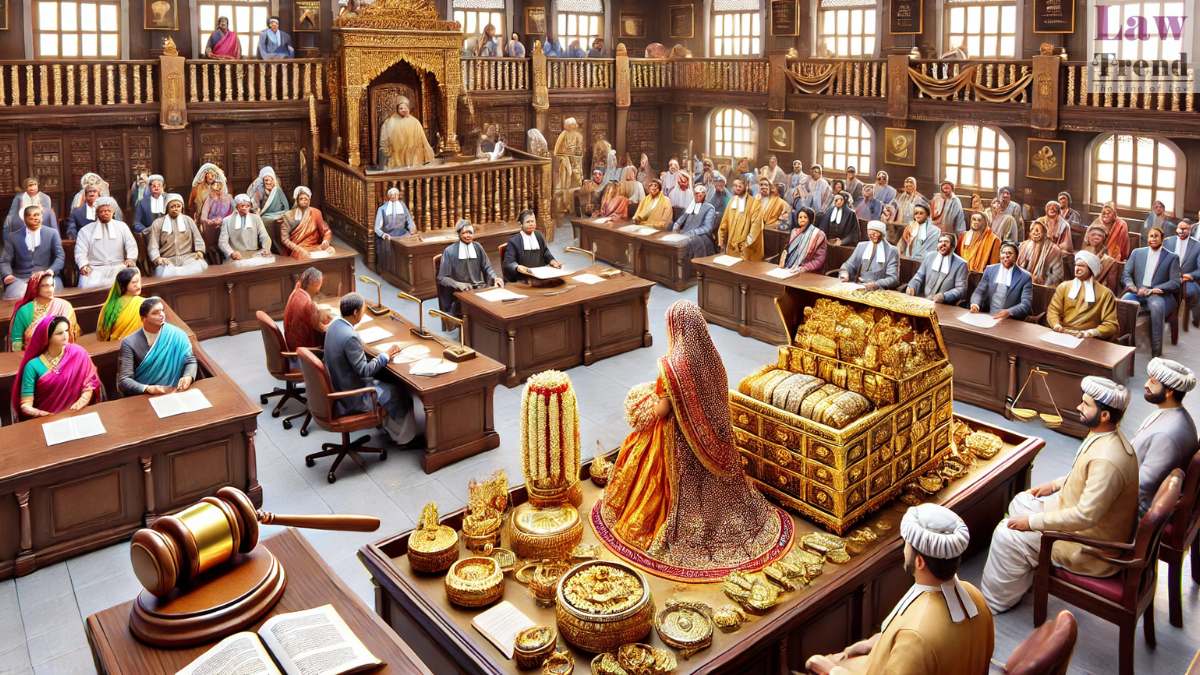
The High Court of Himachal Pradesh has held that retention of stridhan may no longer remain a “continuing offence” once marital ties have been severed through a decree of divorce, and any criminal complaint for its recovery must be instituted within the three-year limitation period prescribed under Section 468 of the Code of Criminal Procedure, 1973 (Cr.P.C.). A single-judge bench comprising Justice Chirag Bhanu Singh allowed a petition filed under Section 482 Cr.P.C., quashing criminal proceedings for criminal breach of trust and criminal intimidation initiated by an estranged wife against her former husband after finding that the complaint, instituted nearly five years after their divorce decree, was barred by statutory limitation.
Background of the Case
The parties solemnized their marriage according to Hindu rites and ceremonies on February 7, 2007. Allegations arose from the beginning regarding dowry, leading to police reports and causing the complainant to reside at her parental home. The parties had been living separately since approximately 2008.
On October 9, 2012, a competent court dissolved the marriage by granting an ex-parte decree of divorce on grounds of cruelty and desertion in favour of the petitioner. Prior to and after the dissolution, several legal disputes arose between the parties: proceedings under Section 125 Cr.P.C. reached the High Court, where the complainant was held not entitled to maintenance on September 21, 2016; and a civil suit for permanent maintenance was dismissed by the Family Court on May 13, 2022. In none of these prior maintenance proceedings did the complainant assert a claim for the return of her ‘Istridhan’.
Subsequently, on July 19, 2017, the complainant filed a criminal complaint under Section 190 Cr.P.C. before the Judicial Magistrate First Class, Court No. VII, Shimla, alleging offences punishable under Sections 406 (criminal breach of trust) and 506 (criminal intimidation) of the Indian Penal Code (IPC) for the alleged retention and misappropriation of her ‘Istridhan’. The Magistrate summoned the petitioner on June 1, 2018, and later put a notice of accusation to him on September 3, 2022. Challenging the maintainability of these proceedings, the petitioner approached the High Court under Section 482 Cr.P.C. seeking to quash the complaint and consequential orders.
Arguments of the Parties
Counsel for the petitioner submitted that the complaint was an abuse of the judicial process, mala fide, and filed after concealing material facts, including the 2012 divorce decree. It was argued that although the complainant claimed to have made repeated requests since 2011, the criminal complaint was preferred only on July 19, 2017. Because offences under Sections 406 and 506 IPC attract a maximum punishment of up to three years, Section 468 Cr.P.C. mandates a limitation period of three years for taking cognizance, thereby barring the complaint. In support, reliance was placed on State of Himachal Pradesh v. Tara Dutt & Anr. (AIR 2000 SC 297).
Conversely, counsel for the complainant contended that an offence relating to the claim of ‘Istridhan’ constitutes a continuing offence. Relying on Supreme Court rulings in Krishna Bhattacharjee v. Sarathi Choudhury and Another (2016) 2 SCC 705 and Kamatchi v. Lakshmi Narayanan (2022), it was asserted that so long as the property remains in the custody of the husband, the wife can claim it and the question of limitation does not arise. Citing Pratibha Rani v. Suraj Kumar & Anr. (1985) 2 SCC 370, it was further urged that the High Court under Section 482 Cr.P.C. must proceed entirely on the face of the complaint allegations and cannot test their correctness at this preliminary stage.
Court’s Analysis and Observations
Justice Chirag Bhanu Singh observed that where the punishment for offences ranges between one and three years, Section 468 Cr.P.C. prescribes a three-year period of limitation to take cognizance, which is to be reckoned on the basis of the major offence. Consequently, for offences under Sections 406 and 506 IPC, the applicable period of limitation is three years.
Examining the Supreme Court’s ruling in Krishna Bhattacharjee, the Court highlighted the crucial legal distinction between a decree of judicial separation and a decree of divorce, noting that in the former the marital bond remains legally intact, whereas in the latter the status of husband and wife is dissolved:
“In Krishna Bhattacharjee’s Case (supra), it was held that if there is only a decree of judicial separation, the relationship between husband and wife continues and the legal relationship continues as if it has not been snapped. Thus understood, the demand for ‘Istridhan’ will remain a continuing offence. After the dissolution of marriage, it may not remain the same. The distinction may be subtle, but it is indeed marked, and so has it been held in the aforesaid judgment. After the relations between the husband and the wife severed, the offences relating the Section 498-A and demand of ‘Istridhan’ may no more ramin as ‘continuing offence’.”
The Court held that severance of marital status occurred on October 9, 2012:
“In the case at hand, admittedly there has been a severance of the relationship between the parties as husband and wife with effect from 09.10.2012. Even in case the respondent/complainant had forgotten to lay a claim to the ‘Istridhan’, either while filing a petition under Section 13 HMA or filling a suit for maintenance under Section 528 of the Hindu Adoptions and Maintenance Act, she could have done so within the prescribed period of limitation, that is, three years therefrom. Had the marriage not been dissolved and their relationship had continued even subject to their being separated the offence of retention of ‘Istridhan’ could have been said to be a continuing offence.”
Concluding on the aspect of limitation, the Court observed:
“Viewed in the totality of circumstances discussed above, it can safely be held that in the factual circumstances of the present case, it cannot be said that the offence was a continuing offence. The respondent/complainant could have laid a claim to the ‘Istridhan’ at best within three years of the decree of divorce, that is, three years from 09.10.2012. The complaint having been made much thereafter, the same was thus barred by limitation as prescribed by Section 468 of the Code of Criminal Procedure.”
The Decision
Finding that the complaint had been preferred well beyond the statutory three-year limitation period from the date of the divorce decree, the High Court allowed the petition under Section 482 Cr.P.C. The Court quashed Case No. 1 of 2017 pending before the Judicial Magistrate First Class, Court No. VII, Shimla, along with the summoning order dated June 1, 2018, the notice of accusation dated September 3, 2022, and all consequential proceedings.
Case Title:
Tota Ram v. Kanchan Lata & Anr.
Case No.: Cr. MMO No. 901 of 2022
Bench: Justice Chirag Bhanu Singh
Date: October 14, 2026


