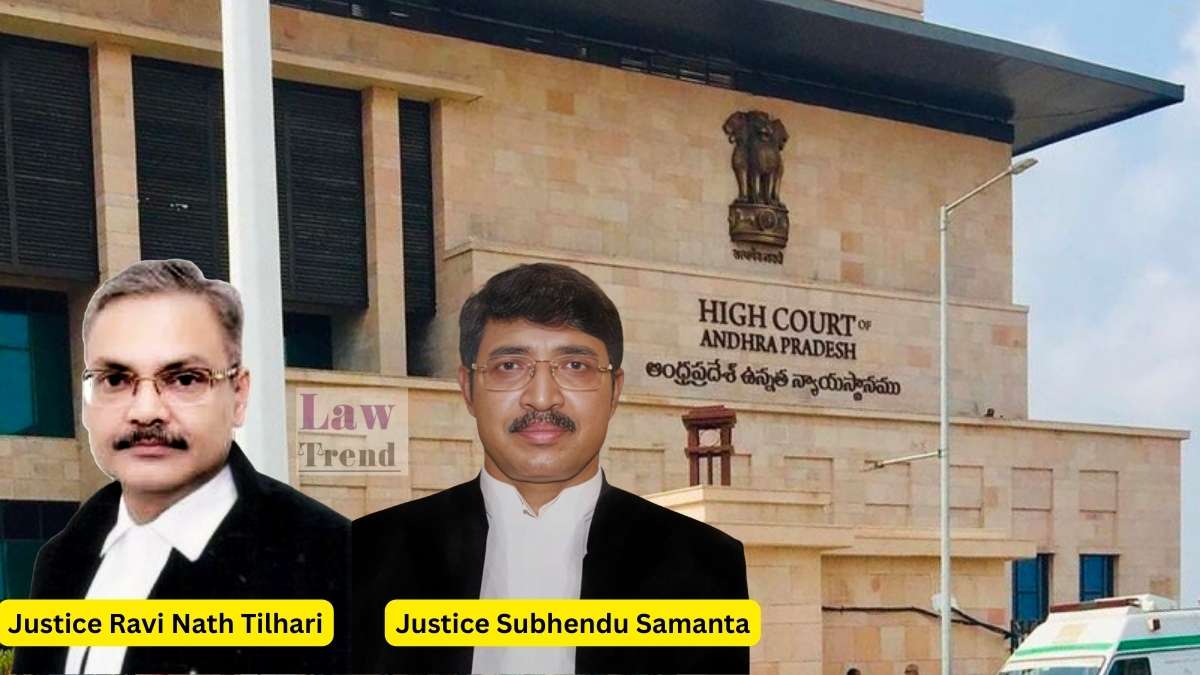
The High Court of Andhra Pradesh at Amaravati has ruled that a contempt petition filed beyond the statutory one-year limitation period cannot be entertained when a specific compliance timeline has expired. The division bench comprising Justice Ravi Nath Tilhari and Justice Subhendu Samanta dismissed a contempt plea alleging non-compliance of a 2022 order, holding that the period of limitation, once set in motion, runs its full course and cannot be bypassed under the guise of a “continuing wrong” unless exceptional grounds are properly pleaded.
Background of the Case
The petitioner, S. Janardhana, filed the contempt petition alleging willful disobedience of a judgment and order dated July 22, 2022, passed by a coordinate bench of the High Court in Writ Petition No. 21758 of 2022.
The coordinate bench had disposed of the writ petition by directing the respondents, Shri Anil Kumar Singhal and others, to implement an order passed by the Administrative Tribunal on September 25, 2018, in O.A. No. 2044 of 2018. The respondents were directed to carry out the implementation as expeditiously as possible, preferably within a period of three months from the date of receipt of a copy of the court’s order.
Arguments of the Parties
The petitioner’s counsel, Sri P. Raghavender Reddy, appearing virtually, did not dispute that the contempt petition was presented well after the expiry of the one-year limitation period prescribed under Section 20 of the Contempt of Courts Act, 1971.
However, the petitioner argued that because the directions had still not been implemented, the cause of action was continuous, thereby exempting the petition from the standard one-year limitation constraint.
The petitioner further submitted that the underlying Tribunal order from September 25, 2018, was subsequently challenged by the Tirupati Municipal Corporation in Writ Petition No. 3322 of 2024. Since that writ petition was dismissed by the High Court on February 8, 2024, the petitioner argued that this subsequent litigation should enure to his benefit regarding the limitation period for the contempt plea.
The Court’s Analysis and Precedents
The court evaluated the statutory bar under Section 20 of the Contempt of Courts Act, 1971, which mandates that no court shall initiate contempt proceedings, on its own motion or otherwise, after the expiry of one year from the date on which the contempt is alleged to have been committed.
The bench relied extensively on the law laid down by the Supreme Court of India in S. Tirupathi Rao v. M. Lingamaiah (2024) 20 SCC 188. In that case, the apex court clarified that contempt proceedings are original in nature, and the application of Section 5 of the Limitation Act, 1963, to seek condonation of delay is excluded. While exemption from limitation can be claimed in exceptional circumstances under the principles of Order 7 Rule 6 of the Civil Procedure Code (CPC), the Supreme Court warned against entertaining stale claims.
Highlighting the apex court’s observations in S. Tirupathi Rao, the High Court quoted:
“Stale claims of contempt, camouflaged as a ‘continuing wrong/breach/offence’ ought not to be entertained, having regard to the legislative intent for introducing Section 20 in the Act… If the bogey of ‘continuing wrong/breach/offence’ is mechanically accepted whenever it is advanced as a ground for claiming exemption, an applicant may knock the doors of the Court any time suiting his convenience.”
The Supreme Court had further observed:
“If an action for contempt is brought belatedly, say any time after the initial period of limitation and years after the date of first breach, it is the prestige of the court that would seem to become a casualty during the period the breach continues. Once the dignity of the court is lowered in the eyes of the public by non-compliance of its order, it would be farcical to suddenly initiate proceedings after long lapse of time.”
Applying these principles, the High Court rejected the petitioner’s argument that the non-compliance constituted a continuous cause of action. The bench observed:
“There is a specific direction to comply within a specified period. If the order was not complied within that period, the contempt petition should have been filed within a period of limitation as prescribed under Section 20 of the Act from the date of expiry of the period as specified in the order of the writ Court.”
The court noted that the petitioner’s pleadings contained no assertions of a continuous cause of action, nor did they show any grounds to claim exemption from the law of limitation.
Addressing the petitioner’s reliance on the dismissal of Writ Petition No. 3322 of 2024, the bench held that it did not rescue the contempt petition for two reasons. First, the direction to implement was issued on July 22, 2022, with a three-month deadline, meaning the limitation period expired long ago. The bench emphasized:
“It is well settled that the period of limitation once starts running it would run its full course.”
Second, there was no record to show that the writ court’s order dated July 22, 2022, was ever stayed or kept in abeyance during the subsequent proceedings.
The High Court also cited the Supreme Court’s decision in Secretary, Government of Tamilnadu v. S. Raja (2026 SCC OnLine SC 659), which referred to the landmark ruling in Pallav Sheth v. Custodian (2001) 7 SCC 549, to reiterate that the limitation for initiating contempt proceedings is strictly one year from the date of the alleged contempt.
Decision of the Court
Holding that the petition was clearly barred by limitation, the High Court dismissed the contempt case. The court made no order as to costs and closed all pending miscellaneous petitions.
Case Details
Case Title: S. Janardhana v. Shri Anil Kumar Singhal & 2 others
Case No.: Contempt Case No: 3541/2024
Bench: Justice Ravi Nath Tilhari and Justice Subhendu Samanta
Date of Judgment: 23.06.2026