

Winding-Up Proceedings Do Not Extend Limitation Period For Money Recovery Suit: Supreme Court
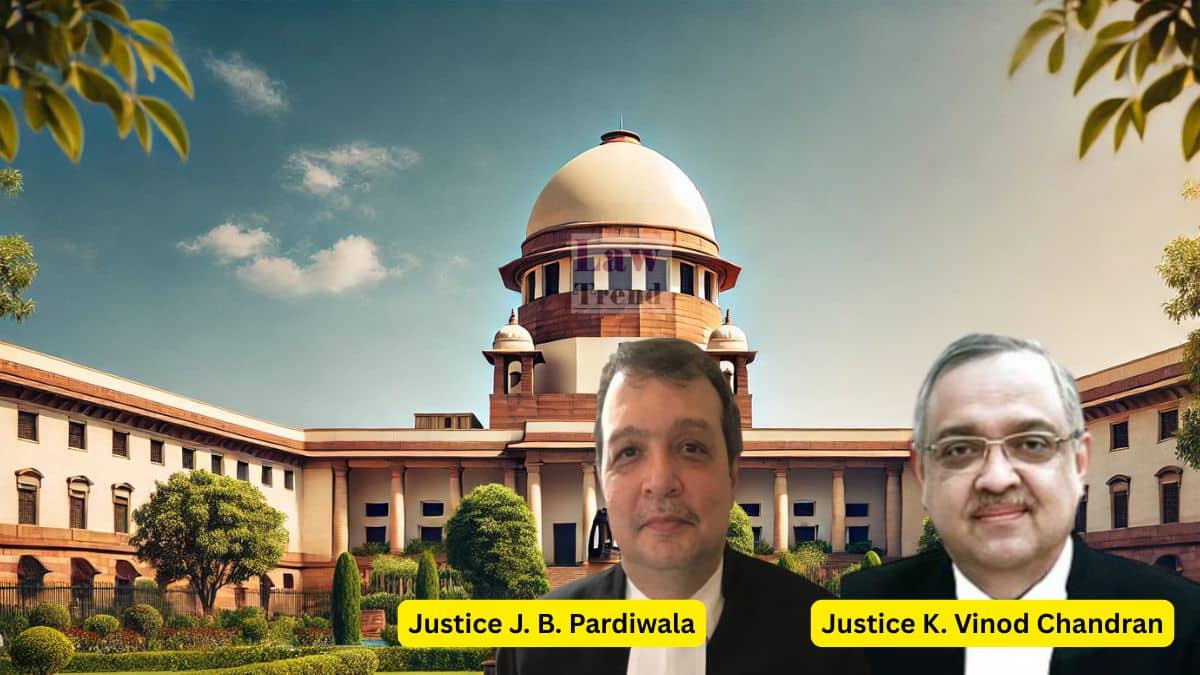
The Supreme Court, in a bench comprising Justice J. B. Pardiwala and Justice K. Vinod Chandran, has held that initiating winding-up proceedings before a Company Court does not extend or impact the limitation period for filing an independent civil suit for recovery of money. Reversing the judgment of the First Appellate Court, the apex court set aside a monetary decree passed against Mageba Bridge Products Private Limited in a suit filed by M/s. Trade Centre, holding that the claim was barred by limitation despite the suit being properly instituted by a registered partnership firm.

Background of the Case

The dispute originated from a money recovery suit filed by M/s. Trade Centre against Mageba Bridge Products Private Limited for unpaid supply bills amounting to Rs. 23,41,693/-, claiming a total sum of Rs. 24,36,105/- along with interest.

The Trial Court initially dismissed the suit, concluding that the plaintiff failed to establish its status as a registered partnership firm, which rendered the suit non-maintainable under Section 69(2) of the Indian Partnership Act, 1932.

On appeal, the First Appellate Court set aside the dismissal. It relied on Exhibit-8, a Memorandum of Registration issued by the Registrar of Firms, West Bengal, which recorded the registration of the respondent firm on May 14, 2010 (Registration No. L73931). The Appellate Court also allowed an application under Order XLI Rule 27(1) of the Code of Civil Procedure (CPC) to take on record a certified copy of Form-VIII. Accepting these documents, the First Appellate Court decreed the suit, directing Mageba Bridge Products Private Limited to pay Rs. 24,36,105/- with 6% interest per annum from the date of filing. Mageba Bridge Products Private Limited appealed this decree before the Supreme Court.

Arguments of the Parties

Senior Counsel Sri Nikhil Nayyar, representing the appellant (Mageba Bridge Products Private Limited), submitted that the suit claim was barred by limitation and that valid proof of registration had not been established by the plaintiff firm before the Trial Court.

READ ALSO  Courts Must “Lift the Veil” Where Clever Pleadings Conceal Statutory Bar Under Benami Law: Supreme Court

Senior Counsel Sri Manish Goswami, representing the respondent (M/s. Trade Centre), contended that the registration of the firm was conclusively established. On the issue of limitation, the respondent argued that the cause of action arose on June 3, 2008 (demand of debt), August 1, 2008 (appellant’s reply letter), and September 2, 2008 (part payment). The respondent further argued that the Company Court, before which a winding-up petition had been filed within the limitation period, had granted permission to file the civil suit within three months of disposing of the company petition.

Court’s Analysis

The Supreme Court examined the twin issues of partnership registration and limitation.

Regarding registration under Section 69(2) of the Indian Partnership Act, 1932, the Court affirmed the finding of the First Appellate Court. It held that Exhibit-8 and the certified copy of Form-VIII conclusively established that the firm was registered on May 14, 2010. The Court observed that allowing the additional evidence under Order XLI Rule 27(1) CPC was justified as it served to “further the cause of justice and enable the court to pronounce judgment”.

However, on the question of limitation, the apex court agreed with the appellant. The Court highlighted that the suit was filed specifically on the strength of individual bills raised against the defendant, rather than on a running account. Examining the appellant’s communication dated August 1, 2008 (Annexure P-18), the Court found that it did not constitute an acknowledgment of debt; the payment made was towards three specific admitted invoices rather than a part payment of the total disputed claim.

READ ALSO  गबन की राशि जमा करने से कदाचार माफ नहीं हो जाता: सुप्रीम कोर्ट ने पोस्ट मास्टर की बहाली का हाईकोर्ट का आदेश रद्द किया

Analyzing the applicability of Section 14 of the Limitation Act, 1963 regarding time spent in winding-up proceedings, the Court referenced Kalpraj Dharamshi and Anr. v. Kotak Investments Advisor Limited and Anr. (2021), noting that “the object of enacting the legislation is to advance public welfare. The entire legislative process is influenced by considerations of justice and reason… the provisions contained in Sections 5 and 14 of the Limitation Act are meant for grant of relief, where a person has committed some mistake.”

Applying the principles from Yeswant Deorao Deshmukh v. Walchand Ramchand Kothari (1950) and Jignesh Shah and Anr. v. Union of India and Anr. (2019), the bench emphasized that a winding-up proceeding before a Company Court and a civil suit for money recovery are independent remedies with divergent procedures. In Yeswant Deorao Deshmukh, the Court held that insolvency proceedings cannot be excluded under Section 14 as they are not for obtaining the same relief, where ultimate recovery is a “mere consequence or result”.

The bench held: “The converse position applies squarely to this case that the initiation of a winding up proceeding, which may or may not enable recovery, will not impact the limitation for the separate remedy of suit for recovery of money.”

The Court further observed that the Company Court had no legal authority to extend the statutory period of limitation. Examining the timelines, the Court noted that the Company Petition was filed on February 10, 2009, whereas the limitation to sue on the bills dated January 30, 2006 had already expired on January 29, 2009. For the remaining unpaid bills, the last of which was dated March 6, 2007, the suit filed on June 5, 2010 was well beyond the prescribed three-year limitation period.

READ ALSO  Supreme Court Advocates for Rigorous Bail Criteria in Custodial Death Cases Involving Police Officers

Court’s Decision

The Supreme Court concluded that while the suit was properly instituted by a registered partnership firm, the claim for monetary recovery was barred by limitation. The Court allowed the appeal, set aside the decree of the High Court in First Appeal to the extent of granting recovery, and dismissed the suit on the ground of limitation.

Case Details:

Case Title: Mageba Bridge Products Private Limited v. M/s. Trade Centre

Case No.: Civil Appeal No. 10658 of 2026 (Arising out of SLP (C) No. 24861 of 2025)

Bench: Justice J. B. Pardiwala, Justice K. Vinod Chandran

Date: August 12, 2026

Law Trend
Law Trendhttps://lawtrend.in/
Legal News Website Providing Latest Judgments of Supreme Court and High Court

Related Articles

Latest Articles


