

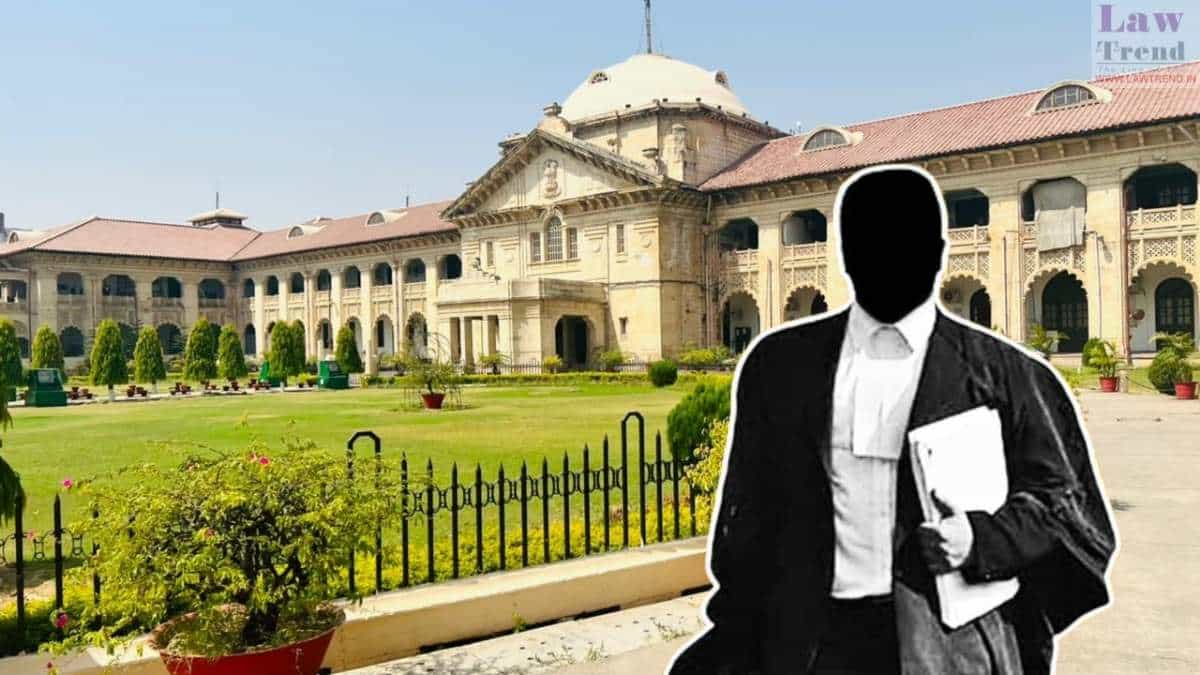
The Allahabad High Court has dismissed four writ petitions filed by a lawyer seeking nearly Rs 4.8 crore in alleged unpaid professional fees from the Uttar Pradesh Basic Education Department, ruling that monetary claims arising from contractual fee disputes cannot be adjudicated through writ jurisdiction.
A division bench of Justice Shekhar B Saraf and Justice Abdhesh Kumar Chaudhary directed the advocate to pursue his monetary recovery before a competent civil court. In an order issued on August 14, the court observed that professional fee arrangements constitute a private matter between an advocate and a client and should ordinarily be resolved through mediation or conciliation, even in cases involving state bodies.
Disputed Contractual Claims
The high court stated that proceedings under Article 226 of the Constitution, which governs the writ powers of high courts, are inappropriate for resolving complex and disputed questions of fact. Examining the record, the bench noted that the petitioner had failed to produce any written admission of liability, acknowledged fee bills, or official letters from state authorities accepting the claimed dues.
A central point of contention involved the interpretation of government orders issued in 2009 and 2011. While the petitioner argued that these orders entitled him to the maximum fee prescribed for special appeals, the education department maintained that the directives merely established a permissible fee range and that no specific fee agreement had ever been finalized between the parties.
State Department Counterarguments
Opposing the petitions, legal counsel representing the District Basic Education Department argued that writ petitions for fee recovery are legally non-maintainable and fall within the exclusive domain of civil courts.
State officials clarified that the advocate had been engaged as a panel lawyer for the Basic Shiksha Parishad to handle special appeal matters originating from Sitapur, Lucknow, Hardoi, and Raebareli districts. Department representatives stated that he was removed from the panel in October 2011 and argued that several of the fee demands pertained to periods outside his formal period of engagement. The state also highlighted that the petitioner had provided no official departmental acknowledgments for the cases he claimed to have conducted.
Dismissal and Civil Court Option
State authorities further raised a preliminary objection regarding the timing of the litigation, noting that the petitioner claimed unpaid fees dating back to 2009 after a lapse of more than 16 years, despite having served as state counsel for approximately 16 years in total.
The high court declined to decide whether the claims were time-barred under limitation laws, explaining that limitation constitutes a mixed question of fact and law that did not require determination once the writ petitions were found non-maintainable. The bench accordingly dismissed all four petitions while granting the advocate liberty to file his claims before a civil court.




