

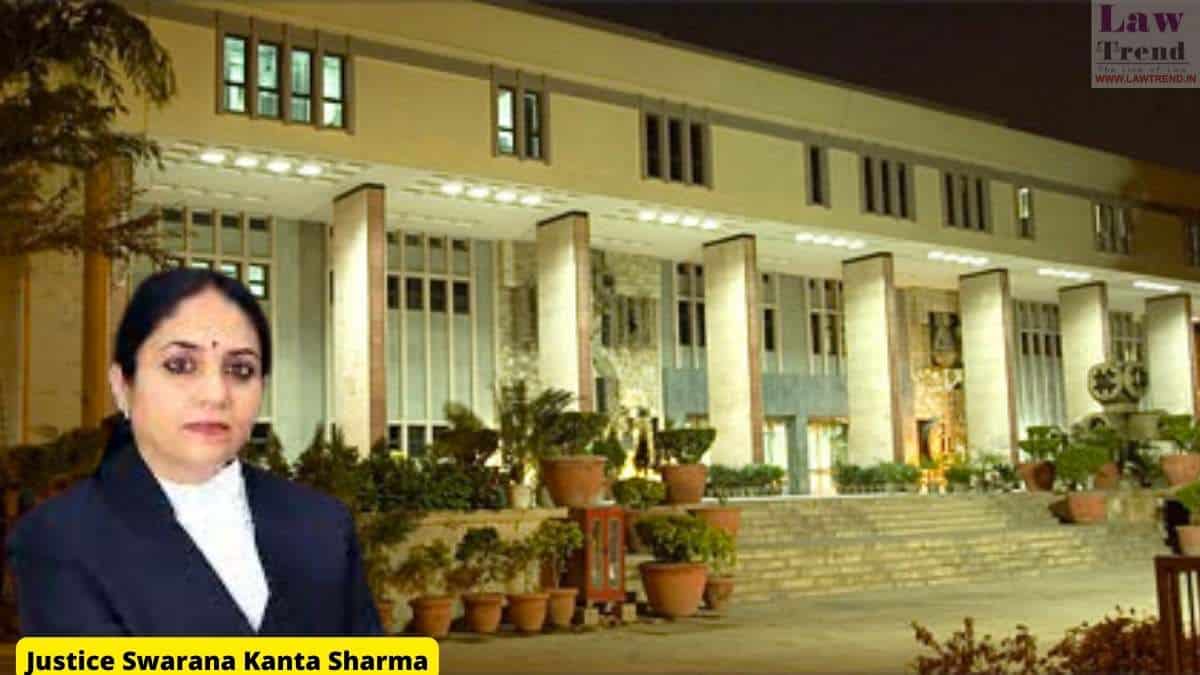
The Delhi High Court has held that a plaintiff who may have had access to their own passbooks or account statements is not, for that reason alone, barred from seeking the bank’s own records through its officials. Justice Swarana Kanta Sharma allowed the plaintiffs in a 2012 specific performance suit to summon bank officials to prove their financial capacity. However, the Court limited the records to the period disclosed in their original list of witnesses.
Background
The suit seeks specific performance of an Agreement to Sell dated 17.03.2008 for property No. B-4, Nizamuddin West, New Delhi, or damages in the alternative. The total sale consideration was ₹5.05 crore. The plaintiffs claim to have paid ₹3.35 crore by 23.08.2008, with the balance due by 31.08.2008. They say they withheld the balance after learning that the property was mortgaged with Citibank. The defendant disputes their readiness and willingness and their financial capacity to pay.
In 2018, the Joint Registrar declined to take on record a UCO Bank passbook, a J&K Bank statement and an Income Tax Return, because they related to the period after the suit was filed. The plaintiffs’ challenge to that order was withdrawn in 2024. A later application to summon witnesses to prove those same documents was dismissed in 2025.
With evidence being recorded before a Local Commissioner, the plaintiffs applied under Order XVI Rule 1(2) CPC to summon the witnesses at serial nos. 7, 12, 13 and 14 of their list of witnesses.
Arguments
Senior Advocate Jagjit Singh, with Advocates Preet Singh and Abhijeet Singh, appeared for the plaintiffs. He submitted that the witnesses are officials of various departments and banks whose attendance cannot be secured without the Court’s process, and that their evidence bears directly on the issues.
Advocates Siddharth Khattar, Divij Andley and Gaurav Raj Sharma appeared for the defendant. They did not object to witnesses 7 and 14, but opposed witnesses 12 and 13. Those witnesses were to produce the bank statements of plaintiffs no. 3 and 4 from January 2007 onwards. Counsel argued that the plaintiffs could have filed these statements with the plaint, and that what cannot be done directly cannot be done indirectly through witnesses. Counsel further argued that the plaintiffs should have applied under Order VII Rule 14 CPC.
No surprise, no new case
The Court noted that witnesses 12 and 13 appear at the same serial numbers in the list of witnesses dated 24.02.2016. The stated purpose there was to produce bank records for January 2007 to September 2009. The Court observed: “There is, therefore, no question of any surprise or introduction of an entirely new case at this stage.”
It also noted that the plaint already contained two cheques of ₹10 lakh each, dated 29.04.2008, drawn on the same accounts at Oriental Bank of Commerce and Punjab National Bank, Farrukhabad.
Financial capacity put in issue
Relying on the Supreme Court’s ruling in U.N. Krishnamurthy v. A.M. Krishnamurthy, the Court held that the plaintiffs’ financial capacity to pay by 31.08.2008 is an important part of the issue of readiness and willingness. Because the defendant had disputed that capacity and cross-examined PW-1 on the source of funds, the Court held: “The defendant cannot, on the one hand, dispute the financial capacity of the plaintiffs and question the source of funds, and, on the other hand, oppose the production of relevant bank records which may assist the Court in determining that very issue.”
Order VII Rule 14 objection rejected
The Court said that what was sought was the banks’ official record, produced through their officials. It held that “the mere fact that the plaintiffs may have had access to their passbooks or account statements would not, by itself, disentitle them from seeking production of the banks’ own records through their officials.” Admissibility and evidentiary value can be examined at the appropriate stage, and the defendant may raise all permissible objections then.
Period of records limited
The Court found that the application sought records “for the period of Jan. 2007 onwards”, which is wider than the period in the 2016 list. No explanation was given for this. It also pointed to the 2018 order, which has attained finality. The Court held that “The present application cannot be thus used to enlarge the scope of the evidence beyond what was originally disclosed in the list of witnesses or to indirectly introduce financial records pertaining to periods beyond the relevant transaction.” To this extent, the defendant’s objection was sustained.
Outcome
The application was allowed. Summons will issue to witnesses 7, 12, 13 and 14 for a date to be fixed by the Local Commissioner. Oriental Bank of Commerce has been amalgamated with Punjab National Bank, so witnesses 12 and 13 will be officials of Punjab National Bank, Farrukhabad. They will produce records only for January 2007 to September 2009. The Local Commissioner was asked to proceed quickly, and the suit is listed on 08.04.2027.
Case Title: Maher Elahi & Ors. v. Aman Ullah Khan
Case No.: CS(OS) 1452/2012 (I.A. 5063/2026)
Bench: Justice Swarana Kanta Sharma
Date: November 19, 2026


