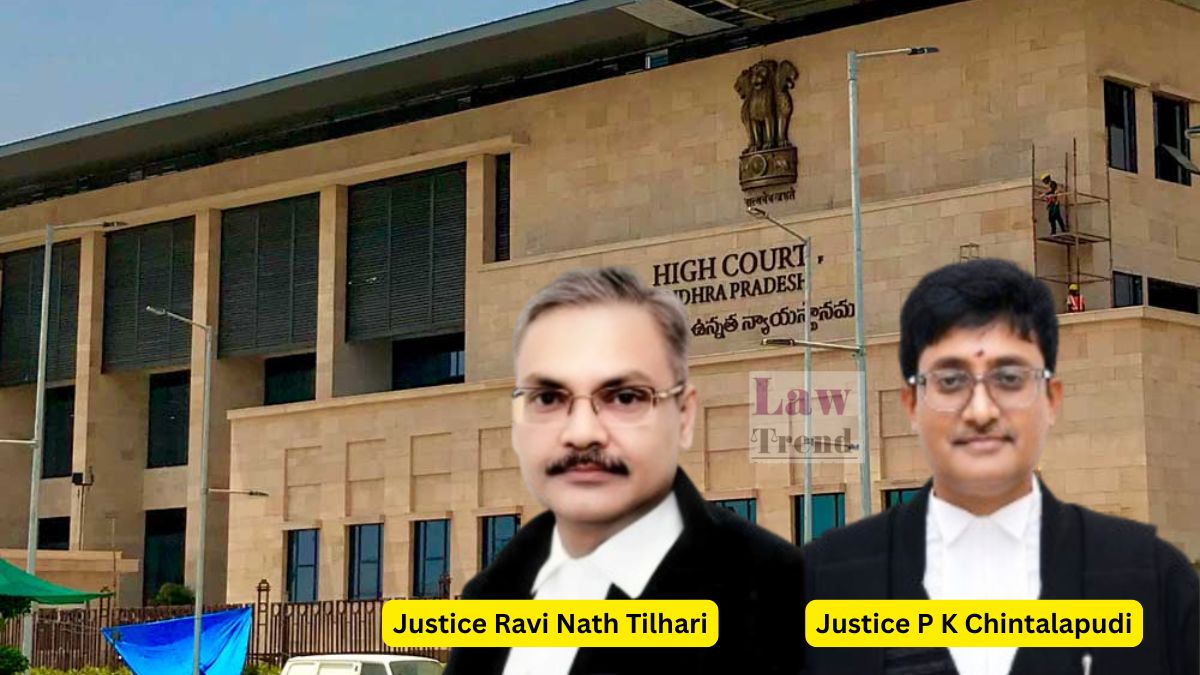
A Division Bench of the High Court of Andhra Pradesh, comprising Justice Ravi Nath Tilhari and Justice Purushottam Kumar Chintalapudi, has held that the mere pendency of a civil suit does not operate as a bar against revenue authorities exercising their statutory power and jurisdiction under the Andhra Pradesh Rights in Land and Pattadar Pass Books Act, 1971. Allowing a writ appeal filed by Makam Sumith, the Court set aside a single judge’s order that had directed the Tahsildar to restore the original owners’ names in the revenue records pending a civil suit.
Background of the Case
The dispute centers on revenue record entries for land admeasuring Ac.9-61 cents across multiple survey numbers (788, 784, 790, 795, 796, 797, 798, 786, 789, 802, and 807/1) situated in Potladurthi Village, YSR Kadapa District. Initially, the revenue entries stood in the names of the writ petitioners, Gummireddy Bharath Kumar Reddy and Padigapati Venkata Sada Siva Reddy.
Makam Ramanjaneyulu, the father of the appellant Makam Sumith, applied for mutation in the revenue records based on registered sale deeds. On August 4, 2017, the Tahsildar, Yerraguntla Mandal, allowed the application under the Andhra Pradesh Rights in Land and Pattadar Pass Books Act, 1971. Subsequently, Makam Sumith applied for mutation in his favour based on a registered gift deed executed by his father. The Tahsildar granted this request on November 13, 2018, noting that notices were issued to concerned parties and no objections were received.
The writ petitioners challenged the November 13, 2018 order in W.P. No. 2669 of 2021. On February 12, 2025, a Single Judge disposed of the writ petition, directing the Tahsildar to restore the petitioners’ names in the revenue records and place the land in the dispute register pending disposal of a civil suit (O.S. No. 33 of 2017) pending before the II Additional District Judge, Kadapa at Proddatur. Aggrieved by this direction, Makam Sumith filed the present writ appeal.
Arguments of the Parties
Senior Counsel appearing for the appellant argued that the primary order dated August 4, 2017 (mutating the land in favor of the appellant’s father) was never challenged in the writ petition. Therefore, the single judge could not have issued directions that effectively wiped out the effect of an unchallenged order. Furthermore, the Tahsildar’s counter-affidavit specifically stated that notices had been served on the writ petitioners before the August 4, 2017 order was passed, and the petitioners filed no rejoinder denying this fact. The appellant also contended that Section 8(2) of the Act, 1971 does not restrain revenue authorities from exercising their statutory powers merely because a civil suit is pending.
Counsel for the writ petitioners argued that they had no knowledge of the August 4, 2017 order and asserted that once a civil suit regarding the property was instituted, the Tahsildar lacked jurisdiction to pass mutation orders under Section 8(2) of the Act, 1971. However, counsel acknowledged that the August 4, 2017 order was not challenged in the writ petition and that no affidavit was filed to controvert the Tahsildar’s statement regarding service of notice.
The Assistant Government Pleader for Revenue supported the record, stating that notices were issued and served on the writ petitioners prior to passing the August 4, 2017 order, to which they failed to respond.
Court’s Analysis
Examining the single judge’s findings, the Division Bench noted that the Single Judge had observed that the Court could not decide whether proper procedure or notice was followed, yet proceeded to declare the mutation unsustainable. Rebutting this approach, the Court observed:
“once it was held that the court could not decide whether the orders were passed by following the procedure contemplated under law by issuing proper notice to the petitioners or not the impugned orders could not be interfered with, as then, what was stated in the order dated 04.08.2017 on the point of notice and service would stand as correct.”
The Court analyzed Section 8(2) of the Andhra Pradesh Rights in Land and Pattadar Pass Books Act, 1971, which reads:
“If any person is aggrieved as to any rights of which he is in possession by an entry made in any Record of Rights, he may institute a suit against any person denying or interested to deny his title to such right for declaration of his right under Chapter VI of the Specific Relief Act, 1963 (Central Act 47 of 1963), and the entry in the Record of Rights shall be amended in accordance with such declaration.”
Interpreting the provision, the Court stated:
“A bare reading of Section 8(2) of the Act, 1971, shows that if any person is aggrieved, as to any rights of which he is in possession, by an entry made in any record of rights, he may institute a suit against any person denying, or interested in denying, his title to such right for a declaration and the entry in the record of rights shall be amended in accordance with such declaration.”
The Bench further clarified:
“However, Section 8(2) of the Act, 1971 does not bar the revenue authorities from exercising their power or jurisdiction under the Act, 1971, with respect to the matters to be dealt under that Act, during pendency of any suit for declaration of title.”
On the legal character of mutation entries, the Bench reiterated:
“It is well settled that the mutation proceedings are summary in nature. Those entries neither prove the title nor do they confer any title, but are only for fiscal purposes. So, those proceedings and the revenue record entries are always subject to, and subservient to, the declaration of title in the civil suit.”
Addressing the precedent cited in V. Goutham Rao v. Revenue Divisional Officer and Another (2003), the Court distinguished the decision, holding that the observations in that case were “only the observations made or at the most the proper course to be adopted, but that is no declaration of law, that if a suit is pending in the civil court the revenue authority should not exercise their power or jurisdiction conferred under the Act, 1971 for the purpose of the Act, 1971.”
Concluding its analysis, the Bench held:
“We are of the view that the pendency of a civil suit does not operate as a bar to proceedings under the Act, 1971. If any person has a bona fide dispute regarding title to the property, it is always open to such person to seek appropriate relief before the competent Civil Court; however, the pendency of the suit proceedings, by itself, does not prohibit the revenue authorities from exercising their statutory powers and jurisdictions under the Act, 1971.”
Court Decision
The High Court allowed the Writ Appeal and set aside the single judge’s order dated February 12, 2025. The Court granted liberty to the writ petitioners to pursue statutory alternative remedies against the orders dated August 4, 2017, and November 13, 2018, before the competent authority in accordance with law, without being influenced by any observations made in this judgment. No order was made as to costs.
Case Title: Makam Sumith v. Gummireddy Bharath Kumar Reddy and Others
Case No.: Writ Appeal No. 536 of 2025
Bench: Justice Ravi Nath Tilhari and Justice Purushottam Kumar Chintalapudi
Date: July 15, 2026