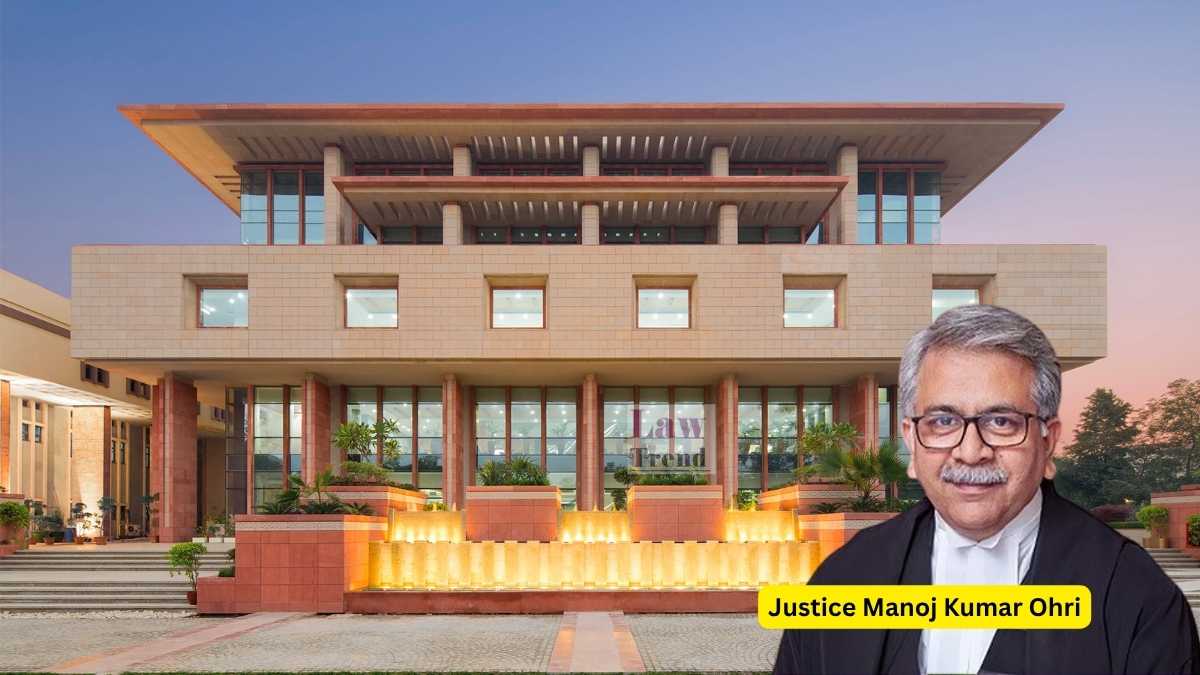
The Delhi High Court has set aside a judgment of the Railway Claims Tribunal that had dismissed a compensation claim on the grounds that the deceased was not a “bona fide passenger” and that the death did not constitute an “untoward incident.” Justice Manoj Kumar Ohri observed that the Tribunal had adopted an “unduly rigid standard of proof” and a “hyper-technical approach,” ignoring beneficial legislation intended to provide prompt relief to victims of railway accidents.
Background
The case pertains to the death of Sh. Devendra Singh on August 16, 2019. According to the appellants, Singh had visited his sister in Aligarh for Raksha Bandhan and was returning via Train No. 54461. While the train was in motion between Rajghat Naraura and Dibai Railway Station, he allegedly fell accidentally and sustained fatal injuries.
The Railway Claims Tribunal dismissed the claim on May 13, 2025, holding that the deceased was not a bona fide passenger since no ticket was recovered from his person. It further concluded that the incident was not an “untoward incident” as defined under the Railways Act, 1989.
Arguments of the Parties
Appellants’ Submissions: Counsel for the appellants argued that GRP proceedings and inquest material consistently showed the deceased was found “lying near the railway track.” They emphasized the testimony of Chandra Pal Singh (AW-2), who deposed that he had accompanied the deceased to the station and witnessed the ticket purchase. They further contended that the post-mortem report recorded ante-mortem injuries consistent with a fall from a moving train.
Respondent’s Submissions: The Union of India supported the Tribunal’s judgment, highlighting that no journey ticket was recovered during the jamatalashi (search). They relied on a Divisional Railway Manager (DRM) report stating there was no report of an “untoward incident” by the loco pilot and argued that the circumstances of the incident remained unestablished.
Court’s Analysis and Observations
The Court addressed two primary issues: whether the event was an “untoward incident” and whether the deceased was a bona fide passenger.
On “Untoward Incident”: The Court noted that the deceased was found “adjacent to the track” with injuries, contradicting any suggestion that he was “run over” while crossing. Critically, the Court rejected the DRM report dated June 24, 2024, noting it was conducted nearly five years after the incident. Citing Bhola vs. Union of India, the Court stated:
“Such a belated inquiry, conducted long after the occurrence and even after institution of the claim proceedings, lacks contemporaneous basis and cannot be accorded due evidentiary value…”
Addressing the delay in finding the body, the Court cited Sh. Surendra Prasad Verma vs. Union of India, observing that “mere delay in the recovery or discovery of the body cannot, by itself, be a determinative factor to disbelieve the case of accidental fall.”
On “Bona Fide Passenger”: Regarding the missing ticket, the Court referred to the Supreme Court’s landmark ruling in Union of India vs. Rina Devi, which held that the initial burden on the claimant can be discharged by an affidavit, after which the burden shifts to the Railways. The Court observed:
“…mere non-recovery of a ticket cannot, by itself, be treated as conclusive to deny compensation.”
The Court found that the presence of a “Rakhi” on the deceased’s person corroborated the testimony that he had traveled to visit his sister. It held that minor discrepancies in witness testimony regarding distance or timing were “peripheral in nature” and did not affect the substratum of the case.
Strict Liability: Justice Ohri emphasized that Section 124-A of the Act is beneficial legislation. Citing Union of India vs. Prabhakaran Vijaya Kumar, the Court reiterated:
“…once the occurrence of an ‘untoward incident’ is established, the liability of Railways is strict unless the case falls within the statutory exceptions.”
Decision
The High Court concluded that the Tribunal erred by placing “undue reliance on conjectural material while ignoring the surrounding circumstances.” Consequently, the Court set aside the impugned judgment and remanded the matter back to the Tribunal to assess and disburse the compensation amount within two months. The parties were directed to appear before the Tribunal on May 11, 2026.
Case Details:
- Case Title: Smt. Raj Kumari & Ors. v. Union of India
- Case No.: FAO 352/2025
- Bench: Justice Manoj Kumar Ohri
- Date: April 27, 2026