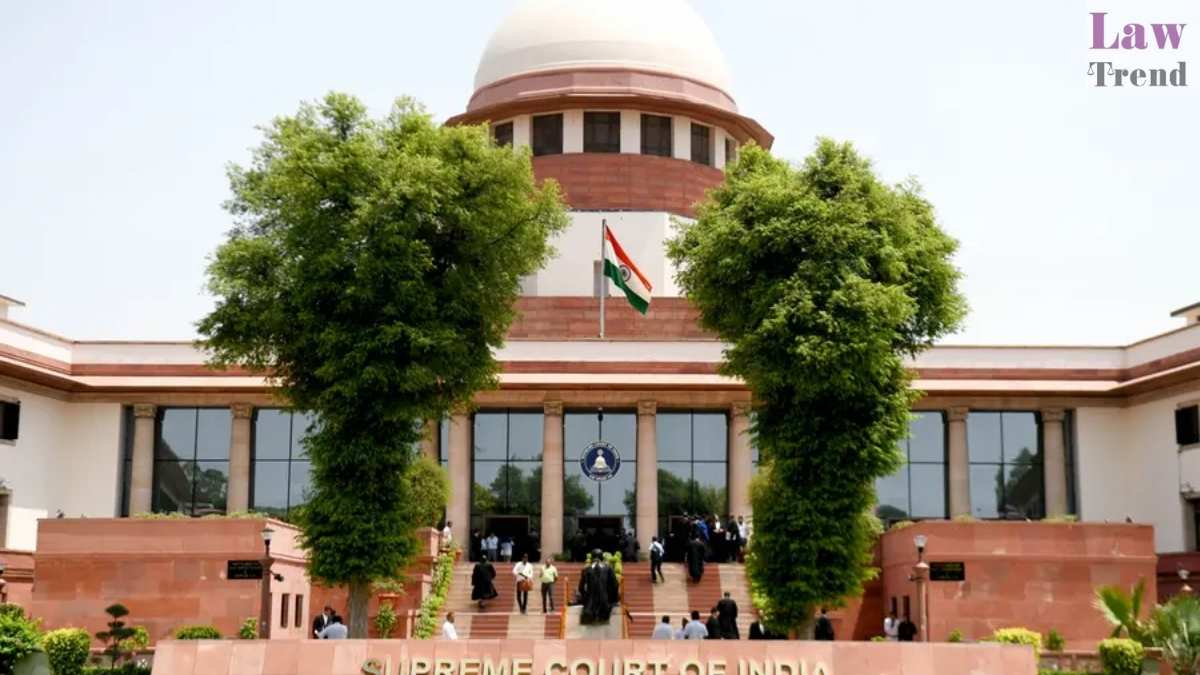
The Supreme Court of India, comprising a bench of Justice J. B. Pardiwala and Justice K. Vinod Chandran, has held that when a departmental termination order is set aside and substituted with a minor penalty of reduction by one stage, the penalty relates back to the officer’s initial termination date. Resolving a quarter-century-long litigation, the Court directed the Union of India and the Central Reserve Police Force (CRPF) to grant the retired officer promotion as Deputy Commandant from the date his peers were promoted, along with full back wages, pensionary arrears, and Rs 10 lakhs in costs.
Background of the Case
The appellant, Prakash Kumar Dixit, joined the CRPF as an Assistant Commandant in 1986. In 1989, departmental proceedings were initiated against him alleging that while commanding a platoon in a sensitive area, he handed over charge to an Inspector without prior approval and remained absent without leave for 420 days from April 7, 1988, violating the Central Civil Services (Classification, Control and Appeal) Rules, 1965 (CCA Rules).
Following an inquiry and consultation with the Union Public Service Commission (UPSC), the Disciplinary Authority (D.A.) imposed a penalty of removal from service on July 10, 1995. The appellant challenged his removal in a series of legal proceedings over two decades. In 2011, a Single Judge of the Delhi High Court set aside the penalty for non-application of mind and remanded the matter to the D.A. Subsequent proceedings led to a Division Bench directing his reinstatement in 2012, which was affirmed by the Supreme Court in 2014, leading to his reinstatement in 2015 effective from July 10, 1995, albeit placed under deemed suspension.
Upon reconsideration, the Director General of CRPF noted mitigating factors: the leave issue had been mishandled, handing over charge was done on oral directions of the Commandant (which was omitted in the inquiry), and medical certificates were submitted. The D.A. finalized a minor penalty of reduction by one stage for three years without cumulative effect, not adversely affecting pension.
However, officials in the Ministry of Home Affairs (MHA) and Department of Personnel and Training (DoPT) interpreted UPSC’s response as a “disagreement” and referred the matter to the Prime Minister under Entry 39(2) of the Third Schedule to the Government of India (Transaction of Business) Rules, 1961. This resulted in a second termination order in 2018.
A Division Bench of the Delhi High Court in December 2019 set aside the 2018 termination, declaring the minor penalty of the D.A. as proper and directing that reinstatement relate back to July 10, 1995, with seniority and consequential benefits. This order was affirmed by the Supreme Court in December 2020.
During subsequent contempt proceedings, a Review Departmental Promotion Committee (DPC) convened on March 14, 2023, granted the appellant promotion to Deputy Commandant notionally with effect from October 17, 2021, on the premise that the three-year minor penalty period ran from the second termination date (October 16, 2018). Further promotion to Inspector General (I.G.) was denied due to lack of eligibility criteria, including mandatory field service and residency. A Single Judge found CRPF officials in contempt for not promoting him to I.G., but on appeal—remanded by the Supreme Court following principles in Midnapore Peoples’ Coop. Bank Ltd. v. Chunilal Nanda—the Division Bench held that the appellant was ineligible for the post of I.G. The appellant then appealed to the Supreme Court.
Arguments of the Parties
Senior Counsel Mr. Sanjoy Ghosh, appearing for the appellant, submitted that the directions of the High Court required reinstatement from July 10, 1995, to which date the minor penalty must relate. He argued that pay fixation, seniority, and consequential promotional benefits ought to follow accordingly. He further contended that even if promotion to Inspector General was not feasible, the punishment should relate back to his initial termination date, allowing notional promotions during his out-of-service period to enable retirement from a higher post with higher pensionary benefits.
Additional Solicitor General Mrs. Archana Pathak Dave, appearing for the respondents, argued that the disciplinary inquiry validly established misconduct. She submitted that the minor penalty of reduction to a lower stage for three years restricted consideration for promotion during the three subsequent years from the date of the second termination. She contended that disciplinary proceedings were deemed pending during the years out of service and that the appellant had already been promoted to Deputy Commandant and retired with due pensionary benefits.
Court’s Analysis
Writing for the bench, Justice K. Vinod Chandran lamented the prolonged administrative ordeal suffered by the officer, observing:
“A promising career in the Central Reserve Police Force (CRPF), commenced as an Assistant Commandant in the year 1986, was sacrificed by the Departmental Authorities at the altar of callous indifference to the directions of the High Court and brazen pen-pushing.”
The Supreme Court examined the procedure followed under OM No. 39023/02/2006-Estt. (B) dated December 5, 2006, and observed that in disciplinary matters involving a disagreement with the UPSC, the matter must first be placed before the Committee of Secretaries before submission to the Minister-in-Charge or Prime Minister. However, the Court highlighted that the UPSC advice did not actually express disagreement, as it explicitly permitted the D.A. to take an independent view.
Addressing the scope of judicial review in disciplinary matters, the Court stated:
“It is trite that a judicial review under Article 226, of an order passed in a departmental inquiry holding the delinquent guilty and imposing punishment, is not concerned with the merits of the case and is more on procedure; unless the decision is without authority or vitiated by patent arbitrariness, extraneous considerations or is blatantly perverse.”
The Court further cautioned departmental authorities against administrative obstinacy:
“However, the authorities; be it the original authority or the appellate authority, should be cautious to consider the matter and not merely reiterate the earlier findings in mechanical compliance of the directions issued, when a Constitutional Courts directs reconsideration.”
The bench concurred with the High Court that the appellant could not claim promotion to the rank of Inspector General as he did not meet essential eligibility requirements, such as the five-year residency, two years of mandatory field service, and completion of a pre-promotional course.
However, the Court rejected the Union’s contention that the three-year penalty period commenced from October 16, 2018. The bench held that the minor penalty decided by the D.A. must relate back to the initial termination date of July 10, 1995. Consequently, the rigor of the punishment expired on July 10, 1998, causing no adverse impact on his subsequent promotional eligibility.
Decision of the Court
The Supreme Court allowed the appeal and issued the following directions:
- Promotion and Pay Fixation: The promotion granted to the appellant as Deputy Commandant via the Review DPC dated March 14, 2023, cannot be purely notional from October 17, 2021. The appellant shall be promoted from the date on which other Assistant Commandants were promoted under the original DPC.
- Back Wages: The appellant shall receive full back wages from the date of entitlement to promotion as Deputy Commandant. If the promotion date falls after November 30, 2012 (the date of the High Court Division Bench reinstatement order in Writ Appeal No. 506 of 2011), full back wages shall be paid from that date until retirement. If the promotion date is prior to November 30, 2012, the period prior shall be treated notionally, and back wages paid from November 30, 2012 onwards.
- Pension and Arrears: Retirement benefits and pension shall be recomputed incorporating annual increments in the higher pay scale, and all arrears disbursed.
- Litigation Costs & Contempt: The Supreme Court quashed the pending contempt proceedings against the officials on the condition that the respondents pay Rs 10 lakhs in costs to the appellant within two months for prolonged litigation spanning over 25 years. Failure to pay within two months will attract 7% annual interest.
- Timeline: A detailed speaking order covering promotion date, pay fixation, increments, and arrears must be issued and disbursed within six months, failing which arrears will carry 7% annual interest.
Case Details
Case Title: Prakash Kumar Dixit v. Ajay Kumar Bhalla and Ors.
Case No.: Civil Appeal No. 9224 of 2026 (@ Special Leave Petition (C) No. 10712 of 2025)
Bench: Justice J. B. Pardiwala and Justice K. Vinod Chandran
Date: July 21, 2026