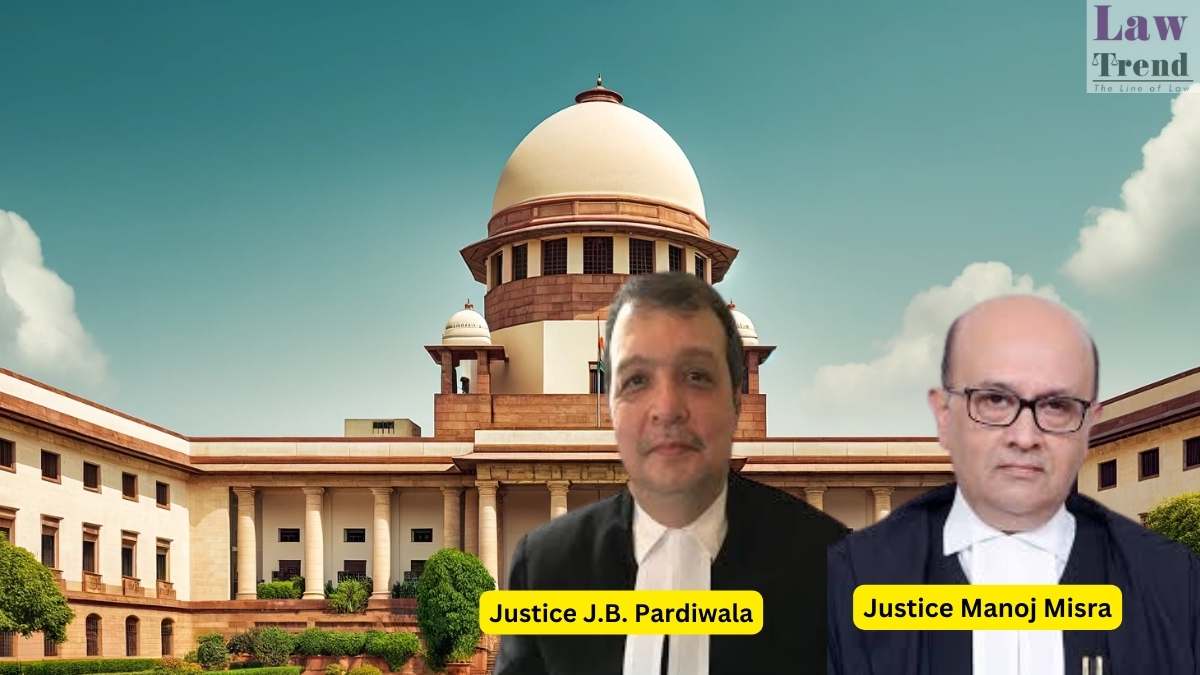
The Supreme Court has held that the availability of an alternative remedy of filing a revision petition under Section 397 of the Code of Criminal Procedure, 1973 (CrPC) does not operate as a threshold bar to the maintainability of a quashing petition under Section 482 of the CrPC. A Division Bench comprising Justice J.B. Pardiwala and Justice Manoj Misra set aside an order of the Bombay High Court and quashed criminal complaints and summoning orders pending against Standard Chartered Bank and its officer, Ms. B. Mchugh. The Court ruled that issuing a mandatory opportunity notice under the proviso to Section 61(2) of the Foreign Exchange Regulation Act, 1973 (FERA) is a mandatory precondition before initiating prosecution, and that a 23-year delay caused by persistent inaction on the part of the prosecution violated the appellants’ fundamental right to a speedy trial under Article 21 of the Constitution of India.
Background of the Case
The case relates to Criminal Case Nos. 1503-1504 of 2002 instituted for alleged offences punishable under Sections 56(1) and 73(3) of FERA against Standard Chartered Bank, an authorised dealer in foreign exchange, and Ms. B. Mchugh, an officer in the bank’s Bills Department at Manchester.
The prosecution alleged that the appellants contravened FERA provisions while handling foreign exchange remittances routed through the Vostro Account of Standard Chartered Bank, London, maintained at its Mumbai branch. According to the complainant, a chain of banker’s cheques and drafts procured in India through proxy purchasers fronting for a UK-based beneficiary were forwarded by the bank’s Manchester and New Delhi offices for collection. These were credited by the Mumbai office for the onward benefit of Indo International Corporation Ltd., a person resident outside India.
Upon realizing that the remittances were not in conformity with Exchange Control Regulations, the bank reversed the credit entries, blocked the entire amount of Rs. 30,00,000/- in its books, and subsequently surrendered the funds to respondent authorities vide Pay Order No. 279893 dated 06.01.1993 pursuant to a directive under Section 33(2) of FERA. On 30.05.2002, complaints were filed alleging unauthorized credit under Section 56(1) of FERA for transactions occurring in 1991-1992.
The appellants approached the Bombay High Court under Section 482 CrPC seeking quashing of the complaints and summoning orders. On 22.03.2012, the High Court rejected the petitions, holding that a petition under Section 482 CrPC was not maintainable when an alternative remedy of revision was available under Section 397 CrPC, and that a 10-year delay alone did not justify quashing the complaints. The appellants subsequently appealed to the Supreme Court.
Submissions of the Parties
Senior Counsel Mr. Shyam Divan, appearing for the appellants, argued that the complaint was filed on 30.05.2002 for 1992 transactions merely to overcome the sunset period under the Foreign Exchange Management Act (FEMA), which expired on 01.06.2002. He submitted that the High Court erred on maintainability, relying on Dhariwal Tobacco Products Ltd. v. The State of Maharashtra, which established that the availability of a revisional remedy under Section 397 CrPC does not bar a petition under Section 482 CrPC. He further urged that the mandatory opportunity notice under Section 61(2) proviso of FERA was neither placed on record nor ever served on the appellants, depriving the Magistrate of jurisdiction to take cognizance. Lastly, he contended that a 10-year delay in investigation followed by a 10-year delay in trial violated the right to a speedy trial under Article 21.
Senior Counsel Ms. Ruchi Kohli, appearing for the respondents, submitted that the High Court had actually considered the merits of the quashing petition and rejected it on the ground that delay alone did not warrant quashing. She argued that the delay was attributable to the appellants, who failed to appear before the trial court upon the initial service of summons. She further asserted that the fundamental right to a speedy trial under Article 21 is attracted only where there is intentional delay by the prosecution, which was not the case here.
Court’s Analysis and Legal Findings
The Supreme Court framed three specific issues for determination and analyzed each in detail:
I. Maintainability of Section 482 CrPC vis-à-vis Revisional Jurisdiction under Section 397 CrPC
The Court held that the High Court erred in treating the availability of a revisional remedy under Section 397 CrPC as a threshold bar to examining maintainability under Section 482 CrPC. Reaffirming Dhariwal Tobacco Products Ltd. v. The State of Maharashtra, Prabhu Chawla v. State of Rajasthan, and Akanksha Arora v. Tanay Maben, the Court noted that Section 482 CrPC begins with a non-obstante clause preserving the inherent powers of the High Court.
Referring to Prabhu Chawla, the Court quoted: “abuse of the process of the court or other extraordinary situation excites the Court’s jurisdiction. The limitation is self-restraint, nothing more”
The Bench further cited Akanksha Arora, reiterating that: “nomenclature of a petition is immaterial and for doing substantive justice, the High Court can always convert a petition under Section 482 CrPC to a revision under Section 397 CrPC and vice versa.”
II. Mandatory Nature of Opportunity Notice under Section 61(2) Proviso of FERA
Examining Section 61(2) of FERA, the Court held that serving an opportunity notice to allow the accused to show requisite permission is a mandatory statutory precondition before filing a complaint and taking cognizance.
Reviewing decisions of the Delhi High Court in Devashis Bhattacharya v. Union of India, Sanjay Malviya v. R.K. Rawal, United India Airways Ltd. v. Chief Enforcement Officer, and Shilpi Modes v. Directorate of Enforcement, the Court held that such opportunity must be adequate and meaningful, given the drastic penal consequences under FERA. The burden rests on the prosecution to prove that notice was issued and served in the prescribed manner.
On facts, the Supreme Court observed that the respondents failed to state the date of the opportunity notice, failed to attach a copy or proof of service with the complaint, and failed to produce it even when granted opportunity by the Supreme Court in 2015. The Magistrate took cognizance without recording satisfaction of compliance with Section 61(2), and the High Court ignored the issue. This non-compliance constituted a violation of natural justice, rendering the cognizance and summoning order legally unsustainable.
III. Violation of Right to a Speedy Trial under Article 21
Applying the principles laid down by the Constitution Bench in Abdul Rehman Antulay v. R.S. Nayak, the seven-Judge Bench in P. Ramachandra Rao v. State of Karnataka, and Kailash Chandra Kapri v. State of Uttar Pradesh, the Court held that the right to a speedy trial under Article 21 extends to all stages of a criminal proceeding.
Referring to Kailash Chandra Kapri, the Court emphasized that keeping a person in a state of “suspended animation” is wholly incompatible with the fair, just, and reasonable procedure guaranteed under Article 21.
Evaluating the factual chronology, the Court found that the delay was entirely attributable to persistent prosecution inaction:
- The complaint was filed on 30.05.2002 for 1991-1992 transactions without supporting documents.
- The respondent-complainant did not collect the summons for service for nearly 2 years (until 2004).
- From 2004 to 2012, process remained unserved, and the complainant took no steps to apply for non-bailable warrants until May 2012.
- When the High Court in March 2012 directed trial completion within one month, the complainant refused to collect fresh notices from the Magistrate’s court.
- Even after an extension of six months was granted, the complainant remained absent, preventing the trial from commencing.
The Court held that such conduct could not be explained as systemic delay or administrative constraint, reflecting a clear lack of diligence and unwillingness to prosecute.
Decision
The Supreme Court allowed the appeals, set aside the judgment of the Bombay High Court dated 22.03.2012, and quashed Criminal Case Nos. 1503-1504 of 2002 along with the summoning order dated 30.05.2002 against the appellants. The Registry was directed to circulate a copy of the judgment to all High Courts.
Case Title: Standard Chartered Bank & Anr. v. Enforcement Officer Ministry of Home Affairs & Anr.
Case No.: Criminal Appeal Nos. 2142-2143 of 2013
Bench: Justice J.B. Pardiwala, Justice Manoj Misra
Date: July 21, 2026