

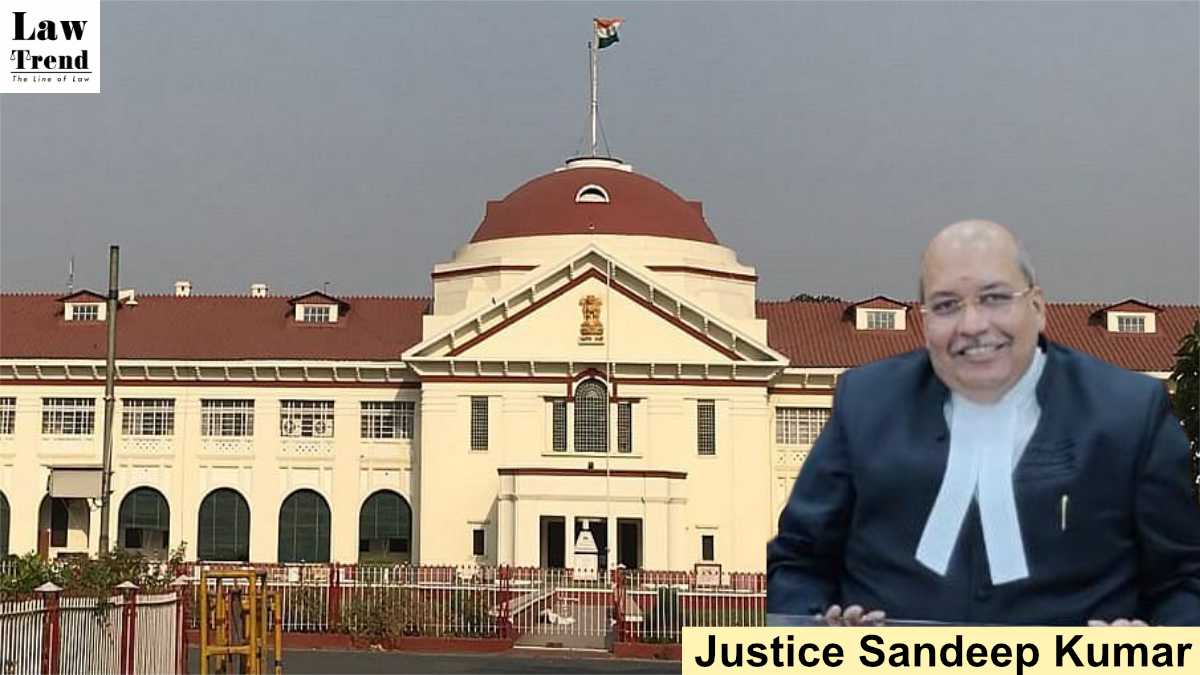
The Patna High Court has held that lying on top of a woman and pressing her mouth, without evidence of any overt act towards penetration, is insufficient to establish the offence of attempted rape under Sections 376/511 of the Indian Penal Code (IPC). Justice Sandeep Kumar, while partly allowing an appeal against a 2013 conviction, held that the conduct established against the accused constituted an offence under Section 354 IPC for outraging the modesty of a woman. The Court accordingly altered the conviction while upholding the accused’s conviction for house trespass under Section 448 IPC.
The Court observed that although the prosecution had proved that the appellant entered the complainant’s house at night, extinguished a lamp, lay upon her and pressed her mouth to prevent her from shouting, there was no evidence that he had undressed himself or the woman, removed any garment or committed an overt act towards penetration.
Background of the Case
The case arose from an incident on February 8, 2010, in Begusarai district, Bihar.
According to the complaint, the appellant, Md. Ainul Haque, entered the house of a widow at approximately 10 pm while she was sleeping. The complainant alleged that he pressed her mouth and sexually assaulted her.
When she raised an alarm, villagers gathered, apprehended the appellant and assaulted him. The complainant subsequently approached the court on February 10, 2010, alleging that the local police had failed to register her complaint and that an attempt to resolve the matter through a village panchayat had been unsuccessful.
Following investigation, charges were framed against the appellant under Sections 376/511 and 448 IPC.
On July 29, 2013, the Additional Sessions Judge-V, Begusarai, convicted him of both offences. He was sentenced to four years of rigorous imprisonment and a fine of ₹2,000 for attempted rape, along with six months of rigorous imprisonment for house trespass.
The appellant challenged the conviction before the Patna High Court.
Arguments Before the High Court
The appellant’s counsel argued that the prosecution case rested primarily on the complainant’s testimony, which contained material inconsistencies.
The defence pointed out that although the original complaint alleged rape, the complainant stated during her cross-examination that the appellant had attempted to commit rape.
It was further submitted that her clothes were not torn, there were no injury marks on her body or clothes, and she had not undergone any medical examination.
The defence also highlighted that the investigating officer and medical witnesses were not examined, while two prosecution witnesses had turned hostile.
The State opposed the appeal, maintaining that the complainant had consistently described the appellant entering her house at night, extinguishing the lamp, lying upon her and pressing her mouth.
It submitted that a neighbouring witness had corroborated the appellant’s presence at the scene immediately after the incident.
Presence of Accused Established, But Attempted Rape Not Proved
After examining the evidence, the High Court held that the prosecution had established beyond reasonable doubt that the appellant entered the complainant’s house at night.
The Court relied on the testimony of the complainant and her neighbour, Ram Chandra Poddar, who had reached the spot after hearing her cries and found the appellant being removed from the house by villagers.
However, the Court distinguished between establishing the appellant’s presence and conduct and proving the specific offence of attempted rape.
It noted that the complainant’s original allegation was of rape, whereas her testimony during trial referred to an attempt to commit rape. There was also no medical evidence or testimony establishing an act towards penetration.
The Court observed:
“The question is not what description the prosecutrix would give to the act, but whether the evidence establishes the overt act which the law requires for an attempt to commit rape.”
The Court emphasised that Section 511 IPC requires an act towards the commission of the offence and that the evidence must establish conduct beyond mere preparation.
Lying on Woman and Pressing Her Mouth Attracts Section 354 IPC
The High Court referred to the Supreme Court’s decisions in Aman Kumar v. State of Haryana (2004) and Tarkeshwar Sahu v. State of Bihar (2006), which examined the distinction between attempted rape and an indecent assault punishable under Section 354 IPC.
Applying these principles, the Court held that the appellant’s conduct clearly constituted an offence under Section 354 IPC.
It observed:
“However, in the absence of any evidence that the appellant undressed himself or the prosecutrix, or did any act towards penetration, it cannot be held that he had gone beyond the stage of preparation and had done an act which, if not interrupted, would have resulted in the commission of rape.”
The Court further noted that the established acts of entering the woman’s house late at night, extinguishing the lamp, lying upon her and pressing her mouth were sufficient to establish the offence of outraging her modesty.
However, those acts, without further evidence of an attempt towards penetration, could not sustain the conviction under Sections 376/511 IPC.
The Court also referred to Madan Lal v. State of Jammu & Kashmir (1997), where the Supreme Court had upheld an attempted rape conviction based on evidence that the accused had gone beyond the stage of preparation.
Conviction Under Section 354 Possible Even Without Specific Charge
The High Court next considered whether the appellant could be convicted under Section 354 IPC despite not having been separately charged with that offence.
Referring to Section 222(2) of the Code of Criminal Procedure and the Supreme Court’s decision in Dalbir Singh v. State of U.P. (2004), the Court held that a conviction for a minor offence was permissible where the necessary facts had been established and the accused had suffered no prejudice in defending himself.
The Court found that the appellant had been given sufficient opportunity during trial to contest the allegations constituting the offence under Section 354 IPC.
Accordingly, it substituted the conviction under Sections 376/511 IPC with a conviction under Section 354 IPC.
The Court separately upheld the conviction under Section 448 IPC, finding that the appellant had unlawfully entered the complainant’s dwelling house with the intention of committing an offence.
Sentence Reduced to Period Already Undergone, ₹25,000 Compensation Ordered
While deciding the sentence, the High Court considered that the incident had occurred more than sixteen years earlier and that the appellant, now approximately 60 years old, had no criminal antecedents.
The Court also noted that he had already undergone approximately two-and-a-half months of custody and had remained on bail since August 2013 without any adverse report.
Considering these circumstances, the Court reduced the substantive imprisonment for both offences to the period already undergone.
However, it stressed that the victim’s interests could not be overlooked.
Referring to the Supreme Court’s decisions in Hari Singh v. Sukhbir Singh (1988) and Ankush Shivaji Gaikwad v. State of Maharashtra (2013), the Court examined the importance of compensation under Section 357 CrPC.
It directed the appellant to pay a fine of ₹25,000 under Section 354 IPC, with the entire amount to be paid to the complainant as compensation.
The Court ordered the appellant to deposit the amount before the trial court within eight weeks. In default, he would have to undergo six months of simple imprisonment.
The appeal was thus partly allowed. The conviction and sentence under Sections 376/511 IPC, including the earlier fine of ₹2,000, were set aside, the conviction was altered to Section 354 IPC, and the conviction for house trespass under Section 448 IPC was affirmed.
Case Details
Case Title: Md. Ainul Haque v. The State of Bihar
Case No.: Criminal Appeal (SJ) No. 579 of 2013
Bench: Justice Sandeep Kumar
Date: October 8, 2026




