

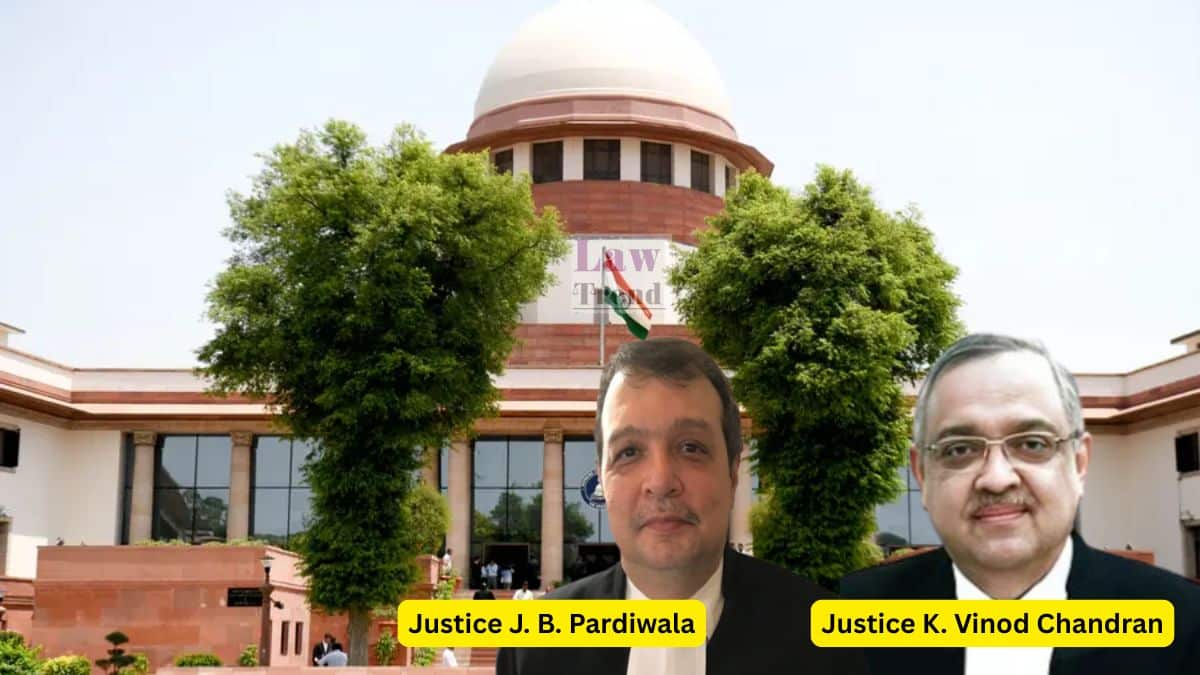
Setting aside a High Court order that quashed criminal proceedings against an absconding accused in a narcotics case, the Supreme Court bench comprising Justice J. B. Pardiwala and Justice K. Vinod Chandran held that criminal charges under the Narcotic Drugs and Psychotropic Substances Act, 1985 (NDPS Act) cannot be prematurely quashed simply because the identity of the accused who fled the scene was disclosed by co-accused persons apprehended on the spot. The Court ruled that while a co-accused’s confessional or disclosure statement cannot be used to convict an accused at trial, such disclosures constitute legitimate investigative material to pursue further evidence, making pre-trial quashing under inherent powers improper.
Background of the Case
The case originated from FIR No. 30 of 2025 registered at Lashkar Police Station, Mysuru City, against three individuals under Section 20(b)(ii)(C) of the NDPS Act. According to the prosecution, acting on tip-off information regarding the transportation of ganja in a car, a police team found three persons standing near the vehicle in a parking area. One of the suspects fled the scene, while the remaining two were apprehended. A subsequent search of the vehicle yielded 32.615 kilograms of ganja packed across 42 bundles, concealed inside the dashboard and trunk.
The respondent, an engineering graduate who had moved to the United States after his studies, was a student at the time of the incident and was arrayed as Accused No. 3. As he had fled the scene and evaded arrest, he was declared an absconder in the chargesheet, and the prosecution was split.
The respondent moved the High Court seeking to quash Special Case No. 24 of 2022 (arising out of Special Case No. 131 of 2019) pending before the Principal District and Sessions Judge and Special Court, Udupi. The High Court quashed the proceedings on the sole reasoning that the respondent was neither apprehended at the scene nor found in physical possession of contraband, having been implicated only through the confessional statements of the co-accused arrested on the spot. The High Court had relied on several Supreme Court decisions concerning statements recorded under Section 67 of the NDPS Act. The State of Karnataka subsequently appealed to the Supreme Court.
Submissions of the Parties
Before the Supreme Court, Additional Advocate General Aman Panwar appeared on behalf of the State of Karnataka.
No one entered an appearance on behalf of the respondent accused, despite notice having been duly served through the Commissioner of Police, Mysuru, via the Assistant Sub-Inspector of Lashkar Police Station, as verified by an official communication dated April 16, 2026.
Analysis of Precedents Cited in the Impugned Order
The Supreme Court examined the legal authorities relied upon by the High Court to ascertain whether their principles applied to quashing pending prosecutions:
- Tofan Singh v. State of Tamil Nadu (2021): A three-judge bench held that officers empowered under Section 53 of the NDPS Act are police officers under Section 25 of the Evidence Act, 1872, rendering confessional statements recorded under Section 67 inadmissible as substantive evidence to convict an accused. The Supreme Court highlighted that Tofan Singh arose from an appeal against conviction where guilt was rested on such confessional statements.
- State (by NCB) Bengaluru v. Pallulabid Ahmad Arimutta and Another (2022): The State sought cancellation of bail where the sole material connecting the accused was statements recorded under Section 67. The Court had declined to cancel bail because confessional statements did not constitute substantive material for that purpose.
- Balwinder Singh (Binda) v. Narcotics Control Bureau (2024): The appellant’s conviction—based solely on co-accused statements and his own Section 67 statement with no other independent incriminating evidence—was set aside in an appeal against conviction.
- Firdoskhan Khurshidkhan v. State of Gujarat and Another (2024): An appeal against conviction where an accused who fled was later convicted solely upon Section 67 statements without contraband recovery, resulting in an acquittal.
The Supreme Court observed that all four precedents involved either challenges against final convictions or proceedings seeking cancellation of bail where the sole incriminating circumstance was a confessional statement. None pertained to quashing a trial at the threshold.
Court’s Analysis and Key Findings
The Supreme Court drew a clear distinction between the evidentiary standard required to convict an accused at trial and the threshold required to maintain a pending prosecution.
The bench emphasized that the respondent had escaped arrest, meaning no Section 67 statement had even been recorded from him, nor was there a formal disclosure statement from the co-accused beyond naming the fleeing suspect:
“The facts noticed from the instant case clearly indicate that one person fled from the spot, from which, two others were arrested and were found in conscious possession of the contraband. In the First Information Statement (FIS) itself, the name of the person who fled, was recorded, presumably on the others disclosing the same. There is neither a disclosure statement recorded from the co-accused nor a statement recorded under Section 67 of the NDPS Act from the respondent himself; he having evaded arrest. The quashing of charges merely on the ground that a confessional statement cannot be relied on in the trial, would not be a proper exercise of the inherent powers conferred on the High Court.”
Addressing the legal effect of disclosures made at the scene of the crime, the Court clarified:
“We have no doubt that the confessional statement under Section 67 or a disclosure statement under Section 53A of the NDPS Act, can have no evidentiary value in a trial and it cannot lead to a conviction. Section 53A of the NDPS Act does not enable the disclosure of the co-accused to be placed before Court, especially when he is not examined as a witness or made an approver. The disclosure made by the co-accused who were apprehended at the spot, about the identity and the name of the one who fled, is only a material which the Investigating Officer could use to gather further evidence, which alone could be the basis of a chargesheet or a conviction, in a properly instituted trial.”
The Court criticized the High Court for failing to examine the evidence gathered in the chargesheet and noted that determining culpability at the quashing stage was premature.
Decision and Directives
Holding the High Court’s exercise of jurisdiction improper, the Supreme Court allowed the appeal and set aside the quashing order.
The criminal proceedings in Special Case No. 24 of 2022 (arising out of Special Case No. 131 of 2019 in Crime No. 94 of 2018) were restored to the file of the Principal District and Sessions Judge and Special Court, Udupi.
The Court directed the respondent to appear before the Special Court within two weeks from the date of the order, upon which the Special Court shall release him on bail subject to suitable terms and conditions. If he fails to appear, the trial court has been directed to take coercive steps for his apprehension and production.
The Supreme Court clarified that it made no observations on the merits, leaving it open to the respondent to argue the absence of incriminating material either at the stage of taking cognizance or by filing an application for discharge before the Special Court.
Case Details
Case Title: The State of Karnataka & Anr. v. Sadiq Pasha
Case No.: Criminal Appeal No. 4720 of 2026
Bench: Justice J. B. Pardiwala, Justice K. Vinod Chandran
Date: October 01, 2026




